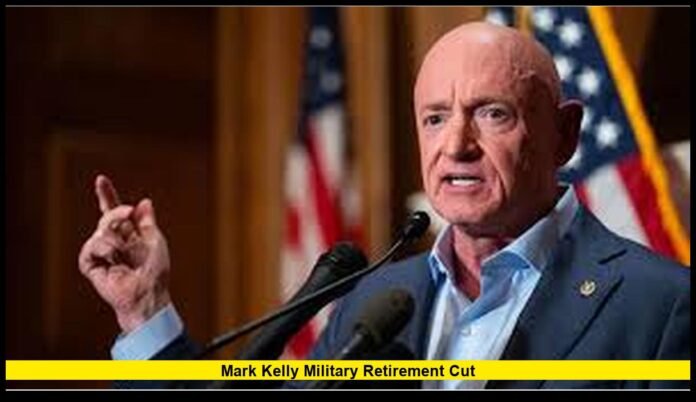

Mark Kelly military retirement cut has become one of the most consequential and closely watched developments in U.S. civil-military relations, after the Pentagon confirmed it is reviewing whether to reduce the retired rank and military pension of Senator Mark Kelly. The case has sparked intense debate across Washington, raised alarms among military retirees, and ignited fresh questions about free speech, constitutional protections, and the reach of executive authority over former service members.
As of today, the review remains active, with no final determination announced. Still, the process itself has already reshaped national discussion about how retired officers may participate in public life.
Pentagon Confirms Review of Retired Rank and Pay
The Department of Defense has formally acknowledged that it has initiated a retirement grade determination involving Mark Kelly, a retired U.S. Navy captain and sitting U.S. senator. This administrative process allows military officials to reassess the rank under which a service member officially retired, a decision that directly affects lifetime military retirement pay.
Defense officials say the review was triggered by public remarks Kelly made in late 2025 while appearing in a video directed at active-duty service members. In that appearance, Kelly emphasized that military personnel are legally obligated to refuse unlawful or illegal orders, a point long taught within military training and doctrine.
Pentagon leadership argues that the context and delivery of those remarks crossed a boundary for a retired senior officer and warranted administrative scrutiny.
What a Retirement Grade Determination Means
A retirement grade determination is not a criminal proceeding. It is an administrative review designed to assess whether a retired service member’s highest held rank should remain intact for retirement purposes. If a lower rank is assigned, retirement pay is recalculated permanently based on that grade.
In Kelly’s case, any reduction would likely involve a downgrade from his retired rank as a Navy captain. Such a move would carry both financial consequences and symbolic weight, especially given his high-profile role in public office.
While the mechanism exists within military regulations, it is rarely used, particularly against retirees who left service decades earlier and now serve as elected officials.
Role of Pentagon Leadership
The review is being overseen by Defense Secretary Pete Hegseth, who has stated that retired officers receiving military pay remain subject to specific conduct standards under existing military regulations. Pentagon leadership has emphasized that the issue at hand is not a disagreement over political views, but whether a retired senior officer used his position and credibility to deliver guidance that could be interpreted as influencing active-duty personnel.
Defense officials argue that statements aimed directly at service members carry unique weight, particularly when delivered by a former high-ranking officer with extensive operational experience. From their perspective, even when such statements are framed as reminders of legal obligations, they must be carefully assessed to ensure they do not create uncertainty within the chain of command or undermine confidence in military leadership.
Pentagon leadership has further stressed that the distinction between active-duty and retired status does not fully remove responsibility when it comes to communications that may affect force readiness, discipline, or morale. Officials maintain that consistent enforcement of conduct standards is essential to preserving good order and discipline across the armed forces, especially during periods of heightened political and operational sensitivity.
By advancing the review, Pentagon leaders have signaled that they view this case as a matter of institutional responsibility rather than partisan conflict. How that authority is ultimately applied, however, remains under scrutiny, as the outcome may clarify the extent to which Pentagon leadership can regulate the public conduct of retired officers in prominent civilian roles.
Kelly Pushes Back Strongly
Mark Kelly has forcefully rejected the Pentagon’s action, describing it as politically motivated and inconsistent with both constitutional principles and long-standing military law. He has emphasized that his record as a naval aviator, combat veteran, and test pilot reflects decades of service rooted in discipline, accountability, and respect for lawful authority. Kelly has framed his remarks as a continuation of those same values rather than a departure from them.
Kelly maintains that his statements did not encourage disobedience or insubordination. Instead, he argues they reaffirmed a foundational rule of military service: service members are obligated to refuse unlawful orders. According to Kelly, this principle is deeply embedded in military training and doctrine, and reiterating it supports the rule of law within the armed forces. He has stated that reminding service members of this duty strengthens military integrity rather than undermining command structure.
He has also warned that penalizing such speech could have far-reaching consequences beyond his own case. Kelly argues that punishing retired officers for speaking about legal and ethical responsibilities may discourage veterans from contributing their experience to public discussions on military law, accountability, and constitutional duty. In his view, the risk of administrative or financial retaliation could create a chilling effect, silencing knowledgeable voices that have historically played an important role in informing public understanding of military conduct.
Kelly has positioned his response not only as a defense of his own record, but as a broader stand for the rights of retired service members to participate openly in civic life. He has made clear that he intends to contest any action that he believes undermines those principles, framing the dispute as a test of how the nation treats veterans who continue to serve the public in civilian roles.
Legal and Constitutional Questions Take Center Stage
The Mark Kelly military retirement cut debate has elevated a series of complex legal and constitutional questions that extend far beyond military regulations. Central to the dispute is the tension between Pentagon authority over retirees and the constitutional protections afforded to elected officials.
Key questions include:
- Whether retired military officers can be disciplined for speech made years after active service
- How much authority the Pentagon retains over retirees who hold public office
- How free speech protections apply to lawmakers who remain on the military retired rolls
Supporters of Kelly argue that retirement grade reductions were designed to address misconduct during active service, not public commentary made long after retirement. Applying the process to speech, they say, represents a significant expansion of administrative power.
Others point out that retired officers remain part of the military structure in a limited sense, receiving federal pay and holding an ongoing status that places them in a legal gray area. How that gray area is resolved could define future boundaries for retired service members nationwide.
Reaction on Capitol Hill
Lawmakers have reacted sharply, with responses largely falling along partisan lines. For many in Congress, the issue goes beyond Kelly himself and touches on broader concerns about executive overreach and democratic norms.
Supporters argue that using retirement pay as leverage against a sitting senator risks setting a dangerous precedent. They warn that financial penalties could be used to pressure or silence elected officials, weakening the independence of the legislative branch.
Critics counter that retired officers must exercise caution when addressing active-duty personnel. They argue that accountability should apply regardless of political status and that statements from former senior officers carry unique influence within the ranks.
The dispute has prompted calls for congressional review of Pentagon authority over military retirees who serve in public office, with some lawmakers signaling interest in clarifying or revisiting existing statutes.
Why This Case Matters to Military Retirees
The implications of this case extend far beyond one senator and have resonated deeply within the military retiree community. Former service members across the country are closely following the developments, mindful that the outcome could affect how their own rights and responsibilities are understood long after leaving active duty.
Veterans’ advocates note that the case may influence how retired officers engage in public debate, especially on issues related to military ethics, legality, and constitutional duty. Retirees often carry decades of institutional knowledge, and many view public discussion of lawful conduct as a continuation of their obligation to uphold military values. If such speech becomes grounds for administrative punishment, some retirees may opt for silence rather than risk professional or financial consequences.
Many former service members also express concern that discouraging open discussion of lawful behavior and constitutional obligations could weaken transparency and accountability within the armed forces. For them, the core issue is not political alignment but precedent. How this case is resolved may determine whether retired service members feel empowered to contribute to civic discourse or compelled to withdraw from it, shaping the relationship between military experience and democratic participation in the years ahead.
Potential Outcomes and Their Impact
If the Pentagon Moves Forward
If defense officials decide to proceed, Kelly’s retired rank could be formally reduced, leading to a permanent decrease in his military retirement pay. A formal censure would also remain in his service record, carrying long-term professional and symbolic implications.
Such an outcome could signal a broader willingness to apply administrative discipline to retired officers for public statements, potentially reshaping expectations for retiree conduct.
If Kelly Prevails
If the review concludes in Kelly’s favor, his retired rank and benefits would remain unchanged. This outcome could reinforce speech protections for retired service members and clarify limits on Pentagon authority over retirees who serve in public office.
Either result is expected to influence how similar cases are approached in the future.
What Happens Next
Kelly has been granted a defined period to submit a formal written response to the Pentagon’s notice, during which he is expected to outline the legal, factual, and procedural basis for contesting the proposed action. That submission will become part of the official administrative record and will be reviewed by senior defense officials responsible for overseeing retirement grade determinations.
Once Kelly’s response is evaluated, Pentagon leadership will decide whether to move forward with a reduction in retired rank and corresponding retirement pay or to close the case without further action. If the review proceeds to a final determination, any decision would carry lasting implications for Kelly’s military record and benefits.
Beyond the Pentagon’s internal process, the case is drawing increased attention from lawmakers, particularly regarding the scope of executive authority over military retirees who serve in elected office. Depending on the outcome, congressional oversight efforts may intensify, and formal legal challenges could be initiated to contest the decision under constitutional or administrative law principles.
As these next steps unfold, the case is expected to remain under close public scrutiny, with its resolution likely to influence future policy discussions involving military retirees, public service, and the boundaries of civil-military authority.
Broader Implications for Civil-Military Relations
At its core, the Mark Kelly military retirement cut controversy underscores long-standing tensions between military discipline and democratic participation in a modern constitutional system. The case sits at the intersection of civilian authority, military professionalism, and the rights of individuals who transition from uniformed service into public life. How this situation is resolved may help define where the boundaries lie between preserving military order and respecting the civic freedoms of retired service members.
The outcome could influence how future retirees navigate their dual identities as veterans and private citizens, particularly those who assume visible roles as elected officials, advocates, or commentators on national security issues. A ruling that affirms broad Pentagon authority may prompt greater caution among retirees when engaging in public debate, while a decision favoring speech protections could reinforce the principle that military service does not permanently restrict participation in democratic discourse.
For many Americans, this case represents a broader test of how constitutional rights are applied in roles that bridge civilian and military life. It raises fundamental questions about whether democratic institutions can accommodate dissent, legal discussion, and ethical debate without compromising military effectiveness. As civil-military relations continue to evolve, the resolution of this controversy may serve as a reference point for balancing discipline, accountability, and individual liberty in the years ahead.
Final Thoughts
The unfolding controversy surrounding the Mark Kelly military retirement cut places free speech, military discipline, and democratic accountability in sharp focus at a critical moment in U.S. governance. What began as a discussion about lawful military conduct has escalated into a broader national debate over how much authority the Pentagon should have over retired service members, especially those who go on to serve in elected office. As the review continues, legal scholars, veterans, lawmakers, and everyday citizens are watching closely to see whether administrative processes will uphold long-standing protections for constitutional rights or expand executive reach in unprecedented ways.
This case has already sparked discussions on Capitol Hill, stirred concern among veteran communities, and inspired prominent voices on both sides to weigh in on the future of civil-military relations. Many view the outcome as a potential turning point that could either solidify clear boundaries protecting retirees’ speech or open the door to more expansive interpretations of military oversight. The implications extend beyond one individual; the decision may influence how retired service members engage in civic debate, advocate on matters of national importance, and interact with active-duty personnel without fear of professional or financial repercussions.
As the Pentagon’s review unfolds and Kelly readies his formal response, the nation remains tuned to what this moment will mean for the balance between national security, individual rights, and democratic norms. Ultimately, the resolution of this dispute will not only affect one senator’s legacy but could help define the future landscape of military service, public discourse, and constitutional freedom for generations of veterans and public servants to come.
Disclaimer
This article is for informational purposes only and does not constitute legal advice. Facts and circumstances may change as official proceedings continue.
What do you think this case means for veterans and free speech? Share your perspective and stay informed as developments continue.