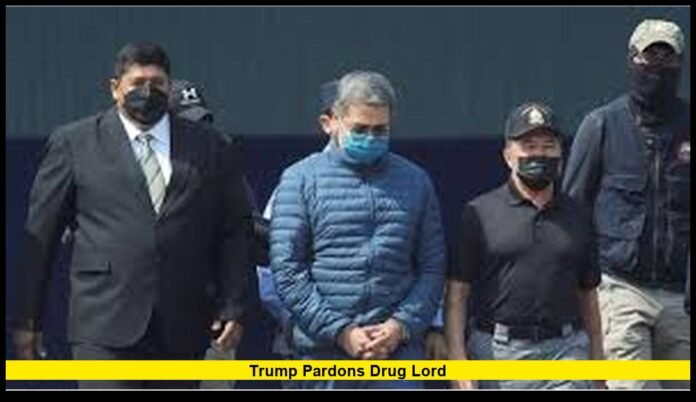

Trump pardons drug lord is a misleading claim, as there is no verified record that Donald Trump pardoned anyone legally defined as a drug lord under U.S. law.
Trump pardons drug lord is a headline that has circulated widely across digital platforms, drawing attention, outrage, and confusion among readers across the United States. Within the first moments of encountering this claim, many assume it refers to a confirmed presidential action involving a major narcotics figure. However, when examined against verified federal records and constitutional limits, the claim does not align with documented reality. As of today, there is no confirmed evidence that Donald Trump granted a presidential pardon to an individual legally defined under U.S. law as a drug lord.
This article presents a clear, factual examination of how the claim emerged, what presidential clemency actually covers, and why accuracy matters when discussing executive power and drug-related convictions.
Understanding the Origin of the Claim
The claim gained momentum in a fast-moving media environment shaped by social platforms, short headlines, and algorithm-driven amplification. In many cases, complex legal developments are condensed into attention-grabbing language that removes critical distinctions.
When readers see the words “drug lord,” they often imagine cartel leaders, international traffickers, and individuals who command large criminal networks. In U.S. law, however, that term carries a specific meaning tied to leadership, control, and scale. Not every drug conviction, even a serious one, meets that threshold.
The repeated use of dramatic labels has played a significant role in turning a loosely framed claim into a widely accepted assumption.
What Presidential Clemency Actually Means
Presidential clemency includes two primary tools:
- Pardons, which forgive a federal offense
- Commutations, which reduce a sentence without erasing the conviction
Both powers are granted under the U.S. Constitution, but they apply only within clearly defined legal boundaries.
Clemency does not determine innocence. It does not rewrite court findings. It does not remove historical records of conviction. It simply alters the legal consequences tied to a federal offense.
Understanding this distinction is essential when evaluating any claim involving pardons and serious crimes.
Who Qualifies as a Drug Lord Under U.S. Law
The term “drug lord” is not a casual descriptor in federal prosecutions. It refers to individuals who:
- Lead or control large-scale drug trafficking organizations
- Direct international distribution routes
- Manage significant financial operations tied to narcotics
- Use violence, coercion, or corruption to maintain control
These cases typically involve years of investigation, international cooperation, and extensive indictments outlining organizational leadership.
As of today, no individual meeting this definition appears in any official presidential pardon record issued by Donald Trump.
Reviewing Trump’s Clemency Record
During his presidency, Trump did issue clemency in a number of criminal cases, including some involving drug offenses. A careful review of these actions shows a consistent pattern.
Drug-related clemency focused primarily on:
- Non-violent offenders
- Individuals convicted of lower-level roles
- Cases involving lengthy sentences viewed as disproportionate
- People who had already served decades in prison
None of the clemency actions involved individuals prosecuted as leaders of major narcotics organizations or international cartels.
This distinction is supported by the structure and descriptions found in federal clemency documentation.
Why the Claim Resonated With the Public
Several factors contributed to the rapid spread of the claim.
First, drug policy remains a deeply emotional issue in the United States. Communities affected by addiction, trafficking, and violence respond strongly to any suggestion of leniency toward major offenders.
Second, political polarization amplifies mistrust. Claims involving presidential power are often interpreted through partisan lenses rather than legal frameworks.
Third, repetition creates familiarity. When a claim appears frequently enough, it can feel credible even without confirmation.
Together, these elements allowed a misleading narrative to gain traction.
The Role of Headline Culture
Modern headlines are designed for speed, not depth. In many cases, legal nuance is sacrificed for clarity and clicks.
A person convicted of a drug offense may be labeled a “drug lord” even when:
- The individual did not lead an organization
- The conviction involved facilitation rather than command
- The sentence was reduced rather than erased
Once introduced, such labels spread rapidly. Corrections rarely travel as far as the original claim.
This dynamic underscores why readers must look beyond headlines to understand what actually occurred.
Legal Limits of Presidential Power
The president’s pardon authority is broad, but it is not unlimited.
It applies only to:
- Federal crimes
- U.S. court convictions
It does not apply to:
- State convictions
- Foreign court rulings
- Active or hypothetical prosecutions
Any claim suggesting a president erased a foreign conviction or intervened in state-level sentencing falls outside constitutional authority.
Understanding these limits helps readers assess which claims are legally possible and which are not.
Why Accuracy Matters in Clemency Reporting
False or exaggerated claims about pardons have real and lasting consequences. Presidential clemency is one of the most powerful and least frequently used executive authorities, and misunderstanding how it is applied can quickly distort public perception. When inaccurate narratives take hold, they shape opinions based on assumption rather than documented fact.
First, misinformation distorts public understanding of executive power. Clemency operates within constitutional limits and legal procedures, yet exaggerated claims can make it appear arbitrary, unrestrained, or politically motivated beyond its actual scope. This weakens informed debate about when and how such authority should be exercised.
Second, inaccurate reporting undermines trust in verified records and institutions. Presidential pardons are publicly documented and transparent, but repeated false claims can cause readers to question official records even when they are accurate and complete.
Third, misleading narratives confuse legitimate criminal justice reform with favoritism. Clemency aimed at addressing disproportionate sentences or rehabilitation is often mischaracterized as protection for serious offenders, diverting attention from meaningful reform goals.
Finally, exaggerated claims inflame political division without factual grounding. In a polarized environment, misinformation becomes a tool for outrage rather than understanding, reinforcing partisan divides and reducing space for constructive dialogue.
Clemency decisions influence legal precedent, diplomatic relationships, and public confidence in the justice system. Reporting on them requires precision, context, and restraint — not sensationalism.
Impact on Criminal Justice Reform Conversations
Clemency has long been part of national conversations about sentencing fairness, rehabilitation, and proportional punishment. It exists as a corrective tool within the justice system, meant to address cases where penalties no longer serve public safety, rehabilitation goals, or equitable outcomes. When clemency decisions are accurately reported, they can contribute to thoughtful debate about how laws are applied and whether sentences reflect modern standards of justice.
However, when inaccurate or exaggerated narratives dominate public discussion, meaningful reform debates suffer. Mischaracterizing clemency actions as favoritism toward major criminals distracts from legitimate concerns about excessive sentencing, prison overcrowding, and the long-term consequences of incarceration for non-violent offenders. It shifts attention away from policy analysis and toward emotionally charged but misleading conclusions.
Equating low-level offenders with cartel leaders erases critical legal and moral distinctions. Non-violent drug offenses, facilitation roles, and first-time convictions are fundamentally different from leadership positions within large-scale trafficking organizations. Treating them as equivalent discourages nuanced discussions about how the justice system should differentiate between levels of culpability and threat.
Accuracy protects the integrity of reform efforts. Clear, fact-based reporting allows policymakers, advocates, and the public to evaluate clemency and sentencing policies on their merits. Without that clarity, reform conversations risk becoming polarized and unproductive, undermining opportunities to improve fairness, accountability, and effectiveness within the criminal justice system.
Public Records and Transparency
All presidential pardons are documented through formal federal processes designed to ensure transparency and public accountability. Each act of clemency is officially recorded and becomes part of the permanent federal record. These records clearly identify:
- The recipient’s name
- The federal offense involved
- The date the clemency was granted
- The type of action taken, such as a pardon or sentence commutation
This structured documentation exists to prevent ambiguity or secrecy surrounding the use of executive power. Presidential clemency is not issued informally or retroactively confirmed through unofficial channels. There are no hidden pardons, undisclosed actions, or later-revealed clemency decisions involving cartel leadership or high-level narcotics figures.
Transparency is built into the system by design. If a pardon involving a cartel leader or major drug trafficking organizer had been granted, it would appear plainly in public records and be immediately verifiable. The absence of such documentation confirms that no such pardon exists, reinforcing the importance of relying on official records rather than unverified claims or speculative reporting.
Why This Clarification Matters Now
In today’s information environment, speed often outruns verification. Headlines, social media posts, and short-form videos can circulate nationwide within minutes, while careful fact-checking takes far longer to reach the same audience. As a result, claims that are dramatic or emotionally charged can gain visibility and credibility before they are properly examined.
The phrase “Trump pardons drug lord” gained traction largely because it was repeated across platforms, not because it was confirmed by official records. Once a claim is echoed often enough, it can begin to feel true, even in the absence of evidence. Over time, repetition can replace documentation in the public mind, especially when legal terms are simplified or misused.
This dynamic has real consequences. Misleading narratives can distort public understanding of presidential authority, blur the legal limits of clemency, and fuel unnecessary political outrage. Separating verified facts from amplified narratives ensures that discussions about executive power, criminal justice, and accountability remain grounded in reality rather than assumption. Clear distinctions allow readers to engage with the issue based on confirmed actions and established law, rather than viral interpretations that prioritize impact over accuracy.
Key Facts at a Glance
- There is no confirmed case in which Donald Trump pardoned a drug lord as defined under U.S. federal law. In legal terms, a drug lord refers to an individual who leads, directs, or controls a large-scale narcotics trafficking organization. No such individual appears in any official presidential pardon record.
- All verified presidential pardons are publicly recorded and transparent. Each act of clemency is formally documented and includes the recipient’s name, the federal offense involved, the date of action, and the type of clemency granted. There are no hidden, sealed, or later-revealed pardons involving top-level drug traffickers.
- Drug-related clemency issued during Trump’s presidency focused on sentencing reform and non-violent cases. These actions largely addressed concerns over disproportionately long sentences, rehabilitation, or fairness, rather than excusing leadership roles in organized narcotics operations.
- No cartel leader or internationally recognized trafficker received a pardon. Individuals prosecuted as heads of drug cartels, commanders of trafficking networks, or organizers of cross-border narcotics distribution did not receive presidential pardons or sentence erasures.
These facts reflect the most current and verifiable status as of today and provide a clear framework for understanding how presidential clemency has actually been applied, separate from exaggerated or misleading claims.
The Bottom Line
Claims that Trump pardons drug lord do not align with verified federal records or established legal definitions. While Trump exercised clemency in select drug-related cases, none of those actions involved individuals who were prosecuted and convicted as leaders of major narcotics operations under U.S. law. This includes the fact that the only high-profile pardon tied to a serious international drug trafficking conviction involved a former foreign head of state, not a cartel commander or organizational leader defined under federal statutes as a drug lord. The distinction between high-volume offenders, facilitators, and genuine narcotics bosses is critical in legal classification and public understanding.
Understanding this distinction preserves factual accuracy, protects public discourse, and ensures that debates about executive power remain rooted in confirmed information rather than viral misinterpretation. Accurate reporting prevents the spread of misinformation that can distort perceptions of presidential authority, undermine trust in legal institutions, and erode clarity around how clemency should be applied. By focusing on what is verifiably documented — including the scope, limits, and specific individuals involved in federal clemency decisions — readers can engage with real policy issues rather than conflated narratives. Clear, fact-based discussion also allows for a more meaningful examination of how clemency intersects with broader debates on criminal justice reform, sentencing policies, and the appropriate use of executive powers in cases involving drug offenses.
What are your thoughts on how presidential pardons should be applied in serious drug cases? Join the conversation and stay informed as public records evolve.