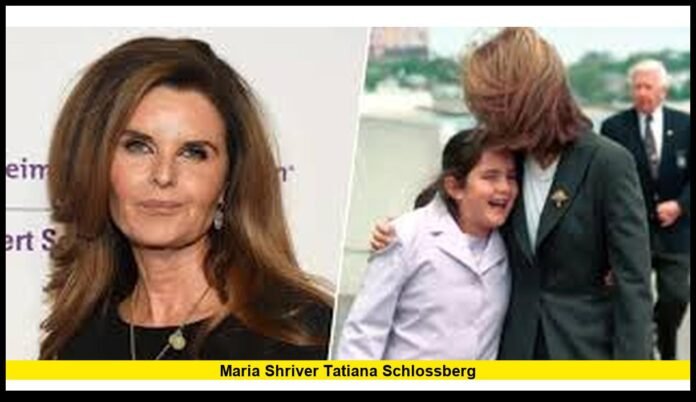

The connection between Maria Shriver Tatiana Schlossberg highlights how the Kennedy family legacy continues to thrive across generations. Both women have forged independent paths rooted in journalism, social awareness, and advocacy. While they come from one of America’s most recognized families, their impact reaches far beyond politics — into the realms of storytelling, public service, and modern media.
As of 2026, Maria Shriver remains an influential voice in journalism and philanthropy, focusing on women’s empowerment and brain health research. Her niece, Tatiana Schlossberg, is shaping her own identity as a writer and environmental journalist, tackling issues that define the future of the planet. Together, they represent how the Kennedy legacy has evolved — driven by empathy, intellect, and purpose.
Maria Shriver: A Lifelong Commitment to Journalism and Service
Born on November 6, 1955, in Chicago, Maria Shriver grew up immersed in the values of leadership and public service. Her mother, Eunice Kennedy Shriver, founded the Special Olympics, while her father, Sargent Shriver, launched the Peace Corps under President John F. Kennedy.
Maria’s early exposure to these efforts shaped her lifelong dedication to meaningful work. Her career in journalism began in the late 1970s, when she joined CBS as a writer and producer. She later joined NBC, becoming a reporter and anchor on NBC Nightly News and Dateline NBC. Over time, she became known not only for her professionalism but also for her compassion — a hallmark of her interviewing style.
Her coverage earned numerous honors, including Peabody and Emmy Awards. Yet her true impact lies in her ability to blend journalism with advocacy. Through stories focused on women, families, and social issues, Shriver has consistently amplified voices often left unheard.
When she served as First Lady of California from 2003 to 2011, during her marriage to Arnold Schwarzenegger, she expanded her influence beyond journalism. She spearheaded community programs, focusing on volunteerism and economic opportunities for women. Her leadership in public initiatives like the California Women’s Conference drew national attention for empowering women across all backgrounds.
Today, Maria continues her advocacy through The Women’s Alzheimer’s Movement, a nonprofit funding groundbreaking research into how Alzheimer’s disease affects women differently. She has raised awareness about brain health through campaigns, conferences, and public discussions, helping millions better understand a condition that disproportionately impacts women worldwide.
Her weekly digital publication, The Sunday Paper, also continues to attract a loyal readership, offering inspiration, essays, and interviews that explore personal growth, wellness, and social purpose.
Tatiana Schlossberg: A New Voice for a Changing World
Tatiana Schlossberg, born May 5, 1990, represents the next generation of Kennedy women reshaping the family’s influence. As the daughter of Caroline Kennedy and Edwin Schlossberg, and the granddaughter of President John F. Kennedy and Jacqueline Kennedy Onassis, she carries one of America’s most historic surnames. But like her aunt Maria, Tatiana has carved her own path — away from politics and toward journalism and environmental advocacy.
After graduating from Yale University with a degree in history, she pursued a master’s degree in American history at Oxford University. Her studies helped her develop a nuanced understanding of how human behavior and policy intersect with the environment — a perspective that later shaped her journalism.
Tatiana began her professional career at The New York Times, reporting on environmental and climate issues. Her articles explore how everyday consumer habits — from the clothes people wear to the devices they buy — contribute to environmental challenges. Her writing stands out for its accessible, research-based explanations and its practical guidance for readers seeking change.
In 2019, she published her first book, Inconspicuous Consumption: The Environmental Impact You Don’t Know You Have, which became a bestseller. The book earned widespread praise for its detailed yet relatable breakdown of how modern lifestyles affect the planet. It positioned Tatiana as one of the most thoughtful environmental voices of her generation.
Her work blends science, history, and culture — showing how even small lifestyle choices ripple through global ecosystems. By encouraging readers to think critically about sustainability, Tatiana continues a form of public service deeply rooted in Kennedy family values.
A Shared Family Legacy of Service
Though they belong to different generations, Maria Shriver and Tatiana Schlossberg share a common thread: both use communication to inspire awareness and action.
The Kennedy legacy has always been tied to civic duty and compassion. President John F. Kennedy’s call to “ask what you can do for your country” continues to echo in the ways his descendants serve — not only in politics, but in education, media, and advocacy.
Maria and Tatiana embody this evolution of public service.
- Maria Shriver’s focus lies in social change, women’s empowerment, and brain health advocacy.
- Tatiana Schlossberg’s mission revolves around environmental protection and sustainability.
While their causes differ, both women rely on storytelling as their most powerful tool. Whether through television, digital media, or books, they use words to educate, connect, and motivate people to make meaningful change.
Maria Shriver’s Influence on Modern Media
Maria’s approach to journalism changed how audiences perceived news and human-interest storytelling. She balanced intelligence with warmth, making complex issues relatable.
Her Emmy-winning interviews often focused on human resilience — from families overcoming adversity to leaders driving change. Over the years, she became a trusted figure, known for her sincerity and ability to listen with empathy.
Maria also used her platform to explore issues beyond politics. Through The Shriver Report, a multimedia initiative, she examined how economic and social changes affect women and families in America. The report sparked national conversations about caregiving, poverty, and gender equity.
Her voice remains influential because she has adapted to changing times. In an age of digital journalism, Maria has embraced new ways to reach people — through newsletters, podcasts, and online conversations. Yet her message remains timeless: storytelling can lead to understanding, and understanding can lead to change.
Tatiana Schlossberg’s Impact on Environmental Journalism
While Maria Shriver helped define an era of television reporting centered on empathy and storytelling, Tatiana Schlossberg represents a new kind of journalist — analytical, research-driven, and deeply invested in the planet’s future. She uses her platform to explore how modern life affects the environment in ways that often go unnoticed.
Tatiana’s reporting emphasizes the connection between personal choices and global consequences. Rather than focusing on government policy or celebrity activism, she dives into the quieter, more personal aspects of environmental responsibility. Her writing reminds readers that the fight against climate change starts in everyday decisions — from what we wear and eat to how we travel and consume technology.
In her critically acclaimed 2019 book, Inconspicuous Consumption: The Environmental Impact You Don’t Know You Have, Tatiana breaks down how industries such as fashion, technology, food, and fuel quietly drive environmental degradation. She explores the hidden systems behind products most people take for granted — tracing how they’re made, shipped, and discarded.
The book’s strength lies in its accessible tone. Tatiana writes with both intellect and warmth, transforming complex scientific data into relatable stories that readers can understand and act upon. Rather than overwhelming readers with guilt, she focuses on awareness and empowerment. Her message is clear: sustainability isn’t just about politics or policy — it’s about personal mindfulness.
Changing the Conversation on Climate Responsibility
Tatiana Schlossberg stands out among environmental writers for her ability to link large-scale issues to daily life. Her work shifts the focus from distant crises to the individual’s role in solving them.
She often discusses how consumption habits have become intertwined with identity and convenience. For example, in the fashion industry — one of the world’s largest polluters — she reveals how fast fashion trends contribute to waste, water contamination, and carbon emissions. Yet instead of shaming readers, she encourages more thoughtful choices, like buying fewer items or supporting sustainable brands.
Her exploration of the technology sector is equally insightful. Tatiana uncovers the unseen environmental cost of the digital age — from the energy required to power data centers to the mining of rare materials for smartphones and computers. She highlights the irony that many people advocating for climate awareness use technology that itself leaves a sizable carbon footprint.
By addressing these contradictions with empathy and clarity, Tatiana invites readers to think more critically about their relationship with the environment. She frames sustainability not as an obligation but as an opportunity to live with greater awareness.
Recognition and Influence
Tatiana’s thoughtful and fact-based approach has earned her recognition from both environmental experts and fellow journalists. Her work has been praised for making climate change a personal and relatable issue rather than an abstract global problem.
She is regularly cited by educators who use her writing to help students understand environmental systems and consumer responsibility. Her book, Inconspicuous Consumption, has been featured in university courses, environmental studies programs, and sustainability workshops as a model of accessible, solutions-oriented communication.
Her articles for The New York Times and other outlets reflect the same balance of rigor and relatability. Rather than relying on fear or sensationalism, she grounds her reporting in verified research, translating complex scientific information into everyday language.
Through her journalism, Tatiana has proven that the Kennedy legacy of public service can evolve with the times — that advocacy today can mean writing a well-researched article that changes how people view their world.
Beyond Journalism: A Voice for a Sustainable Future
Tatiana Schlossberg’s influence goes beyond traditional reporting. She has become part of a growing generation of communicators who view sustainability as a cultural shift, not just an environmental issue.
She frequently participates in public discussions, panels, and interviews about climate change, using these opportunities to connect with audiences outside the newsroom. Her focus remains practical: helping people recognize that even small, individual actions can lead to collective impact.
Tatiana’s writing also highlights the emotional side of environmental awareness. She acknowledges the climate anxiety felt by many young people while offering hope grounded in knowledge and action. Her message resonates strongly with readers who feel powerless in the face of global issues — reassuring them that informed choices, multiplied across millions, can lead to meaningful change.
Carrying Forward a Modern Kennedy Legacy
As a member of one of America’s most famous families, Tatiana Schlossberg is acutely aware of the weight of her name. Yet, she has intentionally stepped out of the political spotlight to build her own platform. Her success in environmental journalism underscores her individuality — she’s not defined by her lineage but by her work and intellect.
Her approach reflects a new kind of public service. Where earlier generations of Kennedys influenced society through politics and legislation, Tatiana’s influence comes through education and awareness. Her work bridges the gap between science and society, helping readers understand that environmental health is inseparable from human well-being.
By focusing on facts, compassion, and clear communication, she continues to embody the Kennedy family’s long-standing values of service and responsibility — but in a way that speaks to the challenges of the 21st century.
Tatiana Schlossberg’s voice is not loud or partisan, but it’s powerful in its honesty and precision. Her reporting invites readers to take part in a collective movement — one where information leads to understanding, and understanding leads to action.
In a world where environmental issues can feel distant or overwhelming, her work reminds people that change begins with knowledge — and that knowledge begins with storytelling.
Personal Lives and Family Connections
Despite their public profiles, both Maria and Tatiana have maintained a grounded approach to life.
Maria Shriver, who shares four children with Arnold Schwarzenegger — Katherine, Christina, Patrick, and Christopher — remains close to her family. She often speaks about her children’s achievements and their shared commitment to philanthropy and creativity. Her daughter Katherine Schwarzenegger Pratt, for example, has followed in her footsteps as an author and advocate.
Tatiana Schlossberg, on the other hand, leads a quieter life. She married George Moran, a Yale-educated physician, in September 2017. The couple keeps a low public profile, focusing on their professional goals and shared interest in science and education.
Both women represent a new phase of the Kennedy legacy — one where public service coexists with personal privacy and humility.
Their Role in the Kennedy Family’s Modern Identity
The Kennedy name remains a powerful symbol in American culture, but it has evolved beyond politics. The family’s influence now extends into journalism, philanthropy, art, and education.
Maria Shriver and Tatiana Schlossberg exemplify this transformation. They prove that public service can take many forms — whether through advocacy for women’s health or through education about the environment.
Their approach to leadership is quiet but impactful. They don’t rely on titles or campaigns; instead, they lead through integrity and example. Each project they undertake — from a book to a public program — reflects a mission to inform and empower.
Recent Work and Public Engagement (2025–2026)
As of 2026, Maria Shriver continues her work as a global advocate for health and wellness. She remains at the forefront of Alzheimer’s research, collaborating with universities and medical centers to explore how gender and hormones influence brain function. Her organization funds both scientific research and educational programs designed to support caregivers.
She also remains active in media, hosting discussions and producing documentaries that highlight personal growth, aging, and the search for meaning in modern life.
Tatiana Schlossberg remains engaged in climate communication. She contributes essays and features to major media outlets and participates in environmental panels and conferences. Her focus is on bridging the gap between science and daily living — helping readers understand that sustainability begins with awareness.
Both women continue to represent the Kennedy values of compassion, intellect, and courage in contemporary contexts.
The Kennedy Legacy, Reimagined
The influence of Maria Shriver Tatiana Schlossberg reflects how the Kennedy spirit endures — not through political power, but through education and empathy.
They’ve shown that legacy is not only about what you inherit, but how you use it to uplift others. Shriver’s advocacy for women and health awareness, paired with Schlossberg’s dedication to climate journalism, demonstrates how the next generation carries the family’s values into new frontiers.
In a world hungry for authenticity, both women remind audiences that leadership can take many forms — from a well-researched article to a compassionate conversation that inspires change.
Maria Shriver Tatiana Schlossberg represent the enduring Kennedy ideal of service through truth and compassion — proving that legacy is not about fame, but about impact that lasts.