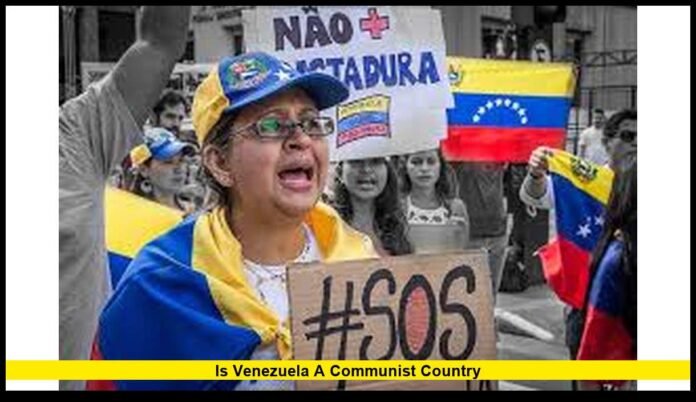

The factual answer is no. Venezuela is governed by a socialist political movement with authoritarian characteristics.
Is Venezuela a communist country remains a question many Americans are asking as political events in Venezuela continue to make international headlines in 2026. Despite years of socialist rhetoric, centralized authority, and tense relations with the United States, Venezuela is not officially a communist country. Its political system is better understood as a socialist-led state with authoritarian features rather than a nation governed by classical communism. Understanding this difference is essential for accurately interpreting Venezuela’s past, present, and possible future.
This article explains Venezuela’s political identity using confirmed facts, current conditions, and structural realities, without speculation or ideological shortcuts.
What People Mean When They Ask the Question
When people ask whether Venezuela is communist, they are often reacting to visible outcomes rather than formal definitions. These include state control over industries, long-term rule by a single political movement, weakened opposition power, and government influence over daily life. While these traits raise concerns and criticism, they do not automatically define a country as communist.
Communism, in its traditional meaning, involves the abolition of private property, a classless society, and complete collective ownership of production. Venezuela does not meet these conditions, either legally or in practice.
Venezuela’s Declared Political Ideology
Venezuela’s ruling ideology since the late 1990s has been rooted in socialism, specifically a model often described by its leaders as a modern, nationalist form of socialism. This approach emphasizes state leadership in key sectors, social welfare programs, and resistance to foreign political influence.
Crucially, the government has never formally declared Venezuela a communist state. Its official documents, party platforms, and constitutional framework do not describe communism as the governing system. Instead, they reference social justice, national sovereignty, and state responsibility for economic planning.
The Ruling Party and Its Identity
The country has been governed for years by a dominant political party that identifies as socialist, not communist. While its leadership has praised leftist thinkers and revolutionary movements, the party has consistently maintained a distinct ideological identity separate from orthodox Marxist communism.
The party structure centers on loyalty to leadership, control of institutions, and political continuity. Its power has come from electoral victories, legal mechanisms, and institutional dominance rather than from a revolutionary overthrow of private ownership or class structures.
This matters because political labels are defined by policy and structure, not slogans.
Communist Parties Exist, but They Do Not Rule
Venezuela does have legally recognized communist parties. These groups openly advocate for Marxist ideology and deeper structural changes than those implemented by the government.
However, they do not control the presidency, the military, or the core state institutions. At times, they have even criticized the government for failing to deliver what they consider genuine socialism. Their limited influence reinforces the reality that Venezuela’s system is not governed by communism.
The existence of communist parties alone does not define a country’s political system.
Government Structure and Institutions
Venezuela retains a formal government structure that includes a presidency, courts, a legislature, and regional authorities. While power has become heavily centralized and democratic standards have eroded, these institutions still exist in law and function in practice.
In classical communist systems, political pluralism is eliminated entirely, and all authority flows directly from a single ideological party without institutional separation. Venezuela’s system, though deeply flawed, does not fully match that model.
Elections continue to occur, even if their fairness is contested. Opposition parties exist, even if constrained. These realities separate Venezuela from historical communist states.
Economic Reality on the Ground
Venezuela’s economy has long been shaped by state involvement, especially in oil and energy. Nationalization of key industries played a central role in earlier decades and remains a defining feature of the system.
At the same time, Venezuela has never eliminated private economic activity. Small businesses operate across cities and rural areas. Informal markets are widespread. Private property ownership remains legal. People buy, sell, trade, and work outside the state sector every day.
A communist economy would not allow this level of private activity. Venezuela’s economic model is better described as state-dominated but mixed, rather than fully planned or collectively owned.
Recent Policy Shifts and Economic Flexibility
In recent years, economic controls have loosened in certain areas. Market-based transactions, foreign currency use, and private enterprise have become more visible, driven by economic necessity rather than ideological change.
These adjustments reflect pragmatic responses to crisis, not a move toward communism. In fact, they move Venezuela further away from rigid communist economics by tolerating market mechanisms and private initiative.
Why Venezuela Is Often Misclassified
Venezuela is frequently labeled communist in political debates, especially in the United States. This happens for several reasons:
- Long-term socialist leadership
- Strong anti-capitalist language
- Hostile relations with Washington
- Government control over major industries
These factors create an association with communism, even when the formal definition does not apply. The label is often used as shorthand rather than an accurate description.
Precision matters, especially in global politics.
Political Upheaval in 2026
In early 2026, Venezuela entered a new phase of uncertainty following the removal of its long-standing president during a U.S. military operation. This event disrupted the existing power structure and triggered intense domestic and international reactions.
Despite the shock, the country did not suddenly become communist or non-communist overnight. Political identity is shaped by institutions, laws, and economic systems, not by a single event.
Interim leadership arrangements and legal disputes are ongoing, but the foundational structure of the state remains rooted in socialism, not communism.
Public Life and Society
Venezuelan society includes religious institutions, private family life, cultural diversity, and independent community networks. These social features continue to function despite political pressure and economic hardship.
In traditional communist systems, social life is tightly regulated by the state, with limited space for independent institutions. Venezuela’s social environment, though constrained, does not reach that level of control.
Media and Information Control
The government has expanded its influence over television, radio, and digital platforms. At the same time, independent voices persist, especially online and through informal channels.
This environment reflects authoritarian tendencies but not total information monopoly. A fully communist system would not permit even limited independent media activity.
Why This Question Matters in the United States
For U.S. audiences, the question of whether Venezuela is communist influences how people understand socialism, foreign policy, and ideological conflict.
Mislabeling Venezuela can distort domestic debates and oversimplify complex international realities. Accurate understanding helps separate policy analysis from political rhetoric.
A Clear Answer Based on Facts
So, is Venezuela a communist country?
The factual answer is no.
Venezuela is governed by a socialist political movement with authoritarian characteristics. It allows private property, maintains formal institutions, and does not operate under communist economic or political doctrine.
This remains true as of today, even amid leadership changes and international involvement.
Looking Ahead
Venezuela’s future political direction remains uncertain. Reforms, transitions, or further instability could reshape its system over time. However, any genuine shift toward communism would require structural changes that have not occurred.
For now, Venezuela’s identity is clear when examined carefully and honestly.
Understanding the difference between socialism and communism helps cut through misinformation, and readers are encouraged to share their views and stay engaged as Venezuela’s story continues.