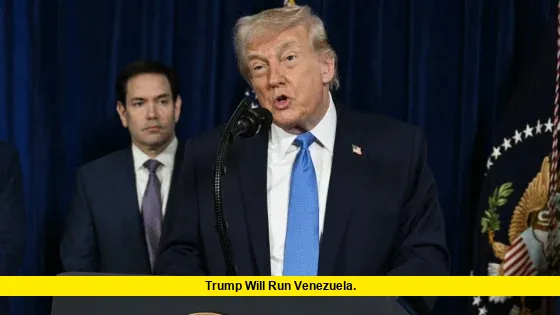

In a moment that reshaped global politics overnight, trump will run venezuela moved from speculation to declared policy after President Donald Trump confirmed that the United States would assume temporary control over Venezuelan governance following the capture of President Nicolás Maduro and his wife, Cilia Flores. The announcement, delivered from Washington as Maduro was transferred into U.S. custody in New York, set off a chain reaction of legal, political, and diplomatic consequences that continue to unfold.
What follows is a detailed, fact-based account of how events unfolded, what the United States says it intends to do, how Venezuela has responded, and why this moment may permanently alter international norms.
A Sudden Operation With Global Consequences
The operation that led to Maduro’s arrest took place in the early hours of January 3. U.S. forces entered Venezuelan territory in a coordinated action targeting government and security sites in and around Caracas. Within hours, confirmation emerged that Maduro and Flores had been taken into custody and removed from the country.
Shortly afterward, U.S. authorities confirmed that Maduro was being held in federal detention in New York ahead of a scheduled court appearance. The arrest was carried out under existing criminal indictments that had been pending for years, making this both a military and judicial action in the eyes of the U.S. government.
Inside Venezuela, the sudden absence of the president created confusion across ministries, security forces, and state-run institutions. Communications briefly faltered, and conflicting statements circulated before officials acknowledged that Maduro was no longer in the country.
Why the United States Acted Now
For years, Washington had accused Maduro’s government of corruption, narcotics trafficking, and systematic repression. Economic sanctions, diplomatic isolation, and international pressure had failed to remove him from power.
U.S. officials stated that the operation was launched after intelligence assessments concluded that conditions were favorable for a decisive action with minimal civilian harm. The stated goals were to enforce U.S. law, disrupt criminal networks, and open a path toward political transition in Venezuela.
President Trump framed the move as overdue and necessary, arguing that decades of instability had harmed both Venezuelans and regional security.
What U.S. Control Is Intended to Look Like
When President Trump said the United States would run Venezuela, he clarified that the role would be temporary and focused on stabilization rather than permanent occupation.
According to official statements, U.S. involvement is centered on several priorities:
- Preventing immediate institutional collapse
- Securing key infrastructure, particularly oil facilities
- Supporting an interim political framework
- Preparing conditions for future Venezuelan-led governance
American officials emphasized that the objective is not annexation or colonization, but administration during transition. However, no firm timeline has been announced, leaving open questions about duration and authority.
Maduro’s Detention and Legal Path Forward
Nicolás Maduro is now facing U.S. federal judicial proceedings. He remains in pretrial detention as prosecutors prepare to bring him before a federal judge in New York. The charges stem from longstanding cases involving drug trafficking conspiracies and related offenses.
Maduro has denied all allegations and maintains that his arrest violated international law. His legal team is expected to challenge jurisdiction and detention procedures, setting the stage for a complex and closely watched court battle.
Cilia Flores, also in custody, is expected to face related legal proceedings.
Venezuela’s Constitutional Crisis
With Maduro removed, Venezuela’s Supreme Tribunal announced that Vice President Delcy Rodríguez would assume executive authority under constitutional succession rules. Rodríguez rejected U.S. claims of control and declared Maduro the legitimate president, accusing Washington of conducting an illegal seizure of power.
This has created a direct standoff: U.S. officials assert administrative authority, while Venezuelan institutions claim constitutional continuity. The result is a dual-claim scenario that has left civil servants, military units, and regional governors uncertain about whose orders to follow.
Life Inside Venezuela After the Arrest
On the ground, the mood in Venezuela is tense and divided.
In some neighborhoods, residents expressed relief and cautious optimism, hoping the end of Maduro’s rule could bring economic relief and political openness. In other areas, protests erupted against foreign intervention, with demonstrators warning that external control could worsen instability.
Essential services have continued in most regions, but disruptions have been reported at government offices, banks, and ports as administrators await guidance on authority and policy.
International Shockwaves and Diplomatic Fallout
The global response has been swift and polarized.
Several governments condemned the U.S. action as a violation of sovereignty and international norms. Others openly welcomed Maduro’s removal, arguing that it removed an entrenched authoritarian leader and created an opportunity for reform.
Emergency diplomatic meetings were convened as countries debated legality, precedent, and potential consequences. Concerns were raised that the action could encourage similar interventions elsewhere, while supporters argued that extraordinary circumstances justified decisive action.
The Debate Inside the United States
Domestically, the decision has ignited fierce debate.
Supporters praise the move as a bold enforcement of law and a blow against organized crime. Critics question whether the president had authority to initiate such an operation without congressional approval and warn of long-term entanglement.
Legal scholars are divided over war powers, jurisdiction, and the balance between executive authority and legislative oversight. The issue is expected to be challenged politically and possibly judicially in the months ahead.
Oil, Economy, and Strategic Stakes
Venezuela’s vast oil reserves loom large over every discussion of the country’s future. U.S. officials have openly stated that restoring oil production is central to stabilization efforts.
Years of mismanagement and sanctions had crippled output, depriving Venezuela of revenue and worsening humanitarian conditions. U.S. administrators have indicated that securing and rehabilitating oil infrastructure will be a top priority, both for Venezuela’s recovery and global energy stability.
What Comes Next Remains Unclear
Several critical questions now define the path forward:
- How long will U.S. administration last?
- What role will Venezuelan institutions ultimately play?
- Can international consensus be achieved?
- How will Maduro’s trial affect negotiations?
At least once more during his remarks, President Trump reiterated that trump will run venezuela only until conditions allow for a transition he described as stable and legitimate.
This moment marks one of the most consequential shifts in hemispheric politics in a generation — and its outcome will shape Venezuela, the United States, and global norms for years to come. Join the conversation and share how you think this unprecedented chapter will end.