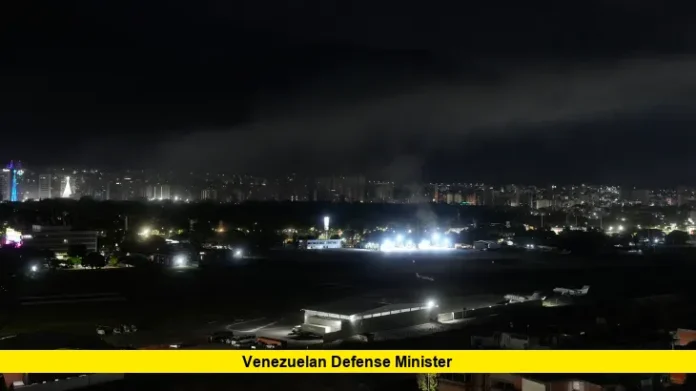

In the early hours of January 3, 2026, Venezuela entered a defining moment as the venezuelan defense minister addressed the nation amid reported U.S. military action, signaling a sharp escalation in tensions that immediately altered the country’s political, military, and diplomatic landscape.
The developments unfolded rapidly, beginning before sunrise with explosions heard across parts of Caracas and surrounding regions. What followed was a cascade of official statements, emergency measures, and international reactions that placed Venezuela at the center of global attention.
A Night That Changed the Security Landscape
Residents in multiple districts of the capital reported being jolted awake by loud detonations and the sound of aircraft overhead. Emergency sirens echoed through neighborhoods as electricity disruptions affected several areas. Within minutes, social media filled with images of darkened streets, shaken buildings, and citizens seeking safety indoors.
Authorities later confirmed that the explosions coincided with military operations targeting strategic locations. While officials continued to assess damage, it was acknowledged that both security installations and nearby civilian zones were impacted, intensifying concern over public safety.
Immediate Mobilization of Armed Forces
Within hours, national defense protocols were activated across Venezuela. Military units were placed on high alert, checkpoints increased along major transportation corridors, and security forces were deployed to protect government facilities, utilities, and communication hubs.
The defense leadership emphasized that these actions were defensive in nature, aimed at preserving order and preventing further instability. Officials stressed coordination across all branches of the armed forces and affirmed that command structures remained fully operational.
Address to the Nation Signals Resistance
Later that day, the country’s top military authority delivered a nationally broadcast address, rejecting any foreign military presence on Venezuelan soil and declaring full readiness to defend sovereignty. The speech carried a tone of urgency and resolve, calling on citizens to remain calm while reinforcing national unity.
The address underscored that Venezuela viewed the military activity as a direct challenge to its independence. Authorities stated that casualty assessments were ongoing and that verified information would be released as soon as possible.
Claims Surrounding Presidential Status Deepen Uncertainty
The situation became even more complex following announcements from U.S. officials claiming that President Nicolás Maduro and his wife, Cilia Flores, had been captured and removed from the country. These statements triggered widespread uncertainty inside Venezuela.
Government leaders rejected the claims and demanded proof of life, emphasizing that constitutional processes would guide any leadership transition if required. Until confirmation was provided, officials insisted that state institutions remained intact and functional.
Civilian Life Disrupted Across Major Cities
As news spread, daily life across Caracas and other urban centers slowed dramatically. Schools delayed opening, government offices operated on limited schedules, and public transportation faced interruptions.
Families remained indoors as authorities urged caution and discouraged the spread of unverified information. Hospitals and emergency services were placed on standby, while civil defense teams conducted inspections in affected neighborhoods.
Regional Implications Begin to Emerge
The military developments inside Venezuela quickly drew reactions from neighboring countries. Border security was reinforced in several areas amid concerns about potential displacement and spillover instability.
Latin American leaders held emergency consultations as governments assessed the broader consequences for regional security. Calls for restraint and dialogue emerged alongside warnings about the risks of escalation.
International Reaction Highlights Global Divisions
Globally, reactions revealed sharp divides. Some governments condemned the military action as a violation of sovereignty, while others framed it as a response to long-standing political and security concerns.
Diplomatic discussions intensified across international forums, with emphasis placed on preventing further violence and protecting civilians. The crisis underscored how deeply polarized global views remain regarding intervention, legitimacy, and the use of force.
Debate Over Legal and Political Boundaries
The unfolding events reignited debate over international law and the limits of unilateral military action. Legal experts and political leaders questioned whether such operations align with established norms governing state sovereignty and the use of force.
Within the United States, discussions emerged over executive authority and oversight, while in Venezuela the focus centered on defending national autonomy and constitutional order.
Military Messaging and Public Confidence
Throughout the day, Venezuelan defense officials worked to project stability and control. Statements emphasized discipline, coordination, and readiness, seeking to reassure citizens that the armed forces were focused on protection rather than escalation.
Public messaging stressed resilience and unity, portraying the moment as a test of national resolve rather than a collapse of authority.
A Nation at a Turning Point
As night fell, Venezuela remained on high alert. Key questions lingered over leadership status, future military actions, and the potential role of diplomacy in easing tensions.
What is clear is that the events of January 3 marked a profound turning point. The balance between military force, political authority, and international pressure has shifted, leaving Venezuela facing decisions that will shape its trajectory for years to come.
How these developments unfold next could redefine Venezuela’s future—join the conversation and stay connected as the story continues.