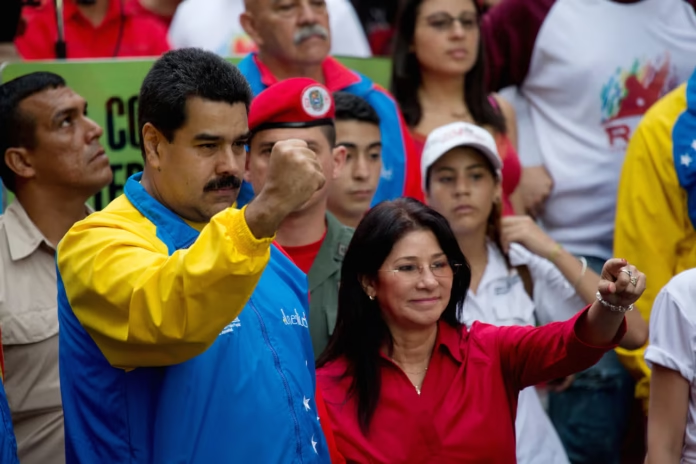

In one of the most consequential moments in modern Latin American politics, nicolas maduro wife Cilia Flores has become a central figure in a rapidly unfolding international and domestic crisis. Her reported capture alongside Venezuelan President Nicolás Maduro during a U.S. military operation on January 3, 2026, marked a historic turning point that reshaped Venezuela’s leadership structure overnight and placed unprecedented attention on a woman whose political reach has long extended far beyond the title of first lady.
For years, Flores has operated at the core of Venezuela’s power structure. Her influence did not emerge through symbolism or proximity alone. It was built through decades of political maneuvering, legal authority, and strategic positioning within the ruling movement that has governed Venezuela for a generation.
Early Life and Legal Foundations
Cilia Adela Flores was born on October 15, 1956, in Tinaquillo, a working-class city in Venezuela’s Cojedes state. Raised in a region shaped by agriculture and limited economic opportunity, Flores grew up observing the stark inequalities that defined much of Venezuelan society in the latter half of the twentieth century. These early surroundings played a role in shaping her worldview, particularly her interest in law as a mechanism for power, protection, and social mobility.
From an early age, Flores demonstrated academic discipline and a strong inclination toward structured study. She pursued higher education in law at a time when Venezuela’s legal system was undergoing strain from corruption, political polarization, and institutional decay. Her formal legal training emphasized constitutional principles, procedural law, and the mechanics of state authority—knowledge that would later prove central to her political ascent.
Before entering national politics, Flores worked as a practicing attorney, building experience during a turbulent era marked by economic instability, public distrust in traditional parties, and recurring social unrest. Her legal work exposed her to the weaknesses of Venezuela’s judicial institutions while also teaching her how influence could be exercised through legal interpretation, bureaucratic navigation, and procedural control. This period helped her develop a reputation as someone who understood not only the law itself, but how it could be used strategically within power structures.
Her legal background made her particularly valuable to emerging leftist political movements, which were seeking legitimacy within existing institutions rather than outright rejection of them. Flores offered something many revolutionary figures lacked: the ability to translate ideology into formal governance, court decisions, and legislative maneuvering. She became known for using legal frameworks to defend allies, counter opposition challenges, and reinforce political authority from within the system.
This grounding in law distinguished Flores from many contemporaries who rose primarily through populist rhetoric or military influence. Instead, she cultivated authority through institutional knowledge, mastery of legal procedure, and an understanding of how laws could be interpreted, delayed, enforced, or bypassed. These skills would later allow her to exert significant behind-the-scenes influence as her political career advanced.
Ultimately, Flores’ early life and legal foundations shaped her into a figure who wielded power less through public charisma and more through structural control. Her ascent was rooted not in spectacle, but in the mechanics of governance—making her one of the most consequential and enduring power brokers within Venezuela’s modern political system.
Rise Within the Chavista Movement
Cilia Flores’ rise within the Chavista movement accelerated as Hugo Chávez transformed his political project into a dominant national force. As the movement consolidated power in the early 2000s, Flores emerged as a trusted legal strategist, valued not only for her loyalty but for her ability to defend the movement’s actions within institutional and constitutional frameworks. She became a key legal presence during moments of political confrontation, helping shield senior figures from legal challenges while reinforcing the legitimacy of the government’s decisions.
Her proximity to the movement’s inner circle grew as she took on increasingly sensitive roles. Flores participated in strategic discussions during periods of attempted opposition pushback, labor unrest, and institutional resistance. Within Chavismo, she developed a reputation as a disciplined operator who understood how to use legislative rules, court procedures, and internal party mechanisms to maintain control during volatile political moments.
This growing influence translated into electoral success when she was elected to the National Assembly, marking her transition from legal adviser to formal political authority. Inside the legislature, Flores quickly distinguished herself as an enforcer of party cohesion. Her command of parliamentary procedure and willingness to confront opposition lawmakers elevated her standing within the ruling bloc and positioned her as a natural candidate for higher leadership.
Between 2006 and 2011, Flores served as President of the National Assembly, one of the most powerful positions in Venezuela’s political system. During her tenure, the legislature functioned as a central pillar of the Chávez government’s transformation of the state. Under her leadership, the Assembly approved major legal and constitutional changes that expanded executive authority, reduced institutional checks, and redefined the balance of power between branches of government.
Flores presided over sessions during which enabling laws, judicial restructurings, and institutional reforms were passed at high speed. Her leadership style prioritized efficiency and ideological alignment over debate, ensuring that the legislative agenda moved in lockstep with the executive branch. Opposition voices were increasingly marginalized, while procedural rules were used to limit dissent and accelerate votes.
Internally, Flores enforced strict party discipline, reinforcing loyalty to the Chavista project as a prerequisite for influence. Her approach helped solidify the movement’s dominance over state institutions and normalized the use of legislative power as a tool for political consolidation rather than pluralistic governance.
By the end of her tenure, Flores had firmly established herself as one of the most influential figures within Chavismo, blending legal expertise with political authority. Her ascent reflected the movement’s broader evolution—from insurgent populism to entrenched state power—with Flores serving as one of its most effective institutional architects.
Attorney General and Consolidation of Influence
Following her tenure as President of the National Assembly, Cilia Flores moved into one of the most strategically powerful roles within the Venezuelan state when she assumed the position of Attorney General. This transition marked a critical phase in her consolidation of influence, placing her at the crossroads of law enforcement, criminal prosecution, and political power at a time when institutional loyalty was becoming increasingly central to regime stability.
As Attorney General, Flores gained direct oversight of prosecutorial priorities, judicial coordination, and the handling of high-profile legal cases. The office allowed her to shape how laws were applied, which investigations advanced, and which were quietly stalled. In an environment defined by rising political polarization, public protests, and mounting economic pressures, these powers gave her significant leverage over both political rivals and internal actors within the state.
Her tenure coincided with a period in which the justice system became an essential tool for maintaining political control. Flores played a key role in ensuring that legal institutions remained aligned with executive objectives, reinforcing a governance model in which courts and prosecutors functioned as extensions of broader political strategy. Critics were increasingly framed through legal mechanisms, while allies benefited from institutional protection.
Within government circles, Flores was viewed as a reliable enforcer of system continuity. She was known for her ability to manage sensitive cases discreetly, maintain internal discipline, and prevent fractures between branches of government. Her command of legal procedure allowed her to neutralize challenges without resorting to overt confrontation, further strengthening her standing among senior leadership.
The Attorney General’s office also expanded her influence beyond formal politics. It connected her to security agencies, intelligence networks, and senior judicial figures, deepening her reach across the state apparatus. These relationships would later prove critical as power became more centralized and dependent on trust rather than formal accountability.
By the time her term concluded, Flores was no longer merely a prominent official—she had become a core pillar of Venezuela’s governing structure. Her progression from legislator to chief legal authority demonstrated a deliberate accumulation of power rooted in institutions rather than popularity. Long before becoming first lady, Cilia Flores had already established herself as one of the most consequential and enduring figures within the Venezuelan state.
Read Also-Where Is Maduro Now: A Definitive Look at Nicolás Maduro’s Current Status
Partnership With Nicolás Maduro
Cilia Flores’ partnership with Nicolás Maduro developed over decades, rooted in their early involvement in leftist political activism and labor-oriented movements. Long before either reached the highest levels of power, they operated within the same political networks, forging a relationship built on shared ideology, mutual trust, and strategic collaboration. Their bond strengthened as both rose through the ranks of the Chavista movement, navigating internal rivalries and external opposition together.
By the time Hugo Chávez’s health declined and the question of succession emerged, Flores and Maduro were already functioning as a political unit. Flores’ institutional experience and legal expertise complemented Maduro’s role as a party loyalist and political organizer, creating a partnership that balanced operational governance with strategic enforcement. Within Chavista circles, their alignment was widely viewed as a stabilizing force during a period of uncertainty.
The couple married in July 2013, shortly after Maduro assumed the presidency following Chávez’s death. While the marriage drew public attention, it largely formalized a relationship that had already exerted significant influence over Venezuela’s political direction. Their union symbolized continuity within the ruling movement at a time when leadership legitimacy was under intense scrutiny.
Unlike traditional political spouses who adopt ceremonial or supportive roles, Flores remained an active political actor. She continued holding elected office, participated in legislative activity, and maintained a direct role in party coordination and strategic decision-making. Her presence within formal institutions ensured that the presidency retained strong influence over legislative and legal processes.
Flores’ proximity to Maduro extended far beyond personal support. She was widely regarded as one of his most trusted advisers, particularly during moments of political crisis, legal confrontation, and internal dissent. Her command of constitutional procedure and institutional mechanics allowed her to provide guidance on how to navigate challenges while preserving executive authority.
Within the government, Flores was often described as a gatekeeper, shaping access to the president and influencing how policy decisions were implemented across state institutions. Her role blurred the lines between personal partnership and political power, reinforcing a governance structure in which trust and loyalty were as critical as formal titles.
Together, Flores and Maduro represented a dual center of authority, combining executive leadership with institutional control. Their partnership became a defining feature of Venezuela’s political system, embedding personal alliance into the structure of state power and shaping the country’s governance during some of its most turbulent years.
A First Lady With Real Authority
As first lady, Cilia Flores departed sharply from traditional expectations associated with the role. Rather than limiting herself to symbolic or ceremonial functions, she remained an active and visible force within Venezuela’s political system. Her presence was not ornamental; it was institutional. Flores continued to operate within the centers of power, maintaining influence over legislative processes, party organization, and strategic decision-making.
She regularly appeared in and around the National Assembly, reinforcing her ongoing connection to the legislative branch even after her formal leadership roles had ended. Her participation in official state delegations, both domestic and international, further emphasized her standing as a political authority rather than a passive companion to the president. These appearances were often interpreted as deliberate signals of continuity and internal strength within the ruling movement.
Within the ruling party, Flores exercised significant influence over internal discipline and loyalty. Her long-standing relationships and deep knowledge of party dynamics allowed her to act as both mediator and enforcer. Party members viewed her approval as a marker of trust, and her disapproval as a warning. This role helped preserve cohesion during periods of unrest, leadership challenges, and external pressure.
For supporters, Flores embodied experience, institutional memory, and resilience. Her decades-long involvement in governance reassured loyalists that the political project remained anchored by figures who understood the mechanics of power. She was often portrayed as a stabilizing presence who could guide decision-making during moments of uncertainty.
For critics, however, Flores became a symbol of power concentration. Her continued authority, despite the informal nature of the first lady’s role, was cited as evidence of a system dominated by a narrow inner circle. Detractors argued that her influence blurred constitutional boundaries and reinforced a governance model rooted in personal alliances rather than institutional checks.
Regardless of perspective, Flores’ authority was unmistakable and enduring. Few first ladies in Latin America have wielded comparable influence while remaining directly embedded in governance. Her role redefined the position itself, transforming it from a ceremonial title into an extension of executive power and leaving a lasting imprint on Venezuela’s political landscape.
The January 2026 Operation
On January 3, 2026, U.S. authorities confirmed that American forces had carried out a highly coordinated military operation inside Venezuela, signaling a decisive and unprecedented escalation in the long-running standoff between Washington and Caracas. The operation unfolded during the early morning hours and involved a combination of precision air activity, electronic disruption, and ground-based special operations, primarily concentrated in and around Caracas and key military installations.
Residents of the capital reported multiple explosions, aircraft noise, and brief power outages, particularly near strategic zones linked to command-and-control facilities. Communications disruptions added to the confusion, with several government offices temporarily unable to coordinate or issue public statements. As the operation progressed, security forces across the city appeared disoriented, and checkpoints were abandoned in several districts.
U.S. officials later announced that President Nicolás Maduro and Cilia Flores had been taken into custody during the operation and removed from Venezuelan territory. According to statements from Washington, both were safely extracted without prolonged resistance and transferred out of the country under heavy military escort. Images and official briefings released afterward confirmed that the operation’s primary objective was the capture and removal of Venezuela’s top leadership, rather than a broad occupation.
Inside Venezuela, the sudden disappearance of both figures triggered an immediate leadership crisis. Government ministries delayed public communications, and conflicting messages emerged from senior officials. Some state media outlets initially denied the reports, while others acknowledged an “irregular situation” without clarifying Maduro’s whereabouts. The lack of a clear chain of command created uncertainty within the armed forces and civilian institutions alike.
International reaction was swift and intense. Governments across Latin America, Europe, and Asia called emergency meetings, while diplomatic channels lit up with urgent consultations. Markets reacted sharply, particularly in the energy sector, as investors assessed the implications for Venezuela’s oil production and regional stability. Protest gatherings and spontaneous demonstrations were reported in several Venezuelan cities, reflecting a mix of fear, anger, and uncertainty among the population.
Within hours, it became clear that the removal of Maduro and Flores had fundamentally altered Venezuela’s political landscape. With no immediate successor universally recognized and power centers fractured, the country entered one of the most volatile periods in its modern history. The January 2026 operation did not simply remove a leader—it reset the balance of power, leaving Venezuela facing an uncertain and rapidly evolving future.
Implications for Venezuela’s Government
The absence of both Maduro and Flores disrupted established power structures. Under constitutional procedures, executive authority would shift to the vice president. However, Flores’ influence extended beyond formal titles.
For years, she acted as a bridge between legislative leadership, party officials, and legal institutions. Her removal weakened internal coordination and raised questions about continuity within the ruling movement.
Political factions within the government now face the challenge of maintaining cohesion without two of their most influential figures.
International and Legal Dimensions
Maduro has faced criminal indictments in the United States related to narcotics trafficking and corruption. While Flores did not hold executive authority at the time of the operation, her capture alongside the president placed her squarely within the international legal spotlight.
Her detention marked an unprecedented moment involving a sitting first lady and intensified diplomatic tensions across the region.
The operation also raised broader questions about sovereignty, enforcement of international law, and the future of U.S.–Latin American relations.
Public Perception and Controversy
Cilia Flores has long divided public opinion. Supporters credit her with defending Venezuela’s political system during years of external pressure and internal instability.
Critics argue that her influence contributed to weakened institutional independence and the consolidation of power. Past controversies involving members of her family added to scrutiny and fueled international attention.
Despite criticism, Flores remained a resilient political figure, navigating decades of change while maintaining authority within one of the world’s most polarized political environments.
Historical Significance and Legacy
The story of Cilia Flores is inseparable from the story of modern Venezuela. She rose from legal advocacy to legislative leadership, from party strategist to one of the most powerful first ladies in the region.
Her reported capture alongside the president marks a defining chapter in her life and in the nation’s history. It underscores how deeply she was embedded within the state’s political machinery.
Whether remembered as a stabilizing force, a controversial power broker, or a symbol of an era, her impact on Venezuelan governance will endure.
Later in history, discussions of nicolas maduro wife will likely focus not on ceremonial titles, but on the extraordinary level of authority she exercised during one of the most turbulent periods in the country’s past.
How do you see this moment shaping Venezuela’s future leadership? Share your perspective and stay engaged as events continue to unfold.