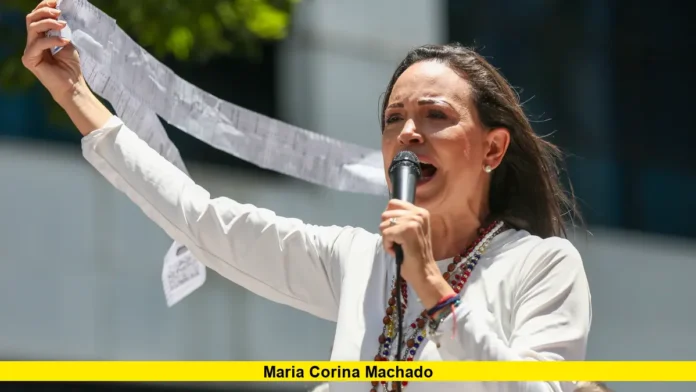

maria corina machado stands at the center of Venezuela’s most dramatic political transformation in decades, as the country confronts the collapse of long-standing power structures and the challenge of rebuilding democratic governance. After years of authoritarian control, economic collapse, and mass migration, Venezuela has entered a decisive moment that could redefine its national identity and political future.
This turning point has brought renewed focus to Machado, a figure whose influence has grown steadily through persistence, sacrifice, and international recognition. As Venezuela navigates uncertainty, her role has become inseparable from conversations about legitimacy, reform, and national recovery.
Venezuela Enters a New Political Era
In early 2026, Venezuela experienced a sudden and destabilizing shift following decisive military and political actions that removed Nicolás Maduro from power. The abrupt nature of the transition ended a prolonged period of centralized rule that shaped nearly every aspect of Venezuelan life, from the economy to civil liberties.
Years of inflation, shortages, infrastructure decay, and institutional erosion left the country vulnerable when the existing leadership collapsed. Government ministries, security forces, and public services now face an urgent need for coordination and reform.
For ordinary citizens, the moment carries a mix of hope and apprehension. Many see an opportunity to rebuild democratic institutions, while others worry about instability, power struggles, and the speed of change. Amid these concerns, leadership credibility has become one of the most valuable political assets.
The Rise of a Relentless Opposition Voice
Maria Corina Machado’s political path did not follow the traditional arc of compromise and coalition-building common in Venezuela’s opposition. From early in her career, she positioned herself as a principled critic of authoritarianism, rejecting accommodation with systems she believed undermined democracy.
As the founder of a liberal, pro-democracy political movement, she emphasized transparency, free markets, judicial independence, and respect for civil liberties. Her approach appealed strongly to citizens frustrated with decades of corruption and centralized control.
Over time, this uncompromising stance made her both influential and vulnerable. State institutions repeatedly moved to limit her participation, stripping her of eligibility for public office and blocking her from running in national elections despite broad popular support.
Rather than silencing her, these actions amplified her message and solidified her standing as a symbol of resistance.
Governing Without Power, Leading Without Safety
One of the most defining chapters of Machado’s story unfolded when political pressure forced her into prolonged concealment. Facing surveillance and credible threats, she operated without public appearances, relying on trusted networks to communicate with supporters and allies.
Even while hidden, she continued shaping opposition strategy, advocating internationally, and maintaining contact with civic groups across Venezuela. This period underscored the risks faced by political dissidents and reinforced the reality of repression under authoritarian rule.
Her endurance during these months became central to her reputation. Supporters viewed her not merely as a politician, but as a figure willing to endure personal hardship for national principles.
International Recognition and Moral Authority
Machado’s global standing reached a new level when she received the Nobel Peace Prize in 2025. The award acknowledged her long-term commitment to democratic advocacy under conditions that placed her freedom and safety at risk.
Beyond personal recognition, the honor drew renewed global attention to Venezuela’s crisis. It reframed the country’s political struggle as a matter of fundamental rights rather than partisan conflict.
The Nobel Prize elevated Machado’s moral authority at a critical time. As Venezuela faces decisions about transitional leadership and institutional rebuilding, that authority carries weight both domestically and internationally.
A Power Vacuum and Competing Visions
The removal of Maduro created a political vacuum that must now be filled through negotiation, legal restructuring, and consensus-building. Venezuela lacks fully functioning institutions capable of managing a seamless transition, making leadership credibility essential.
In this environment, Maria Corina Machado’s experience and consistency have positioned her as a central reference point in national dialogue. Her supporters argue that she embodies the clarity and resolve needed to dismantle authoritarian remnants and restore constitutional order.
At the same time, Venezuela’s diversity of political voices ensures that no single figure can dominate the transition alone. Labor groups, business leaders, civil society organizations, regional authorities, and opposition factions all seek influence over the next phase.
Machado’s challenge lies in helping unify these groups without abandoning the principles that defined her career.
Balancing Reform, Stability, and Justice
Venezuela’s path forward involves complex tradeoffs. Economic recovery requires restoring investor confidence and rebuilding public services. Political stability depends on inclusive governance and the peaceful integration of former power structures. Justice demands accountability for past abuses.
Machado has consistently argued that lasting stability cannot come at the expense of democratic values. Her public positions emphasize the rule of law, institutional independence, and protections against the return of authoritarian practices.
This perspective resonates strongly with citizens who fear that superficial change could leave the underlying system intact. It also presents challenges, as rapid reform must coexist with the practical realities of governance.
International Pressure and National Ownership
Foreign involvement has played a visible role in Venezuela’s recent developments, raising questions about sovereignty and long-term autonomy. While international pressure contributed to the breakdown of authoritarian control, the responsibility for rebuilding now falls primarily on Venezuelans themselves.
Maria Corina Machado has long navigated this tension. She has supported external measures aimed at defending democratic norms while maintaining that Venezuela’s future must be decided internally through legitimate institutions.
This stance positions her as a bridge between international allies and domestic actors, a role that will become increasingly important as Venezuela seeks recognition, aid, and diplomatic normalization.
The Meaning of Leadership in a Post-Authoritarian State
Leadership in Venezuela’s current moment is not defined by titles alone. It requires trust, legitimacy, and the ability to guide a fractured society toward common goals.
Machado’s influence now extends beyond electoral politics. Her words, choices, and alliances shape expectations about transparency, accountability, and the tone of national discourse.
The presence of maria corina machado in these conversations reflects years of sustained political engagement rather than sudden prominence. Her credibility rests on consistency, not circumstance.
A Country Redefining Itself
Venezuela’s future remains unwritten. The coming months will test whether the nation can move from collapse to reconstruction without repeating cycles of exclusion and concentration of power.
Economic reform, institutional rebuilding, and social reconciliation will demand leadership that combines resolve with restraint. Whether Machado assumes a formal role or continues influencing events through advocacy and coalition-building, her impact on Venezuela’s direction is undeniable.
Her journey mirrors that of the country itself: shaped by struggle, driven by resilience, and defined by the pursuit of dignity and democratic choice.
Venezuela’s transformation is unfolding in real time—join the conversation and stay connected as this pivotal chapter continues.