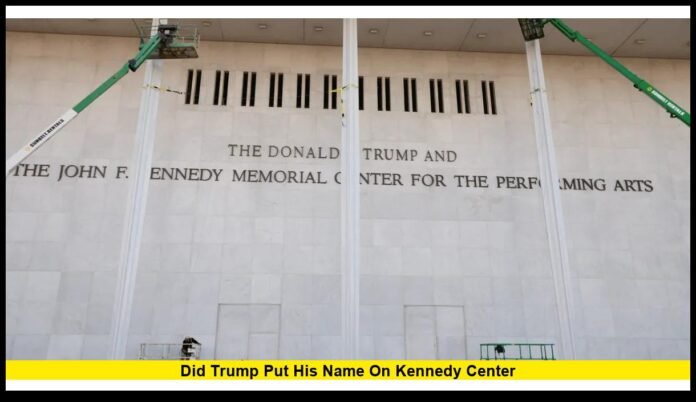

Did trump put his name on kennedy center is a question that continues to surface across search engines, social media platforms, and political discussion spaces in the United States, driven largely by confusion, viral claims, and misunderstanding about how national cultural institutions operate. Despite the persistence of this question, there has been no official action, legal change, or confirmed decision that placed Donald Trump’s name on the John F. Kennedy Center for the Performing Arts, and the institution’s historic name remains intact as of today.
The repeated circulation of this claim highlights how easily public assumptions can form when politics intersects with prominent national landmarks. In an era where information travels instantly and narratives spread faster than verification, even long-established facts can become clouded by rumor. This article provides a complete, factual explanation of what has actually occurred, what has not occurred, and why the Kennedy Center’s name has not changed.
The Kennedy Center’s Identity and Why Its Name Matters
The John F. Kennedy Center for the Performing Arts is not just another performing arts venue located in Washington, D.C. It is a federally chartered national memorial created to honor the legacy, values, and cultural vision of President John F. Kennedy. Its founding purpose was established through congressional action, embedding the institution’s identity into federal law rather than executive preference.
Because the Kennedy Center serves as both a cultural institution and a living memorial, its name carries legal, symbolic, and historical weight. The name reflects not only who is being honored but also the intention of Congress at the time of its creation. That intention has never been altered or amended through legislation.
This legal foundation is a key reason why claims about renaming the Kennedy Center require careful scrutiny and verification.
Why the Question Gained National Attention
The reason the question did trump put his name on kennedy center gained traction has less to do with documented action and more to do with Donald Trump’s public persona and branding history. Throughout his career, Trump has been closely associated with placing his name on buildings, businesses, and properties, making branding a central feature of his identity.
As a result, when discussions arise involving Trump and prominent buildings, many people assume name placement occurred even in the absence of evidence. This assumption becomes amplified when short-form content, headlines, or social media posts frame speculation as fact without context.
Once repeated often enough, the claim begins to feel plausible, even when it lacks confirmation.
Separating Presidential Influence from Legal Authority
Presidents of the United States hold significant influence, but that influence does not extend to unilateral control over federally chartered memorials. While a president may appoint members to boards, influence cultural funding priorities, or shape public discourse, those actions do not override statutory law.
The Kennedy Center’s name is protected by federal statute. Altering it would require a formal legislative process involving Congress. This process includes proposal, debate, approval by both chambers, and enactment into law. None of these steps have occurred in relation to adding Trump’s name to the Kennedy Center.
Understanding this distinction helps clarify why presidential power does not automatically translate into naming authority.
What Donald Trump’s Relationship With the Kennedy Center Looked Like
Donald Trump’s relationship with the Kennedy Center during his presidency was largely defined by distance rather than control. He chose not to attend the annual Kennedy Center Honors ceremonies, a decision that attracted attention and commentary but carried no legal consequences for the institution.
The absence of attendance did not alter governance structures, branding, or the center’s mission. It remained an operational decision reflecting personal preference rather than institutional authority.
At no point did Trump announce, approve, or implement a name change involving the Kennedy Center.
Understanding How the Board of Trustees Works
Another area of confusion involves the Kennedy Center’s Board of Trustees. The president appoints certain board members, which can lead to the perception that the board operates under presidential control. In reality, the board’s responsibilities focus on oversight, fundraising support, and strategic guidance.
The board does not possess unilateral authority to rename the institution. Even if every board member agreed on a name change, that decision would not supersede federal law governing the memorial’s name.
This limitation is intentional, ensuring that national memorials remain insulated from shifting political priorities.
No Evidence of Physical or Administrative Changes
Claims about Trump placing his name on the Kennedy Center would require visible, documented changes. Such changes would include updated signage, revised official documents, public announcements, and federal records reflecting a new name.
None of these indicators exist. The Kennedy Center continues to operate under its original name in programs, communications, signage, and public references. Visitors see the same identity that has existed for decades.
The absence of physical or administrative evidence is a strong indicator that no renaming occurred.
How Misinformation Spreads in the Digital Era
Misinformation often begins with ambiguity rather than outright falsehood. A speculative comment, a misleading headline, or an opinion framed as news can quickly spread across platforms designed to reward engagement.
As posts are shared, reposted, and reinterpreted, nuance disappears. What began as a question becomes framed as a statement, and repetition gives the illusion of confirmation.
The Kennedy Center rumor fits this pattern, illustrating how repetition can overshadow verification.
Why Cultural Institutions Become Political Targets
Cultural institutions often symbolize national identity, making them attractive targets for political narratives. Attaching a political figure’s name to such institutions can provoke strong emotional reactions, whether supportive or critical.
These emotional responses can overshadow factual accuracy. When people react to what a claim represents rather than whether it is true, misinformation can persist even after clarification.
This dynamic underscores the importance of grounding discussions in confirmed facts.
Federal Memorials and Long-Term Stability
Federal memorials are designed to outlast individual administrations. Their stability ensures continuity in national memory and cultural expression. Changing their names requires consensus rather than unilateral action.
This safeguard protects memorials from becoming tools of temporary political influence. The Kennedy Center’s unchanged name reflects this protective framework.
Any future attempt to alter it would be a significant national event requiring broad legislative engagement.
Why No Renaming Has Taken Place
There has been no renaming because:
- No legislation has been introduced or passed
- No executive order authorized such a change
- No physical updates support the claim
- No official announcements confirm it
These facts remain consistent as of today.
Public Confusion Versus Documented Reality
Public confusion does not equate to institutional change. While online discourse may suggest otherwise, documented reality confirms the Kennedy Center’s name remains unchanged.
This gap between perception and fact highlights the need for careful verification, especially when national institutions are involved.
The Importance of Fact-Based Cultural Reporting
Accurate reporting preserves public trust and protects institutions from misinformation-driven controversy. When facts are clearly established, public discourse becomes more productive and less reactive.
The Kennedy Center’s continued identity reflects not political branding but enduring legislative intent.
Clear Answer to the Central Question
To state clearly and definitively: did trump put his name on kennedy center — no. There has been no legal, physical, or administrative action that supports this claim.
The John F. Kennedy Center for the Performing Arts remains a national memorial honoring President Kennedy, operating under its original name and mission.
Looking Ahead
As political discourse continues to evolve, questions about national institutions will likely persist. Staying informed through verified facts helps ensure those discussions remain grounded and constructive.
What is your perspective on how political rumors shape public understanding of national landmarks? Share your thoughts and stay informed with confirmed updates.