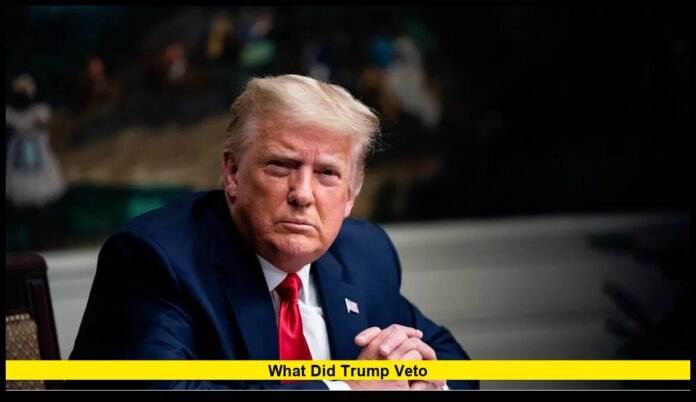

Donald Trump issued ten vetoes during his presidency from 2017 to 2021. Most involved border security, military policy, and foreign affairs. His first veto defended his southern border emergency declaration, while his final major veto, on the 2021 National Defense Authorization Act, was overridden by Congress. These actions reflected his strong, executive-driven approach to power.
Many Americans still ask what did Trump veto during his time in office, seeking to understand how his presidential decisions shaped U.S. law and politics. Between 2017 and 2021, former President Donald J. Trump exercised his veto power ten times, using it to block legislation that he viewed as a threat to his policy goals, executive authority, or national interests. Although he left office in January 2021, his veto record continues to influence political debates through 2025.
Trump’s Use of the Presidential Veto Power
The presidential veto stands among the most significant powers granted by the U.S. Constitution, serving as a critical check within the American system of government. It gives the president the authority to reject a bill passed by Congress and send it back, accompanied by a written explanation outlining the reasons for disapproval. Congress then has the option to override the veto, but doing so requires a two-thirds majority vote in both the House of Representatives and the Senate — a threshold that is rarely achieved.
This mechanism ensures a balance of power between the executive and legislative branches, preventing any single branch from dominating the lawmaking process. It also underscores the importance of negotiation and cooperation in American democracy. Over the nation’s history, many presidents have used this power sparingly, viewing it as a last resort when compromise with Congress fails.
For Donald Trump, however, the veto became more than a constitutional safeguard — it was a central part of his governing strategy. He viewed it as a direct expression of his “America First” philosophy and a way to defend his administration’s authority against what he saw as congressional overreach. Every veto he issued was a statement of conviction, underscoring his belief that the president should have strong, independent control over national policy, especially in areas such as border security, defense, and foreign relations.
Trump’s approach to the veto reflected his larger leadership style — assertive, unapologetic, and deeply focused on maintaining executive dominance. He was not afraid to clash with Congress, even when members of his own party disagreed with him. Instead of treating vetoes as technical acts, he used them to send clear political messages about his priorities and principles.
His ten vetoes during his four years in office demonstrate how he wielded this authority to preserve his policy direction amid intense political opposition. Whether defending his border wall funding, rejecting restrictions on arms sales, or challenging congressional limits on military actions, Trump consistently used the veto to keep control in the hands of the executive branch.
In doing so, he reaffirmed his image as a president determined to act decisively, even when facing bipartisan resistance. His use of the veto power was not just about blocking legislation — it was about defining the boundaries of presidential power and reinforcing his belief that America’s strength depended on firm, centralized leadership from the White House.
The First Veto: Border Wall Emergency Declaration (March 2019)
Trump’s first veto came on March 15, 2019, when he blocked a congressional resolution aimed at ending his declaration of a national emergency at the southern border.
After a long standoff over funding for the U.S.–Mexico border wall, Congress passed a resolution to terminate the emergency declaration. Trump argued that the border situation was a matter of national security and that the declaration allowed him to redirect military funds to build additional wall sections.
By vetoing the resolution, Trump reinforced his campaign promise to strengthen border security. The House of Representatives attempted to override the veto but failed to secure the required two-thirds majority.
Vetoing Congressional Attempts to Limit U.S. Military Involvement in Yemen (April 2019)
In April 2019, former President Donald Trump issued one of his most controversial vetoes when he rejected a bipartisan resolution aimed at ending U.S. military support for the Saudi-led coalition in Yemen. The resolution had been passed under the War Powers Act, a law designed to prevent presidents from engaging in unauthorized military actions without congressional consent.
The measure marked the first time both chambers of Congress had invoked the War Powers Act to try to withdraw U.S. forces from a foreign conflict. Lawmakers from both parties, including some Republicans, argued that American involvement had contributed to a humanitarian crisis and that continued support for the Saudi campaign was inconsistent with U.S. values and strategic interests.
Trump vetoed the resolution on April 16, 2019, defending his decision by stating that the United States was not directly engaged in combat operations in Yemen. He described the congressional effort as “unnecessary” and warned that it could damage America’s strategic relationships in the Middle East. Trump emphasized that maintaining close ties with Saudi Arabia was essential for countering Iran’s influence and for protecting vital U.S. interests in the region.
His veto reflected a broader pattern that defined much of his foreign policy: a strong preference for maintaining executive authority over military and diplomatic decisions. Trump viewed the presidency as the central force in determining when and how the U.S. should act abroad, often resisting attempts by Congress to impose limits on his discretion.
The Yemen veto also highlighted the deep divide between the legislative and executive branches over the proper scope of presidential war powers. While critics saw the move as an overreach that sidelined Congress, supporters argued that Trump was upholding the traditional strength of the Commander-in-Chief.
In the years that followed, this veto became a case study in how modern presidents use their authority to shape U.S. engagement overseas. It reinforced Trump’s image as a leader willing to challenge both political parties in defense of his view of national security — assertive, independent, and unwavering in executive control.
Blocking Resolutions on Arms Sales to Saudi Arabia and the UAE (July 2019)
The summer of 2019 brought one of the most contentious series of vetoes during Trump’s presidency. Congress passed three resolutions attempting to block arms sales to Saudi Arabia, the United Arab Emirates, and other countries over human rights concerns.
Trump vetoed all three on July 24, 2019, stating that halting the sales would undermine U.S. defense industry jobs and damage strategic relationships in the Middle East. Each veto was sustained, as Congress lacked enough votes to override them.
These decisions aligned with Trump’s view that the U.S. economy and security partnerships were more important than congressional objections to foreign policy practices.
Second Border Wall Funding Challenge (October 2019)
Later in 2019, lawmakers made another attempt to block Trump’s border wall funding by passing a resolution to terminate the national emergency declaration he had previously defended.
Trump again issued a veto on October 15, 2019, insisting that border protection remained an essential duty of his administration. He emphasized that illegal crossings, drug trafficking, and national security threats required decisive executive action.
This second veto on the same issue reflected his consistency and unwillingness to compromise on one of his signature policies.
Student Loan Borrower Defense Rule Veto (May 2020)
In May 2020, Trump vetoed a congressional resolution that sought to overturn his administration’s new Borrower Defense rule, which affected student loan forgiveness for borrowers defrauded by colleges.
Lawmakers argued that the new rule made it harder for students to have their loans canceled after attending schools accused of misconduct. Trump maintained that his administration’s version provided fairness to both students and taxpayers, preventing fraudulent claims against the government.
The veto was sustained, meaning the rule remained in place until later policy reversals under the Biden administration.
Read Also-Trump Student Loans Wage Garnishment: What U.S. Borrowers Need to Know in 2025
War Powers Resolution on Iran (May 2020)
In the same month, Trump vetoed another War Powers resolution — this one designed to limit his ability to engage in military actions against Iran without congressional approval.
After heightened tensions following the U.S. drone strike that killed Iranian General Qasem Soleimani, both the House and Senate passed the measure. Trump rejected it, calling it a political move meant to weaken his constitutional authority as Commander-in-Chief.
Congress failed to override the veto, preserving Trump’s ability to act unilaterally in matters related to Iran and broader Middle Eastern strategy.
National Defense Authorization Act Veto (December 2020)
Trump’s most widely publicized veto occurred on December 23, 2020, when he blocked the National Defense Authorization Act (NDAA) for the 2021 fiscal year.
He opposed the bill for multiple reasons, including:
- Its failure to repeal Section 230 of the Communications Decency Act, a law that shields tech companies from liability for user content.
- A provision requiring the renaming of military bases honoring Confederate figures.
- Limits on his ability to withdraw U.S. troops from Afghanistan and Germany.
Congress strongly disagreed with his objections and voted to override the veto. Both chambers achieved the two-thirds majority required, making it the only successful override of a Trump veto during his presidency.
The Ten Official Vetoes of Donald Trump
Below is a comprehensive table listing every official veto issued by Trump during his four years in office:
| Date | Legislation | Subject | Outcome |
|---|---|---|---|
| Mar 15, 2019 | H.J.Res. 46 | Border emergency declaration | Sustained |
| Apr 16, 2019 | S.J.Res. 7 | Yemen War Powers resolution | Sustained |
| Jul 24, 2019 | S.J.Res. 36 | Arms sales to Saudi Arabia | Sustained |
| Jul 24, 2019 | S.J.Res. 37 | Arms sales to UAE | Sustained |
| Jul 24, 2019 | S.J.Res. 38 | Arms sales to other countries | Sustained |
| Oct 15, 2019 | S.J.Res. 54 | Second border wall challenge | Sustained |
| May 6, 2020 | S.J.Res. 68 | Iran War Powers limitation | Sustained |
| May 29, 2020 | H.J.Res. 76 | Student loan borrower defense | Sustained |
| Dec 23, 2020 | H.R. 6395 | National Defense Authorization Act | Overridden |
| Jan 1, 2021 | H.R. 6395 (override completion) | NDAA final passage | Override successful |
Each veto represents a moment when Trump asserted his presidential authority over congressional opposition, reinforcing his vision of a strong executive branch.
Political and Legal Significance of Trump’s Vetoes
Trump’s vetoes covered some of the most divisive issues of his presidency — border control, foreign alliances, student loans, and internet regulation. These actions demonstrated his willingness to challenge both political parties when he believed his policies were at risk.
- National security: Several vetoes protected defense policies Trump saw as vital to America’s safety and global position.
- Executive authority: His rejections of congressional war powers bills showed his insistence that military and foreign policy decisions remain primarily presidential responsibilities.
- Domestic priorities: The border wall vetoes became central to his identity, symbolizing his pledge to enforce immigration laws and strengthen national borders.
Even years after leaving the White House, these vetoes remain part of discussions about the balance between Congress and the presidency.
Comparison with Other Modern Presidents
Trump’s ten vetoes place him in a moderate range compared with other presidents in the modern era.
| President | Years in Office | Number of Vetoes |
|---|---|---|
| Joe Biden (as of 2025) | 2021–2025 | 6 |
| Donald Trump | 2017–2021 | 10 |
| Barack Obama | 2009–2017 | 12 |
| George W. Bush | 2001–2009 | 12 |
| Bill Clinton | 1993–2001 | 37 |
| George H.W. Bush | 1989–1993 | 44 |
| Ronald Reagan | 1981–1989 | 78 |
Trump’s number is smaller than those of some past presidents, but his vetoes were highly visible and politically charged. Unlike others who often vetoed minor legislation, Trump’s decisions centered on major national issues and high-profile disputes.
The Aftermath of Trump’s Veto Record
Trump’s vetoes left lasting policy and political effects. His border emergency vetoes paved the way for future debates over presidential powers in emergencies. His defense bill veto led to renewed discussions about technology regulation and the role of social media in politics.
Legal scholars continue to study how Trump’s actions reshaped the modern understanding of executive power. While his approach drew criticism from many in Congress, his supporters praised him for refusing to compromise on key national priorities.
As of 2025, Trump remains a central figure in American political life, and his veto history is often cited as evidence of his governing philosophy — direct, forceful, and resistant to institutional constraints.
Conclusion
Every veto issued by Donald Trump during his presidency highlighted his firm belief in presidential authority and his commitment to his campaign promises. Whether focused on border security, defense spending, or foreign relations, his vetoes reflected a leader determined to act decisively, even when facing bipartisan opposition.
When people wonder “what did Trump veto,” they are really asking how one president used the full strength of his office to pursue his agenda — and how those choices continue to shape American politics today.
What do you think about Trump’s approach to the veto power? Share your thoughts and join the discussion below.