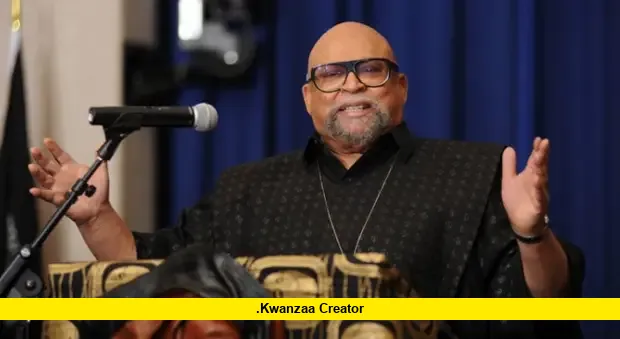

In a defining moment for African American cultural history, kwanzaa creator Dr. Maulana Karenga has announced his retirement from his long-standing academic leadership role, marking the close of a remarkable chapter that spans more than six decades of scholarship, activism, and cultural influence. The announcement arrives as communities across the United States conclude Kwanzaa observances for 2025, adding renewed focus to the origins, meaning, and enduring impact of the holiday Karenga founded in 1966.
Karenga’s retirement underscores a broader transition. While one of the most recognizable figures associated with Kwanzaa steps back from formal institutional leadership, the cultural tradition he created continues to thrive, adapt, and expand in relevance for new generations.
A Life Shaped by Education and Cultural Vision
Born Ronald McKinley Everett in 1941, Maulana Karenga emerged as a prominent intellectual and activist during the height of the Black Freedom Movement. Over the course of his career, he became a leading voice in Africana Studies, serving for decades as a professor and department chair at California State University, Long Beach.
His academic work helped shape Black Studies programs nationwide, emphasizing rigorous scholarship rooted in African and African American experiences. Karenga authored influential books that explored history, ethics, and culture, while mentoring students who went on to become educators, organizers, and community leaders. His retirement formally concludes his day-to-day academic duties, but his ideas and writings remain deeply embedded in the field.
Beyond the classroom, Karenga played a key role in advancing conversations about cultural identity, self-determination, and collective responsibility during a time of profound social change in the United States.
How Kwanzaa Was Born
Kwanzaa was created in 1966 in the aftermath of the Watts uprising in Los Angeles, a moment that exposed deep racial and economic inequalities while igniting renewed calls for cultural affirmation. Karenga envisioned a holiday that would reconnect African Americans with ancestral values and provide a foundation for unity and purpose beyond political protest alone.
The celebration was modeled after various African harvest festivals, emphasizing gratitude, renewal, and communal bonds. Karenga named the holiday “Kwanzaa,” derived from the Swahili phrase meaning “first fruits.” An additional letter was intentionally added to give the word seven letters, symbolizing the holiday’s core structure.
Those seven values, known as the Nguzo Saba, guide each day of the celebration from December 26 through January 1. They are Unity, Self-Determination, Collective Work and Responsibility, Cooperative Economics, Purpose, Creativity, and Faith. Each principle encourages reflection and action rooted in shared cultural values.
The Meaning Behind the Symbols
Kwanzaa is rich with symbolism designed to reinforce its principles in everyday life. Families and communities gather around a kinara, the candleholder that holds seven candles known as the Mishumaa Saba. One candle is lit each night, accompanied by discussion, storytelling, and reflection on that day’s principle.
Other traditional symbols include crops representing harvest, a communal cup signifying shared identity, and handmade gifts that emphasize creativity and intention rather than material excess. Together, these elements create an atmosphere that prioritizes connection, learning, and collective responsibility.
The holiday concludes with Karamu, a communal feast often held on December 31. This gathering highlights music, dance, poetry, and shared meals, reinforcing the idea that culture is a living, participatory experience.
Kwanzaa in Modern America
Nearly six decades after its founding, Kwanzaa remains a meaningful cultural observance for millions across the United States. Celebrations range from large public events hosted by cultural centers and museums to small family gatherings held in living rooms and community halls.
In cities across the country, Kwanzaa programs feature lectures, youth workshops, artistic performances, and candle-lighting ceremonies. Schools, libraries, and community organizations often incorporate educational programming that introduces the holiday’s history and principles to broader audiences.
Kwanzaa is frequently celebrated alongside Christmas, Hanukkah, and New Year traditions, reflecting its non-religious nature. Karenga consistently emphasized that Kwanzaa was designed to complement personal faith practices, not replace them. This inclusive approach has allowed families of diverse religious backgrounds to incorporate Kwanzaa into their end-of-year traditions.
The Founder and the Ongoing Conversation
The public legacy of Maulana Karenga has never been one-dimensional. His life includes moments of controversy rooted in the turbulent politics of the Black Power era. Over the years, these aspects of his biography have sparked debate and discussion, particularly when viewed through a modern lens.
At the same time, many scholars and community leaders separate those historical conflicts from the holiday itself. They point out that Kwanzaa’s principles and practices have taken on a life of their own, shaped by the communities that observe them rather than by any single individual.
This distinction has become increasingly important as younger generations engage with Kwanzaa through education, art, and community service, focusing on how the principles apply to current social and economic challenges.
A Living Tradition Beyond One Person
Karenga’s retirement signals a moment of reflection, but not an ending. Kwanzaa continues to evolve as educators, activists, and families interpret its principles in ways that address contemporary realities. Cooperative economics is discussed in the context of supporting Black-owned businesses. Unity is emphasized amid political polarization. Creativity finds expression through digital art, music, and storytelling shared across platforms.
Each year’s celebration reaffirms that Kwanzaa is not static. It is a living cultural practice shaped by the needs, hopes, and values of the people who observe it. While Karenga’s role as an academic leader may be concluding, the holiday’s influence remains active and forward-looking.
The Enduring Impact of the Kwanzaa Creator
As discussions continue about cultural identity and community resilience in America, the work of the kwanzaa creator remains central to understanding how traditions can foster connection and purpose. Karenga’s vision helped establish a space for reflection at the close of each year, inviting individuals and families to assess not only personal goals but collective responsibilities.
His retirement offers an opportunity to look both backward and forward, recognizing the historical roots of Kwanzaa while embracing how it continues to grow in meaning for new generations.
How do you see Kwanzaa’s principles shaping community life in the years ahead? Join the conversation and stay connected as this cultural tradition continues to evolve.