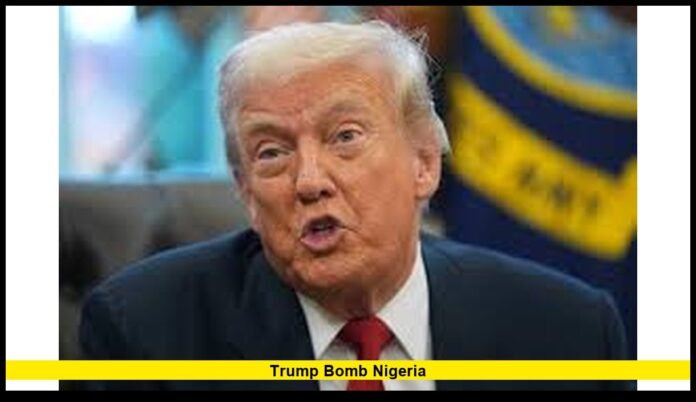

On December 25, 2025, trump bomb nigeria became a defining international headline after President Donald Trump confirmed that the United States carried out direct military airstrikes against Islamic State–aligned militants operating in northwest Nigeria. The announcement marked one of the most direct U.S. combat actions on Nigerian territory in modern history and placed renewed focus on America’s evolving role in counterterrorism efforts across West Africa.
U.S. Airstrikes Confirmed on Christmas Day
President Trump publicly stated that U.S. forces executed a targeted military operation against ISIS militants entrenched in northwest Nigeria. The strikes were carried out by U.S. Africa Command and focused on areas identified as operational hubs for extremist fighters.
Trump described the action as decisive and necessary, emphasizing that the operation aimed to disrupt militant networks responsible for repeated attacks on civilians. U.S. officials confirmed that multiple militants were killed during the strikes, though exact casualty figures were not released for security reasons.
The airstrikes were conducted with coordination from Nigerian authorities, reflecting a joint effort to weaken extremist groups that have proven difficult to eliminate through domestic military operations alone.
Confirmed details of the operation include:
- Date: December 25, 2025
- Region: Northwest Nigeria
- Target: Islamic State–linked militant positions
- U.S. Command: Africa Command
- Outcome: Militant casualties and disruption of operational sites
This action represented a clear shift from advisory support to direct U.S. military engagement in Nigeria.
Why the Trump Administration Authorized Military Action
Escalating Threats From Extremist Groups
The Trump administration tied the strikes directly to ongoing extremist violence in Nigeria. Armed groups linked to the Islamic State have carried out attacks on villages, religious sites, and transportation routes across northern regions, creating instability and fear among local populations.
President Trump framed the strikes as a response to continued civilian killings and warned that militant groups operating with impunity would face consequences. He stressed that previous warnings had not slowed attacks, prompting the decision to authorize military force.
While U.S. statements emphasized the protection of vulnerable communities, Nigerian officials have consistently noted that extremist violence affects both Christians and Muslims. The conflict, they argue, is driven by terrorism, criminal networks, and governance gaps rather than a single religious dynamic.
Understanding Nigeria’s Long-Running Security Crisis
Nigeria’s security challenges did not emerge overnight. For more than a decade, the country has faced persistent violence from insurgent and extremist groups, particularly in the north.
Key Drivers of Instability
Several factors have fueled insecurity:
- Weak state presence in remote regions
- High unemployment and poverty
- Limited access to education and social services
- Porous borders enabling militant movement
- Proliferation of weapons
Groups aligned with ISIS and Boko Haram have exploited these conditions to recruit fighters, establish camps, and carry out coordinated attacks.
The result has been widespread displacement, economic disruption, and ongoing strain on Nigeria’s military and humanitarian systems.
U.S.–Nigeria Relations Before the Strikes
Prior to the December operation, U.S. involvement in Nigeria focused largely on indirect support.
Non-Combat Cooperation
The United States had provided:
- Intelligence sharing on militant movements
- Counterterrorism training for Nigerian forces
- Surveillance and reconnaissance support
- Logistical and planning assistance
Direct combat missions were rare, reflecting sensitivity around sovereignty and concerns about long-term entanglement.
The Christmas Day strikes marked a clear departure from this approach, signaling that the Trump administration was prepared to use force when it believed threats had reached a critical level.
Political Signals Leading Up to the Operation
In the weeks before the airstrikes, the Trump administration increased diplomatic pressure on Nigeria regarding ongoing violence.
Public Warnings and Policy Measures
The administration issued strong public statements condemning extremist attacks and warned that continued violence would lead to action. It also took steps aimed at accountability, including diplomatic measures tied to security conditions.
These moves signaled growing frustration within the administration over what it viewed as insufficient progress against militant groups operating openly in parts of Nigeria.
The December strikes followed this period of escalating rhetoric and policy signaling.
Details of the Military Operation
U.S. Africa Command executed the strikes using precision-guided munitions. Military officials emphasized careful planning to limit civilian harm while targeting identified militant infrastructure.
The operation focused on areas believed to house fighters, weapons, and coordination facilities. Intelligence support from Nigerian forces played a key role in identifying targets.
Officials described the mission as limited in scope, aimed at disruption rather than occupation. No U.S. ground troop deployment was announced in connection with the strikes.
Immediate Impact on the Ground
While full assessments remain classified, the strikes are believed to have:
- Eliminated key militant operatives
- Damaged training and logistics sites
- Disrupted planned attacks
- Sent a deterrent message to extremist groups
However, experts caution that militant organizations often adapt quickly, relocating fighters and rebuilding networks unless sustained pressure is applied.
Reaction Within Nigeria
Government Perspective
Nigeria’s federal government acknowledged cooperation with the United States and reiterated its commitment to combating terrorism. Officials emphasized that international partnerships remain critical in addressing security threats that exceed national capacity.
At the same time, Nigerian leaders stressed the need to balance military actions with broader strategies focused on development, reconciliation, and governance reforms.
Public and Civil Society Views
Reactions among Nigerians were mixed. Some citizens welcomed the strikes as overdue assistance against brutal groups. Others expressed concern about foreign military involvement and the potential for escalation.
Human rights advocates urged transparency and emphasized the importance of protecting civilians during any counterterrorism operations.
U.S. Political and Public Response
In the United States, the strikes sparked debate across political and ideological lines.
Supportive Voices
Supporters praised the administration’s decisive action, arguing that extremist groups must not be allowed safe havens anywhere in the world. They viewed the strikes as a demonstration of strong leadership and a commitment to global security.
Critical Perspectives
Critics raised concerns about expanding military engagement abroad. Some questioned whether airstrikes alone could produce lasting stability without addressing underlying economic and political challenges in Nigeria.
Others emphasized the importance of clear objectives and exit strategies to avoid prolonged involvement.
Regional and International Implications
Nigeria plays a central role in West Africa, and instability there has ripple effects across the region. Neighboring countries face similar threats from militant groups that operate across borders.
The U.S. strikes drew attention to the broader challenge of extremism in the Sahel and surrounding areas. Regional leaders have long called for coordinated international efforts that combine security measures with economic development.
The operation also highlighted the growing internationalization of security efforts in Africa, as global powers weigh how to address threats without undermining local sovereignty.
Humanitarian Dimensions of the Conflict
Beyond military considerations, Nigeria’s conflict has produced a prolonged humanitarian crisis.
Civilian Consequences
Years of violence have led to:
- Millions displaced from their homes
- Disrupted agriculture and food shortages
- Limited access to healthcare and education
- Overcrowded camps for internally displaced people
Humanitarian groups emphasize that long-term peace requires addressing these conditions alongside security operations.
Counterterrorism Strategy Going Forward
The Trump administration indicated that the December strikes could be followed by additional measures if extremist violence continues. Officials suggested that intelligence monitoring would intensify and that future actions would depend on conditions on the ground.
Nigeria, for its part, continues to invest in military operations while seeking international support for broader stabilization efforts.
Analysts note that sustainable progress will likely require:
- Strengthening local governance
- Economic investment in affected regions
- Community engagement to counter radicalization
- Continued regional cooperation
What This Means for U.S. Foreign Policy
The decision to strike ISIS targets in Nigeria reflects a broader shift in U.S. foreign policy toward more assertive and direct counterterrorism actions under President Trump. The administration has framed such operations as essential for deterring extremist groups and protecting vulnerable populations, signaling a willingness to use military force even in regions where the U.S. has historically maintained a limited presence.
This more proactive posture contrasts with prior strategies that emphasized indirect support, such as training, intelligence sharing, and capacity building with partner nations. By choosing direct airstrikes, the U.S. has demonstrated that it may engage militarily when it judges that other measures are insufficient to prevent ongoing violence. At the same time, U.S. defense officials have stressed that future actions will aim to avoid large-scale deployments of American ground forces, relying instead on precision strikes, enhanced surveillance, and cooperation with local militaries.
The Nigeria strikes have also sparked debate within Washington about how counterterrorism policy should evolve. Some policymakers argue that assertive actions like these send a clear message to transnational extremist groups that the U.S. will not tolerate unchecked violence. Others caution that military interventions, if not paired with diplomatic, economic, and governance efforts, risk becoming short-term fixes rather than long-lasting solutions.
In the broader geopolitical landscape, the operation underscores a willingness by the United States to project power in regions facing instability, even when those areas are far from traditional U.S. strategic interests. The administration has tied its actions to wider goals of undermining extremist networks wherever they emerge, while also reinforcing partnerships with nations confronting insurgencies.
As U.S. policymakers assess the results of the Nigeria strikes and monitor ongoing threats, decisions about future engagement will likely balance military readiness, diplomatic cooperation, and efforts to support governance reforms. How these elements are weighted could influence American counterterrorism policy for years to come, shaping the role the United States plays not only in West Africa but across other regions confronting violent extremist movements.
Looking Ahead
As of now, no further U.S. strikes have been publicly announced after the December 25 operation, but American military and diplomatic activity in the region continues to evolve. U.S. Defense leadership has signaled that intelligence flights and monitoring over Nigeria have intensified in recent weeks, indicating sustained vigilance even after the Christmas Day airstrikes. There are ongoing U.S. Africa Command surveillance missions and increased information sharing with Nigerian forces, reflecting a continued focus on identifying and disrupting extremist activity.
Meanwhile, violence by militant groups across northern Nigeria continues to underscore the fluid security environment. A suspected suicide attack in Maiduguri, northeastern Nigeria, killed and injured civilians during evening prayers in late December, highlighting persistent threats from extremist factions including ISIS-linked fighters and Boko Haram affiliates. These incidents show that while the U.S. military action dealt a blow to specific targets, the broader insurgency remains active and unpredictable.
Nigeria’s government has reaffirmed its commitment to cooperating with international partners to fight terrorism and protect civilians of all faiths, even as local authorities press ahead with their own counter-insurgency operations. Analysts note that further military responses — whether by Nigeria’s armed forces, international coalitions, or U.S. support efforts — will likely hinge on how militant groups adapt and whether attacks against civilians escalate or subside.
For now, the December 25 strikes stand as a strategic marker in U.S.–Africa relations, with Defense officials publicly acknowledging the possibility of continued engagement. The next phase of action — whether additional strikes, expanded intelligence cooperation, or diplomatic pressure — will depend on real-time battlefield developments and decisions by both Washington and Abuja about how best to address the evolving extremist threat.
How do you view the Trump bomb Nigeria operation and its implications for U.S. involvement in West Africa? Share your thoughts and stay connected for continued updates.