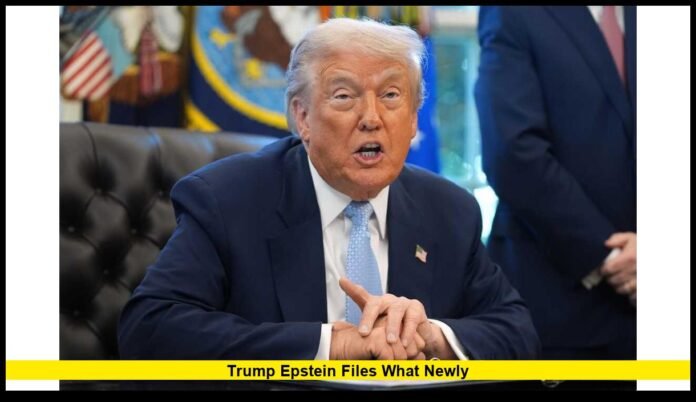

Public attention has surged once again as new details emerge from the recently unsealed Trump Epstein files, part of the growing archive of court documents tied to the late financier Jeffrey Epstein. Released in late 2025 through federal court orders, the files shed light on years of testimony, travel logs, and correspondence that reveal how deeply Epstein’s social and professional network extended.
As of December 2025, these documents confirm that Donald Trump’s name appears several times in connection with Epstein’s social circle during the 1990s and early 2000s. However, no criminal allegations or charges have been filed against Trump based on any of the material made public so far. Legal experts emphasize that the unsealed records primarily provide insight into the extent of Epstein’s influence, rather than establishing new criminal liability for any of the individuals mentioned.
Background: How the Trump Epstein Files Were Unsealed
The recently unsealed court records stem from ongoing civil cases in the U.S. District Court for the Southern District of New York, where victims of Epstein’s abuse have continued to pursue justice. These documents include flight manifests, deposition transcripts, internal emails, and personal correspondence gathered from Epstein’s properties and digital archives.
Federal judges overseeing the case ordered a phased release of the materials throughout 2025, citing the public’s right to know about one of the most significant criminal networks uncovered in modern U.S. history. Portions of the records remain redacted to protect the privacy of victims, but thousands of pages have already been released.
The “Trump Epstein files” is a shorthand term used by reporters and researchers to describe the parts of those court documents where Donald Trump’s name or connections appear. The material has drawn widespread attention because of Trump’s prior acquaintance with Epstein and renewed public scrutiny as he continues to play a central role in American political life.
Donald Trump and Jeffrey Epstein: The Historical Connection
Donald Trump and Jeffrey Epstein first became acquainted in the 1980s, when both men were prominent figures in New York’s elite social scene. Epstein, a financier with mysterious sources of wealth, often attended high-profile charity events and social gatherings frequented by celebrities, business leaders, and politicians.
Trump, then a rising real estate developer and owner of several Manhattan properties, moved in similar circles. The two men were occasionally seen at the same events, including social functions in Palm Beach, Florida, near Trump’s Mar-a-Lago resort.
Trump once acknowledged knowing Epstein in a 2002 interview, describing him as “a terrific guy” who liked “beautiful women as much as I do.” However, by the mid-2000s, their relationship had reportedly ended.
Multiple accounts suggest that Epstein was banned from Mar-a-Lago around 2007 after inappropriate behavior involving a club employee. This occurred shortly before Epstein’s first arrest in Florida for soliciting a minor.
Since then, Trump has consistently denied any involvement in Epstein’s criminal conduct, stating publicly that their connection was purely social and ended nearly two decades ago.
What the Newly Released Files Contain
The 2025 unsealed Epstein records encompass a wide range of material that investigators and attorneys have reviewed for years. Among the most discussed elements are:
- Flight manifests: Records from Epstein’s private jet logs dating from 1993 through 2005.
- Deposition transcripts: Testimonies from Ghislaine Maxwell, Epstein’s employees, and witnesses in related civil suits.
- Personal communications: Emails and notes referencing interactions with prominent individuals.
- Property logs: Visitor records from Epstein’s residences in Palm Beach, New York, and the U.S. Virgin Islands.
In these records, Trump’s name appears in a handful of contexts, most often connected to social gatherings, charity events, and mutual acquaintances. The files show no indication that Trump visited Epstein’s private island or participated in criminal acts.
A single 1997 flight record lists Trump’s name among passengers traveling from Palm Beach to New York, a route consistent with both men’s residences at the time. The manifest does not include minors or any of Epstein’s known associates involved in trafficking crimes.
Other documents include staff emails referencing Trump’s attendance at Palm Beach events hosted by Epstein, though none suggest ongoing communication beyond that period.
Ghislaine Maxwell’s Testimony and Mentions of Trump
Portions of the released files include Ghislaine Maxwell’s deposition transcripts, recorded before and after her 2021 federal trial. Maxwell, Epstein’s longtime associate, was convicted of multiple charges related to sex trafficking and is currently serving a 20-year prison sentence.
In her 2020 deposition, Maxwell confirmed that Trump was “one of many public figures” who knew Epstein socially, describing their relationship as “limited to the same circles.” She did not allege any inappropriate behavior or criminal conduct involving Trump.
Legal analysts reviewing Maxwell’s statements emphasize that her testimony aligns with previously known information about Epstein’s broad social connections, which included business leaders, scientists, and politicians across the globe.
The Broader Epstein Network
The Epstein files have implicated dozens of high-profile individuals in social or professional interactions with the disgraced financier. Some, like Prince Andrew of the United Kingdom and lawyer Alan Dershowitz, have faced separate legal scrutiny or lawsuits connected to the case.
For context, Jeffrey Epstein’s criminal enterprise operated between 1994 and 2008, during which he exploited dozens of underage girls under the guise of offering financial support and professional mentoring. Epstein pleaded guilty in 2008 to state charges in Florida but served only 13 months under a controversial plea deal.
His re-arrest in July 2019 on federal sex trafficking charges brought renewed attention to his connections with global elites. Epstein was found dead in his Manhattan jail cell in August 2019, with his death officially ruled a suicide.
Since then, survivors have continued to file civil suits against Epstein’s estate and individuals accused of facilitating his operations. The unsealed records form part of those proceedings.
Other High-Profile Names in the 2025 Release
While much media attention has centered on Trump, the 2025 document release includes mentions of several other prominent individuals. These references stem primarily from flight logs, guest lists, and witness testimonies.
Notable mentions include:
- Bill Clinton, whose name appears in several flight manifests related to humanitarian trips.
- Prince Andrew, who has been publicly linked to Epstein’s abuse network and reached a settlement with one of the victims.
- Les Wexner, founder of L Brands, who was Epstein’s former financial client.
- Alan Dershowitz, who has both defended and been accused in lawsuits tied to Epstein.
Many of these figures have publicly denied any knowledge of Epstein’s criminal activity. Legal experts caution that the presence of a name in Epstein’s records does not automatically imply complicity.
Public and Political Reactions
The release of the 2025 Epstein files has fueled widespread debate, particularly because of the political implications surrounding Trump’s renewed presidential campaign.
At a rally in Iowa earlier this month, Trump addressed the renewed coverage, stating, “I was never part of Epstein’s crimes. Everyone knows I threw him out of Mar-a-Lago when I saw what he was doing.”
His representatives have repeated that the connection was brief and ended years before Epstein’s first arrest. They also pointed out that multiple witnesses have confirmed that Trump cooperated with authorities during earlier investigations.
Victims’ advocates, however, continue to press for full transparency, arguing that all documents related to Epstein’s operations should be released publicly, regardless of the names involved.
Social media discussions about the Trump Epstein files have generated millions of views, though fact-checkers urge caution against misinformation or unverified claims spreading online.
Legal Clarifications From Federal Authorities
Federal prosecutors overseeing the Epstein civil cases have reiterated that no ongoing criminal investigation currently involves Donald Trump. The Department of Justice has not filed charges against him or designated him as a person of interest in any Epstein-related matter.
Judges involved in managing the unsealing process have also confirmed that Trump’s mentions appear solely in social contexts. The courts’ priority, they noted, remains on uncovering information directly tied to Epstein’s financial operations, recruitment networks, and enablers.
Legal experts predict additional document releases in early 2026, which may include further correspondence or financial records not yet public. However, none of the released or pending material has indicated evidence of criminal wrongdoing by Trump.
Ongoing Civil Litigation
More than 150 Epstein survivors have filed civil claims since his death, resulting in settlements exceeding $120 million through the Epstein Victims’ Compensation Program. These payouts have been funded largely by liquidating Epstein’s real estate and offshore assets.
Civil proceedings continue against certain financial institutions, including those accused of facilitating Epstein’s transactions and concealing his activities. Victims’ lawyers have emphasized the importance of uncovering the full network of individuals who may have assisted Epstein in maintaining his criminal enterprise.
The Trump Epstein files, while grabbing headlines, are only a small portion of a much larger trove of material that paints a comprehensive picture of Epstein’s operations.
Transparency and Future Document Releases
Federal courts have confirmed that more unsealing orders are underway. Roughly 8,000 pages of additional Epstein-related records remain under judicial review as of December 2025. Some contain sensitive financial data and personal communications from Epstein’s associates.
Legal teams involved in the process estimate that the full set of Epstein case files could surpass 20,000 pages once the redaction process concludes. The next release is anticipated in March 2026, potentially including more flight logs and deposition excerpts.
The continued transparency efforts are part of a broader movement to ensure accountability, especially given the systemic failures that allowed Epstein’s crimes to persist for so long.
What the Trump Epstein Files Mean in Context
The 2025 release underscores how interconnected Epstein’s world was with business and political elites, but it also highlights the distinction between association and complicity.
Donald Trump’s mentions in the Epstein documents are limited to historical social interactions, with no supporting evidence of criminal behavior or financial dealings related to Epstein’s operations. Legal observers note that Trump’s early decision to distance himself from Epstein likely explains why he has not been implicated further.
The files add background detail to a long-publicized connection but do not change the legal record or introduce new allegations.
In summary, the Trump Epstein files reveal no evidence of criminal conduct by Donald Trump but provide further insight into the scope of Jeffrey Epstein’s powerful network. The unsealing process continues to uncover details about one of America’s most complex criminal cases — one that remains under public scrutiny even years after Epstein’s death.