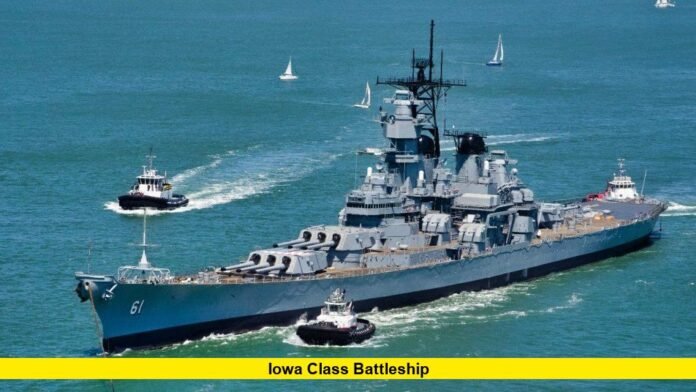

The legacy of the iowa class battleship continues to influence how the United States thinks about sea power, even decades after these massive warships left active service. From their unmatched presence during major 20th-century conflicts to their role today as benchmarks for naval strength, the Iowa-class vessels remain central to conversations about maritime dominance, defense strategy, and national security.
As the U.S. Navy evaluates how to balance historical lessons with modern warfare demands, the relevance of these legendary ships has returned to public focus. Their story is not about nostalgia alone. It is about understanding what power at sea truly means in a rapidly changing world.
Built to Command the Oceans
The Iowa-class battleships were conceived during a time when naval warfare depended on surface dominance. Speed, armor, and firepower defined success. These ships delivered all three at levels never seen before or since.
Each vessel was designed to operate at high speed while carrying some of the largest naval guns ever mounted on a U.S. ship. Their ability to keep pace with aircraft carriers made them unique among battleships, allowing them to protect vital naval assets while also serving as offensive platforms.
Beyond their technical specifications, these ships represented industrial strength and strategic confidence. Their construction reflected a nation prepared to project power globally and defend its interests across multiple oceans.
A Record of Service Across Generations
What truly set the Iowa-class apart was not only how they were built, but how long they remained useful. These ships served in World War II, later returned to action during the Korean conflict, and again supported operations decades later.
Their repeated reactivation demonstrated exceptional adaptability. As warfare evolved, these battleships were modernized with updated electronics, communication systems, and missile capabilities. This ability to integrate new technology kept them relevant long after many comparable platforms had been retired.
Few military assets can claim such a long operational lifespan across radically different eras of conflict.
Retirement Did Not End Their Impact
When the Iowa-class battleships were finally removed from active service, it marked the end of a chapter but not the end of their influence. Strategic priorities shifted toward submarines, missile-equipped destroyers, and carrier strike groups, yet the lessons learned from these ships continued to shape naval thinking.
Their retirement highlighted the changing nature of threats rather than any failure of the platform itself. Long-range missiles, air power, and undersea warfare had become dominant. Still, the Iowa-class proved that large surface combatants could remain relevant when adapted properly.
Today, these ships stand as reminders that naval strength is not defined by a single weapon system, but by flexibility, resilience, and presence.
Preserved as Symbols of National Power
Several Iowa-class battleships remain afloat as museum ships, preserved with care and precision. These vessels serve as educational centers, veteran memorials, and public attractions that connect generations to U.S. naval history.
Their preservation efforts are extensive and ongoing. Maintaining ships of this size requires constant inspection, restoration, and expert oversight. The continued investment reflects how deeply these battleships are valued as national symbols.
Visitors who step aboard gain insight not only into military history, but into the scale of commitment required to operate such vessels. The experience reinforces why these ships commanded respect on the world stage.
Renewed Focus on Surface Combat Power
Recent developments within U.S. defense planning have renewed attention on large surface warships. While modern vessels differ greatly from historic battleships, the strategic logic behind their use shares common ground.
Today’s naval challenges involve contested regions, long-range precision weapons, and the need for visible deterrence. Large surface combatants remain crucial in demonstrating presence, supporting allies, and responding quickly to emerging threats.
The renewed emphasis is not about recreating the past, but about understanding why platforms like the Iowa-class were effective and adapting those principles to modern realities.
Technology Redefines the Modern Warship
Modern warships are built around systems rather than armor thickness or gun size. Precision targeting, networked sensors, and layered defense now define effectiveness at sea.
Key priorities for contemporary surface combatants include:
• Advanced missile defense
• Long-range strike capability
• Integrated command systems
• Electronic warfare readiness
These capabilities allow a single ship to perform multiple roles simultaneously, a necessity in today’s operational environment. While the Iowa-class relied on visible strength and heavy guns, modern ships rely on information dominance and rapid response.
Despite these differences, both generations share the same strategic objective: control of critical maritime spaces.
Lessons Drawn From the Iowa-Class Era
The enduring interest in the Iowa-class battleships stems from the lessons they offer. One of the most important is that adaptability determines longevity. These ships remained effective because they evolved alongside threats.
Another key lesson is the value of presence. Few assets signal commitment and capability as clearly as a large, powerful surface ship. Even today, visible naval strength influences diplomacy, deterrence, and crisis management.
Modern planners continue to study how the Iowa-class balanced firepower, protection, and mobility, applying those principles in new technological contexts.
Strategic Importance in Today’s Global Environment
The global security environment has become more complex, with increased competition in key maritime regions. Sea lanes remain vital to economic stability, and naval forces play a central role in safeguarding them.
Large surface warships provide flexibility in these environments. They can operate independently, integrate into larger task forces, or support humanitarian missions. Their presence reassures allies while discouraging aggression.
In this context, the influence of the iowa class battleship can be seen in how the Navy continues to value ships that combine visibility with capability.
Public Interest and Cultural Relevance
Few military platforms capture public imagination like battleships. Their scale, history, and symbolism resonate far beyond defense circles. The Iowa-class ships, in particular, have become cultural icons.
Their continued popularity reflects a broader interest in understanding how military power has shaped history. They serve as entry points for discussions about strategy, technology, and national identity.
This cultural relevance helps explain why conversations about future naval development often reference these historic vessels.
Balancing Heritage and Innovation
The challenge facing the U.S. Navy today is not whether to honor its past, but how to use it effectively. Innovation must continue, yet it benefits from historical context.
The Iowa-class battleships offer that context. They demonstrate what works, what adapts, and what endures. Modern warships may look different, but their mission remains rooted in the same principles of control, protection, and deterrence.
Balancing heritage with innovation ensures that progress does not come at the expense of hard-earned experience.
A Legacy That Still Guides the Future
The Iowa-class battleships no longer patrol the seas, but their legacy continues to shape naval thinking. They represent an era when industrial power, strategic clarity, and technological ambition aligned to produce unmatched results.
As the United States navigates future security challenges, the influence of these ships remains evident. Their story is not confined to museums. It lives on in the design philosophy, strategic planning, and cultural memory of American sea power.
The oceans may look different today, but the lessons of the Iowa-class still matter.