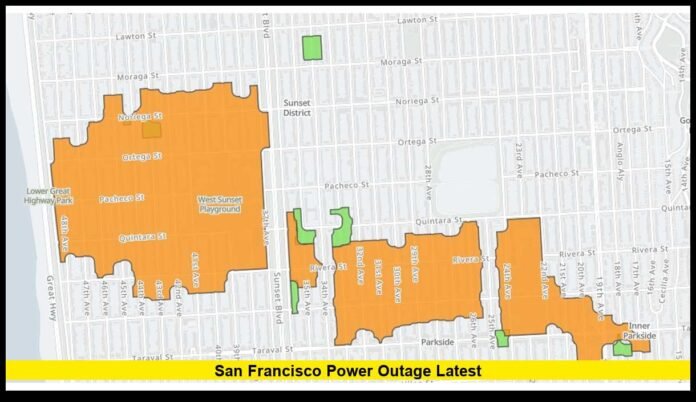

The San Francisco power outage that struck early Sunday morning, December 21, 2025, left tens of thousands of residents and businesses without electricity for several hours before power restoration efforts began in full force. Utility provider Pacific Gas and Electric Company (PG&E) confirmed that severe overnight weather caused widespread damage to the city’s electrical infrastructure, leading to the most significant outage San Francisco has experienced this year.
By late afternoon, the company reported that service had been restored to over 90 percent of affected customers, though isolated areas continued to face interruptions as crews worked through remaining repairs.
Timeline of the Outage
The outage began at approximately 4:40 a.m. PT, when several high-voltage transmission lines near Potrero Hill tripped offline during strong winds and rain. Within minutes, portions of SoMa, Nob Hill, Mission District, Financial District, and parts of the Sunset lost power.
PG&E’s early incident report showed that around 73,000 customers were initially impacted, including residential neighborhoods, retail businesses, and public transit operations. Emergency teams were dispatched immediately to identify the source of the disruption and begin line inspections.
PG&E Confirms Cause of the Power Failure
PG&E engineers determined that the outage stemmed from storm debris striking transmission lines, triggering automatic safety shutoffs at substations to prevent electrical fires. The impacted equipment was located near the Potrero Switching Station, a key component of San Francisco’s power grid.
Utility crews spent several hours assessing damage using both ground inspections and drone surveillance. Once the affected circuits were isolated, power was gradually restored through rerouting electricity from alternative substations.
A company spokesperson said, “Our priority has been to safely and quickly restore service while ensuring no additional equipment risks re-energizing the grid prematurely.”
Restoration Status by Neighborhood
By 3:30 p.m., PG&E confirmed that more than 65,000 customers had their power restored. The remaining customers, concentrated primarily in the Mission District and Potrero Hill, were expected to have service back before midnight.
Current power restoration status:
| Neighborhood | Power Status | Estimated Restoration |
|---|---|---|
| Financial District | Fully restored | Completed 12:10 p.m. |
| SoMa | 95% restored | Ongoing maintenance |
| Mission District | Partial outages | Expected by 10:00 p.m. |
| Potrero Hill | Limited power | Overnight repairs |
| Nob Hill | Fully restored | Completed 11:30 a.m. |
| Sunset District | Normal service | Restored by 1:00 p.m. |
PG&E has deployed over 120 field technicians and additional repair vehicles to expedite remaining service restoration.
Impact on Public Transportation
The power outage heavily affected San Francisco’s public transit network, disrupting early morning travel for thousands of commuters.
The San Francisco Municipal Transportation Agency (SFMTA) reported outages affecting the Muni Metro subway system between 5:00 a.m. and 8:45 a.m. Power loss in underground sections temporarily halted trains on the T-Third, K-Ingleside, and N-Judah lines.
SFMTA arranged bus bridges to assist passengers traveling downtown. Once electricity was restored, regular rail service resumed gradually by late morning.
BART (Bay Area Rapid Transit) also faced minor delays due to a power fluctuation at Embarcadero Station, but operations continued safely throughout the event.
City transportation officials praised quick coordination between transit crews and PG&E’s emergency line teams, emphasizing that no passengers were stranded for extended periods.
Traffic and Streetlight Disruptions
In addition to transit issues, more than 40 intersections across central San Francisco experienced traffic signal failures during the early hours of the outage. Areas most affected included Market Street, Mission Street, and Van Ness Avenue.
Traffic control officers were dispatched by San Francisco Police Department (SFPD) to direct vehicles manually until power returned to the signals. While the outages caused temporary congestion, no major traffic accidents were reported.
The San Francisco Department of Emergency Management (DEM) later confirmed that all intersections were back online by 11:45 a.m.
Hospitals and Public Safety Operations
Critical infrastructure across San Francisco remained secure throughout the power outage, as hospitals and emergency centers immediately switched to backup generator systems.
Facilities such as UCSF Medical Center, Zuckerberg San Francisco General Hospital, and Kaiser Permanente operated without interruption, maintaining full patient care and emergency services.
The San Francisco Fire Department responded to a handful of elevator rescue calls but confirmed that no serious injuries were reported.
DEM officials also noted that 911 services remained fully functional, as the city’s communication network operates on independent backup power.
Weather Conditions Behind the Blackout
The outage occurred as a Pacific winter storm swept across Northern California, bringing heavy rainfall, gusts up to 55 mph, and minor flooding in low-lying coastal neighborhoods.
Meteorologists from the National Weather Service (NWS) Bay Area Office stated that wind gusts and saturated soil contributed to falling branches and debris, leading to line strikes and minor transformer explosions.
Between midnight and 5:00 a.m., San Francisco recorded 1.3 inches of rainfall, with heavier totals along the western coastline. Officials urged residents to prepare for continued scattered showers through Monday.
Effect on Businesses and Daily Life
Downtown San Francisco saw significant morning disruptions as the blackout coincided with the holiday shopping weekend. Many retailers, cafes, and restaurants were forced to delay openings.
Businesses without backup generators temporarily closed during the outage, while others operated with limited service using mobile battery systems.
In the Financial District, several office buildings experienced elevator shutdowns and heating interruptions. Work-from-home policies were reactivated for employees unable to access offices until midday.
Small business owners across Union Square and SoMa described the outage as an “inconvenient setback,” though most reopened by noon once power was restored.
City economic analysts estimated a few million dollars in short-term losses, but expect minimal long-term impact given the outage’s short duration.
Community and Emergency Response
City agencies and community organizations worked quickly to support residents affected by the outage. Local coffee shops and public libraries provided charging stations and free Wi-Fi access while power was being restored.
Community centers in Mission Bay and Civic Center opened briefly as warming sites, offering shelter for those without heating overnight.
Mayor London Breed commended emergency teams for their swift response, stating, “San Francisco showed once again that we can handle challenges with coordination and resilience. Crews worked tirelessly to restore normal life for our residents.”
How Residents Coped During the Blackout
Many residents reported waking up to darkness as alarms, heating systems, and Wi-Fi went offline. Those in high-rise apartments faced elevator delays, while others turned to portable chargers and flashlights.
Despite the inconvenience, San Franciscans largely remained calm. Several residents used social media platforms like X (formerly Twitter) and Threads to share real-time updates and express appreciation for PG&E crews.
A resident in the Mission District shared, “We’ve had outages before, but this one felt different because the response was so fast. Crews were already on our street before sunrise.”
PG&E’s Infrastructure and Response Improvements
PG&E officials emphasized that the company’s infrastructure modernization program, launched in 2024, helped speed up restoration. Upgrades include new smart-grid technology and remote fault detection systems that can isolate power failures within minutes.
The utility company has also increased the number of field teams and adopted drone-based line inspections for hard-to-reach areas. These technological advancements allowed the company to restore power faster than in past incidents, such as the 2023 and early 2024 outages.
PG&E’s Chief Operations Officer reiterated that safety remains the company’s top priority, adding that continuous investment in underground wiring and vegetation management will further reduce storm-related outages across the Bay Area.
Historical Context: Power Outages in San Francisco
While San Francisco’s electrical grid is generally reliable, winter storms often test its limits.
Past notable outages include:
- January 2023: 50,000 customers lost power during a windstorm.
- April 2024: Equipment malfunction triggered short outages across SoMa and Dogpatch.
- December 2025 (current): Largest outage of the year, caused by storm damage and high winds.
The city continues collaborating with PG&E to modernize its grid by relocating overhead lines underground where feasible, especially in densely populated districts.
Preparedness Tips for Future Outages
Emergency management officials urged residents to stay prepared for possible weather-related power failures this winter. Key recommendations include:
- Keep battery-powered flashlights and radios available at home.
- Charge mobile devices before incoming storms.
- Use portable generators outdoors only, ensuring proper ventilation.
- Store nonperishable food and water for at least 48 hours.
- Check on neighbors or family members who rely on electrical medical devices.
Residents can sign up for AlertSF, the city’s emergency notification system, to receive real-time outage and weather updates directly on their phones.
Future Plans to Strengthen the Power Grid
San Francisco and PG&E continue investing in long-term infrastructure upgrades to improve energy reliability. Planned 2026 initiatives include:
- Undergrounding 10,000 miles of power lines statewide to prevent storm-related damage.
- Expanding backup power hubs at critical facilities.
- Enhancing energy storage through solar and battery microgrids.
- Increasing vegetation management near substations and transmission lines.
These upgrades are part of California’s broader strategy to enhance climate resilience amid increasingly severe winter weather patterns.
Public Confidence and Final Restoration
By early evening, PG&E confirmed that final restoration efforts were 98% complete. Crews continued patrolling impacted zones to ensure system stability overnight.
City officials expressed satisfaction with the rapid response, noting that power restoration was completed within hours, far quicker than in past events.
The outage, while disruptive, demonstrated improved communication between utility companies, emergency management teams, and city departments.