
TAE Technologies entered 2025 as a respected name in fusion research, but it is ending the year as one of the most influential companies shaping the future of clean power. With verified scientific progress, substantial financial backing, global partnerships, and a historic corporate merger, tae technologies is no longer viewed as a distant research venture. It is now positioned as a serious contender in the race to deliver practical fusion energy for the United States and beyond.
This article provides a comprehensive, up-to-date look at the company’s confirmed developments and explains why its progress matters for America’s energy future.
A Brief Overview of TAE Technologies
Founded in 1998, TAE Technologies is a U.S.-based fusion energy company headquartered in California. The company has spent more than two decades developing an alternative approach to nuclear fusion that emphasizes simplicity, efficiency, and scalability. Its work focuses on producing clean electricity without carbon emissions, long-lived radioactive waste, or the safety risks associated with traditional nuclear fission.
TAE’s long-term goal is to build commercially viable fusion power plants that can deliver consistent, utility-scale electricity to the grid. Unlike experimental government reactors, TAE’s roadmap is designed from the start with commercial deployment in mind.
Why Fusion Energy Is Gaining Urgency
Electricity demand in the United States continues to rise. Data centers, artificial intelligence systems, electric vehicles, and advanced manufacturing are placing unprecedented strain on power infrastructure. While renewable sources like wind and solar play a critical role, they cannot always provide continuous power without large-scale storage.
Fusion energy offers a potential solution. It can generate power around the clock, uses abundant fuel, and produces no greenhouse gases during operation. If deployed at scale, fusion could become a cornerstone of America’s clean energy transition.
TAE’s Unique Fusion Approach
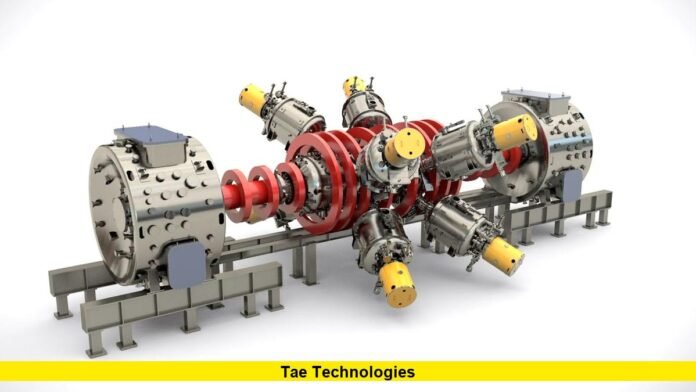
TAE Technologies uses a beam-driven Field-Reversed Configuration reactor design. This method confines superheated plasma in a compact structure using magnetic fields supported by high-energy neutral beams. Compared to more complex reactor designs, this approach reduces the number of components required to maintain stability.
The company believes fewer components lead to lower construction costs, easier maintenance, and faster deployment. This philosophy has guided TAE’s engineering decisions for years and is now showing measurable results.
Confirmed Scientific Progress in 2025
Stable Plasma Creation With Reduced Complexity
One of the most important verified developments in 2025 was achieved using TAE’s Norm reactor. Engineers successfully formed and sustained a stable plasma configuration using neutral beam injection alone. This demonstrated that the reactor can function effectively without relying on additional complex systems.
This achievement represents a major step toward simplifying future fusion reactors. Simpler systems are not just easier to build; they are also more reliable and better suited for commercial use.
Improved Performance and Cost Projections
Additional 2025 testing confirmed that refinements to TAE’s reactor design improved plasma performance while lowering projected costs for future plants. These results showed that years of incremental optimization are producing tangible gains.
By validating its design through real experimental data, TAE shortened its development timeline and strengthened confidence among investors and industry partners.
Financial Momentum and Investor Confidence
Major Funding Round Strengthens Balance Sheet
TAE Technologies completed a significant funding round in 2025, raising more than $150 million. This brought the company’s total funding to over $1.3 billion since inception. The successful raise reflected strong investor confidence in TAE’s technical progress and long-term strategy.
This level of private investment places TAE among the most well-funded fusion companies in the world, providing resources necessary for large-scale engineering and manufacturing.
Strategic Value of Industry Backers
The mix of technology-focused and energy-sector investors highlights the growing recognition that fusion energy could support multiple industries. Technology companies require reliable clean power for computing infrastructure, while energy firms are seeking future-ready solutions as fossil fuel demand evolves.
TAE’s ability to attract long-term strategic backing reinforces its credibility and commercial potential.
Global Partnerships Expand Capabilities
Collaboration With the United Kingdom
In late 2025, TAE confirmed a joint venture with the United Kingdom’s national fusion research authority. The partnership focuses on advancing neutral beam technologies used in fusion reactors and other high-energy applications.
This collaboration allows TAE to share expertise, accelerate component development, and strengthen international supply chains. It also reflects growing alignment between allied nations seeking leadership in next-generation energy technologies.
Importance of International Cooperation
Fusion research is complex and resource-intensive. By working with international partners, TAE can reduce duplication, improve standards, and speed progress toward commercialization. These partnerships also help prepare the regulatory and industrial groundwork needed for future fusion plants.
A Transformational Corporate Merger
Fusion Enters the Public Markets
One of the most consequential developments of 2025 was TAE Technologies’ announced merger with Trump Media & Technology Group. Valued at more than $6 billion, the deal positions the combined company as one of the first publicly traded fusion-focused enterprises.
The transaction is designed to give TAE greater access to capital markets, enabling faster development and broader public participation in fusion energy’s growth.
Leadership and Strategic Direction
The merged company will be co-led by executives from both organizations, blending deep technical expertise with corporate leadership experience. This structure is intended to preserve TAE’s scientific focus while supporting large-scale growth and public market requirements.
Maintaining continuity in engineering leadership ensures that the fusion program remains guided by decades of specialized experience.
Plans for Commercial Fusion Power Plants
First Utility-Scale Facility
The combined company has outlined plans to develop a utility-scale fusion power plant producing approximately 50 megawatts of electricity. Development is targeted to begin in 2026, subject to regulatory approvals and site readiness.
A plant of this size would mark a shift from experimental reactors to grid-connected power generation, demonstrating fusion’s real-world viability.
Scaling Up for Broader Impact
Beyond the initial facility, future plants are projected to reach capacities between 350 and 500 megawatts. At this scale, fusion could meaningfully contribute to regional power grids and support industrial growth.
These expansion plans illustrate a clear commercial vision rather than a purely scientific mission.
National Implications for the United States
TAE Technologies’ progress aligns with broader U.S. goals around energy security, emissions reduction, and technological leadership. Fusion power could help stabilize electricity supply as demand increases while supporting climate commitments.
Keeping fusion innovation anchored in the United States also strengthens domestic manufacturing, research jobs, and global competitiveness.
Fusion’s Role in a Diversified Energy System
Fusion is not expected to replace renewables or existing power sources overnight. Instead, it could complement solar, wind, and other technologies by providing consistent baseload power without emissions.
As electrification expands across transportation and industry, reliable clean energy sources will become increasingly valuable. Fusion offers a path to meet that demand.
What Lies Ahead
With validated scientific results, strong financial backing, global partnerships, and a path to public markets, tae technologies is entering a decisive phase. The next few years will focus on engineering execution, regulatory navigation, and the transition from demonstration to deployment.
Each confirmed milestone brings fusion energy closer to everyday use, turning a long-standing scientific ambition into a practical solution for modern power needs.
What do you think about fusion energy and TAE Technologies’ role in shaping the future of electricity? Share your thoughts and keep following this rapidly evolving story.