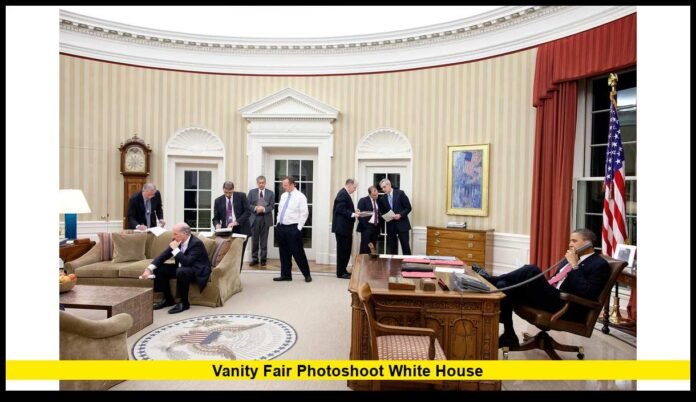

The Vanity Fair photoshoot White House captured national attention in late 2024, offering a rare and beautifully intimate look inside one of America’s most historic landmarks. The exclusive shoot, featuring President Joe Biden and First Lady Jill Biden, was photographed by Annie Leibovitz, one of the world’s most celebrated portrait photographers.
Published in the December 2024 edition of Vanity Fair, the feature presented the White House not only as a seat of power but also as a symbol of culture, humanity, and tradition. The portraits, taken in several of the building’s most iconic rooms, have since become a defining visual moment in contemporary American history.
A Rare Look Inside the Nation’s Most Iconic Residence
The Vanity Fair photoshoot White House feature was part of a special issue dedicated to American leadership and artistic legacy. The project was approved months in advance, marking one of the few occasions in modern history where a publication was granted extensive access to the interior of the White House for an editorial shoot.
Under the creative vision of Vanity Fair editor-in-chief Radhika Jones, the goal was to celebrate the connection between politics and culture in a way that felt personal and timeless. Annie Leibovitz’s portraits accomplished exactly that — merging elegance, restraint, and emotion in every frame.
Leibovitz, who has photographed every sitting president since the 1970s, described the project as “a study in humanity within a house built for history.” Her ability to balance grandeur with intimacy made the series unforgettable.
The Vision and Theme Behind the Shoot
The White House has always been a backdrop for power and diplomacy, but the Vanity Fair feature sought to show something more personal: the sense of home and humanity that coexists with history.
The editorial theme, titled “Leadership and Light,” presented the Bidens as stewards of both tradition and progress. Through composition, lighting, and tone, Leibovitz conveyed a sense of quiet confidence — depicting the White House as a living symbol rather than a distant institution.
Radhika Jones explained that the idea was to bridge the cultural and political narratives of America: “The White House has always reflected who we are as a nation — resilient, evolving, and deeply connected to art and storytelling.”
Locations Used for the Vanity Fair White House Photoshoot
The shoot took place across several of the White House’s most recognizable rooms, each chosen for its symbolic meaning and atmosphere.
- The East Room: The largest and most formal space in the White House, often used for state ceremonies and public addresses. Leibovitz used its sweeping chandeliers and cream-toned walls to evoke historical continuity.
- The Blue Room: Perhaps the most elegant space featured, with curved walls and tall windows overlooking the South Lawn. It served as the setting for the portraits of the Bidens standing together in soft morning light.
- The South Portico: This outdoor terrace, facing the Washington Monument, provided a dramatic yet serene conclusion to the photo series. The natural backdrop symbolized hope and openness.
Lighting played a central role. Leibovitz favored natural illumination to enhance authenticity, capturing daylight filtering through the windows to reflect a calm, reflective mood.
Annie Leibovitz: The Photographer Behind the Lens
Annie Leibovitz’s involvement gave the project its iconic status. Known for her portraiture that balances realism with artistry, Leibovitz has photographed countless influential figures, from Queen Elizabeth II to Barack Obama.
Her long-standing partnership with Vanity Fair has defined the magazine’s visual identity for decades. In the White House feature, she once again demonstrated her mastery of storytelling through imagery.
Leibovitz’s approach for this shoot was intentionally understated. Instead of staged or heavily stylized compositions, she sought to portray authenticity. The result was a series of photographs that felt intimate yet dignified — a modern reflection of leadership in a divided yet hopeful nation.
One of the most striking images shows President Biden in the East Room, standing beside a window with natural light illuminating his face. The composition evokes both vulnerability and strength, qualities that have come to define his public image.
The Bidens’ Presence and Influence
President Joe Biden and First Lady Jill Biden were central to the tone of the shoot. Their genuine comfort and warmth translated through every photograph.
Jill Biden’s role went beyond that of subject; she collaborated closely with the Vanity Fair creative team to ensure the shoot reflected the White House’s dual purpose — as a symbol of government and as a family home.
Her wardrobe choices, which included custom designs by American designers such as Gabriela Hearst and Oscar de la Renta, were deliberately understated to reflect elegance without excess. Her classic blue gown in the Blue Room portrait became one of the most widely discussed fashion moments of the year.
In the accompanying Vanity Fair interview, Jill Biden remarked, “The White House isn’t just about policy or politics. It’s about who we are as a people. Every room tells a story.”
Her words reinforced the editorial’s focus on continuity, compassion, and culture — values that guided both the administration and the artistic direction of the feature.
A Historic Collaboration Between Vanity Fair and the White House
The coordination required for this project was immense. Vanity Fair’s editorial team worked for several months with the White House Communications Office and the White House Historical Association to prepare for the shoot.
Annie Leibovitz’s production team was granted limited access to the building, operating under strict security and preservation guidelines. The photoshoot took place over two consecutive days, during which staff rearranged certain furnishings and adjusted lighting while maintaining historical integrity.
The collaboration demonstrated how media and government can cooperate respectfully to produce cultural documentation that transcends politics. It was not just a fashion shoot, but a visual record of an era.
Public Reaction and Media Coverage
When Vanity Fair released the photographs on November 28, 2024, public response was immediate and overwhelmingly positive. The images dominated social media platforms, with hashtags like #VanityFairWhiteHouse and #AnnieLeibovitz trending for several days.
Critics praised the portraits for their restraint and artistry. Many commented that Leibovitz succeeded in creating images that felt both timeless and contemporary.
The Blue Room portrait of the Bidens, in particular, received widespread attention, drawing comparisons to classic presidential imagery of the past while maintaining a modern sense of intimacy.
Cultural analysts described the spread as “a visual moment of unity” — an example of how art and leadership can intersect meaningfully in an increasingly divided media environment.
Symbolism and Cultural Impact
Beyond its aesthetic appeal, the Vanity Fair photoshoot White House feature holds symbolic significance. The portraits depict not just individuals but an institution — one that represents democracy, continuity, and shared national identity.
Leibovitz’s decision to emphasize natural light and minimal retouching was deliberate. The subdued color palette and soft contrast reflected transparency and authenticity, values that resonated with audiences during a politically tense time.
The editorial also paid homage to past White House photography. By incorporating angles reminiscent of images from the Kennedy and Obama years, the shoot created a visual link across generations.
For art historians and cultural critics, the project reaffirmed the power of photography as a tool of narrative — shaping how history will remember the people and places at its center.
Vanity Fair’s Editorial Direction
Under Radhika Jones, Vanity Fair has shifted toward features that blend politics, art, and culture. The 2024 White House photoshoot represented this evolution perfectly.
Jones described the edition as “an issue about reflection — about how we see leadership and how leadership sees us.” The layout juxtaposed new photographs with historical White House imagery, emphasizing both progress and continuity.
This editorial approach positioned Vanity Fair not only as a lifestyle magazine but also as a cultural archive — a platform documenting the intersection of governance and creativity.
Global Reach and Legacy
The impact of the feature extended beyond the United States. International editions of Vanity Fair, including those in the U.K., France, and Italy, reprinted selections from the shoot, framing it as a celebration of American resilience and artistry.
Exhibitions showcasing Leibovitz’s White House portraits were later held at galleries in New York City and Washington, D.C., drawing large crowds throughout 2025. These displays further solidified the shoot’s status as one of the most important visual projects of the decade.
The photographs are also expected to enter the permanent collection of the White House Historical Association, ensuring their preservation as part of the nation’s cultural record.
The Enduring Power of Presidential Imagery
Throughout U.S. history, presidential photography has shaped how Americans view their leaders. From official portraits to editorial interpretations, these images define eras and influence public perception.
The Vanity Fair photoshoot White House continues that lineage, capturing a balance between authority and humanity. The combination of Annie Leibovitz’s artistry and the Bidens’ authenticity produced a collection that will likely be studied for years as part of the modern visual history of the presidency.
For many viewers, the images represented a moment of calm and unity during a period of global uncertainty — a reminder that leadership can still inspire reflection and pride.
The Vanity Fair photoshoot White House feature remains one of the most visually and culturally significant moments of 2024, blending history, artistry, and leadership into a series of portraits that celebrate both the people and the place that define American democracy.
What’s your favorite image from Annie Leibovitz’s White House series? Share your thoughts in the comments below and tell us how these portraits make you feel about American history.