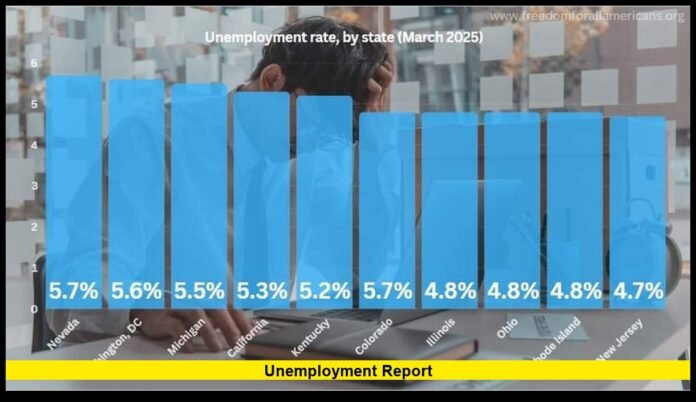

The latest unemployment report confirms a noticeable shift in the U.S. labor market, with the national unemployment rate rising to 4.6 percent in November 2025 as hiring activity slowed and workforce conditions tightened across multiple sectors.
This update reflects a period of adjustment following months of economic uncertainty, uneven hiring patterns, and disruptions that affected employment data earlier in the fall. While job creation continued, the pace weakened enough to raise concerns about labor market momentum heading into the final weeks of the year.
Current Snapshot of the U.S. Labor Market
November’s data presents a labor market that remains active but clearly less robust than earlier in 2025. Employers added jobs, yet not at levels typically associated with strong economic expansion.
Key figures from the report include:
- Unemployment rate: 4.6 percent
- Estimated unemployed individuals: About 7.8 million
- Net jobs added: 64,000
- Labor force participation: Near 62.5 percent
Compared with earlier months when job growth regularly exceeded 150,000 positions, the November total signals a slower hiring environment.
Understanding the Rise in Unemployment
An increase in the unemployment rate does not always point to immediate economic distress, but it often reflects changes in employer behavior.
Several factors contributed to the rise:
- Employers reduced new hiring commitments
- Some sectors experienced layoffs or attrition
- More individuals reentered the labor force and began actively seeking work
At 4.6 percent, unemployment remains below long-term historical averages. However, the upward movement matters because it shows a clear departure from the exceptionally tight labor market seen over the past two years.
Job Growth Continues but Loses Strength
Despite the higher unemployment rate, job creation did not stop. Hiring continued in select areas of the economy, though gains were uneven.
Industries adding jobs included:
- Health care and medical services
- Construction and infrastructure-related work
- Social assistance roles
Industries facing employment declines included:
- Transportation and logistics
- Warehousing and distribution
- Portions of the professional services sector
This divergence highlights a labor market that is increasingly selective, with demand concentrated in essential and population-driven services.
Impact of Missing Employment Data Earlier in the Fall
Labor market interpretation has been complicated by earlier disruptions that prevented the release of complete employment figures for October.
Because of that gap:
- November data was measured against September benchmarks
- Month-to-month trends appear less smooth than usual
- Revisions may occur as additional information becomes available
Even with those limitations, the broader trend points to slower employment growth rather than a sudden contraction.
Labor Force Participation Shows Limited Improvement
The labor force participation rate remained near 62.5 percent, a level that has changed little in recent months.
This figure remains below pre-pandemic norms and reflects ongoing challenges such as:
- Long-term caregiving responsibilities
- Health-related workforce exits
- Skills mismatches in certain industries
While participation has stabilized, it has not recovered enough to offset slower hiring, contributing to upward pressure on unemployment.
Demographic Employment Patterns Remain Uneven
Employment outcomes continue to vary across age and population groups.
- Younger workers experienced higher jobless rates
- Certain communities faced greater difficulty securing employment
- Prime-age workers showed more stability but slower job switching
These disparities suggest that while the labor market remains functional, access to opportunity is not evenly distributed.
Wage Growth Moderates as Hiring Slows
Wages continued to rise in November, though growth remained moderate.
Average hourly earnings increased about 3.5 percent over the past year, reflecting steady but cooling compensation trends. Employers appear focused on maintaining current staff rather than raising pay aggressively to attract new workers.
This moderation may help ease cost pressures for businesses while reducing inflationary momentum tied to labor expenses.
Weekly Jobless Claims Provide Additional Insight
Recent increases in weekly unemployment claims offer another signal of labor market cooling.
Higher claims typically indicate:
- More workers experiencing layoffs
- Longer job search periods
- Reduced confidence among employers
While claims levels remain manageable, the upward trend aligns with the broader slowdown shown in the unemployment report.
Employer Behavior Reflects Caution
Across industries, employers are adjusting strategies rather than expanding aggressively.
Common approaches include:
- Pausing hiring plans
- Filling only essential positions
- Delaying workforce expansion projects
This cautious stance reflects uncertainty around economic growth, consumer demand, and policy direction rather than immediate financial stress.
Policy Environment and Economic Conditions
The unemployment report arrives as economic policy remains focused on sustaining growth without reigniting inflation.
Interest rate reductions earlier in 2025 aimed to encourage borrowing and investment. While those moves helped stabilize parts of the economy, they have not yet sparked a return to strong hiring momentum.
Policymakers continue to watch employment data closely, as sustained increases in unemployment could shape future decisions.
What the Report Means for Job Seekers
For workers, the current environment suggests a more competitive job market.
Key takeaways for job seekers include:
- Greater competition for open positions
- Stronger demand in health care and construction
- Slower hiring timelines across many industries
Adaptability, skill development, and sector awareness are becoming more important as opportunities narrow in some fields.
Business Outlook Moving Forward
For employers, the report reinforces the need for careful workforce planning.
Many companies are focusing on:
- Productivity improvements
- Retention of skilled employees
- Cost control rather than expansion
Until clearer signs of economic acceleration appear, cautious hiring is likely to continue.
What to Watch in Upcoming Reports
Future labor market updates will help clarify whether November marks a temporary pause or the beginning of a longer-term trend.
Key indicators to monitor include:
- Changes in the unemployment rate
- Revisions to prior job totals
- Labor force participation movement
- Weekly jobless claims
Together, these data points will provide a clearer picture of where the job market is heading in 2026.
Bottom Line
The latest unemployment report shows a U.S. labor market transitioning from rapid growth to a more measured pace. Hiring continues, wages are rising modestly, and unemployment remains moderate, but momentum has clearly slowed.
Whether this shift stabilizes or deepens will depend on economic conditions, employer confidence, and workforce participation in the months ahead.
How do you see today’s job market affecting workers and businesses? Share your thoughts below and stay connected for the next unemployment report update.