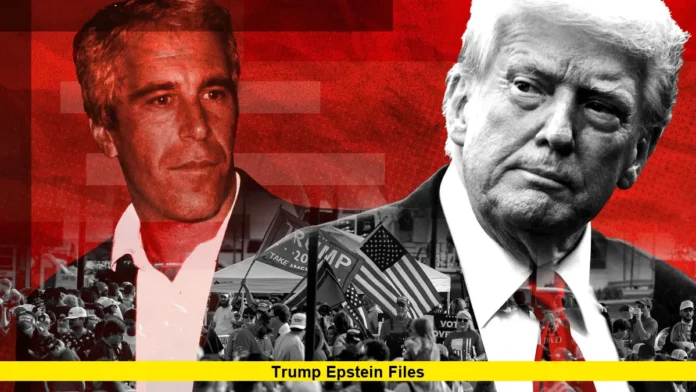

Newly released photographs featuring President Donald Trump have intensified public attention on the trump epstein story, fueling a surge of national debate as the federal government approaches a major disclosure deadline that will release thousands of pages of Epstein-related documents. With Congress, federal courts, and the Department of Justice all involved in a sweeping push for transparency, the country is entering a pivotal moment that could reshape public understanding of Epstein’s network and the government’s historical handling of the case.
A New Set of Images Raises Fresh Questions
A newly released set of photographs from Epstein’s estate has drawn immediate attention due to the presence of President Trump in several frames. The images, provided to a congressional committee during an ongoing review, were selected from a massive collection exceeding 95,000 estate photographs. Each image was screened to protect the identities of individuals unrelated to the public interest, including several women whose faces are blurred or cropped.
The scenes show President Trump at what appear to be social gatherings involving Epstein and other influential figures. While the dates and locations have not been disclosed, the images underscore the breadth of Epstein’s social connections during the years when he moved among political, financial, and entertainment elites.
Some photos depict Trump in group settings with other high-profile individuals such as Bill Clinton, Steve Bannon, Bill Gates, and Woody Allen. The visuals vary from casual events to more formal interactions, but none contain illegal activity or provide evidence of criminal conduct.
Still, the revelations have prompted a wave of public interest and political reaction. Many observers have noted that Epstein’s social world extended far beyond the individuals typically mentioned in public discourse, revealing a large constellation of well-known associates. The photos have also intensified calls for full transparency as the nation approaches the release of extensive government documentation related to Epstein’s criminal investigations.
The Push for Transparency and the Legal Mandate Driving It
The release of these images follows a bipartisan legislative mandate requiring the Justice Department to publish a vast archive of Epstein-related materials. The law, known as the Epstein Files Transparency Act, requires the DOJ to disclose all unclassified documents connected to Epstein and his co-conspirators. The materials must be published in a publicly accessible, searchable format.
President Trump signed the law in November 2025, initiating a 30-day countdown that will culminate in a large-scale disclosure. The legal requirement covers items such as investigative reports, correspondence, photos, court records, federal memos, interview notes, and other materials produced or collected during federal investigations.
The act also mandates that congressional oversight committees receive an unredacted list of politically exposed persons and government officials referenced in the files. Although these names will be reviewed in full by Congress, the public release may include redactions where necessary to protect victim identities or unrelated personal data.
This law represents one of the broadest transparency requirements ever enacted for a federal criminal case. Its passage reflects long-standing public frustration over years of secrecy, delayed investigations, and the unresolved questions surrounding Epstein’s connections to prominent individuals.
Federal Judges Order Additional Releases
In parallel with the legislative push, several federal judges have issued rulings that open additional investigative materials to public scrutiny. One federal court has authorized the release of grand jury records tied to Epstein’s long-running sex-trafficking network. Another lifted protective orders that once shielded investigative files linked to Epstein’s 2019 federal indictment.
These judicial decisions signify growing recognition that transparency is both legally supported and publicly necessary. Judges have acknowledged that while some materials may require redaction—particularly information identifying minors or survivors—the public’s interest in understanding these investigations is compelling and substantial.
Experts believe that the combined effect of the transparency law and recent court rulings will result in the most extensive public release of Epstein-related material to date. This includes records once thought inaccessible due to court protections or federal confidentiality rules.
Political Tension Builds as the Disclosure Deadline Nears
The pending document release has generated intense reactions across the political spectrum. Democrats frame the photo disclosures and upcoming releases as essential steps toward accountability and clarity. They argue that transparency is necessary not only to understand Epstein’s network but also to assess whether federal agencies conducted the case properly over several decades.
Republicans, however, have raised concerns that selectively releasing photos could mislead the public by presenting incomplete context. Some lawmakers on the right argue that revealing images without providing timeline information or investigative findings can unfairly insinuate wrongdoing. Critics also warn that the political environment surrounding these disclosures may cause ordinary associations to be interpreted as something more than they were.
Despite political disagreements, both parties agree that the public deserves access to the full record. Many leaders continue emphasizing that being photographed with Epstein or appearing in government files does not imply criminal conduct. The question, they argue, is not guilt by association—it is transparency in one of the most controversial criminal cases in modern U.S. history.
Public Reactions Show High Concern and Intense Curiosity
Recent national polling shows that Americans remain deeply concerned about unresolved questions surrounding Epstein’s connections and the handling of his case. Polls indicate that a majority of Americans want full access to government files and believe that the criminal justice system owes the public clear answers.
Many citizens also express distrust in how past investigations were conducted. Epstein’s 2019 death in federal custody remains a persistent source of public skepticism, even though multiple investigations concluded that there was no foul play. The demand for the upcoming document release reflects a widespread belief that keeping information concealed fuels doubt and misinformation.
The presence of President Trump in the newly released photographs has added another layer of public interest. The images do not indicate criminal wrongdoing, but they have prompted renewed discussion about the broad range of influential people who interacted socially with Epstein over the years.
What the Public May Find in the Soon-to-Be Released Records
While the exact contents of the release remain undisclosed, informed observers expect the materials to include:
internal Justice Department memos
investigative summaries
communications involving federal agencies
interview transcripts
travel and visitor logs
images and digital files seized during investigations
correspondences outlining investigative progress
These documents may help clarify timelines, provide context about why certain criminal cases were delayed, and reveal procedural shortcomings or communication gaps between federal agencies. Some information may confirm what has already been publicly reported, while other materials could offer new perspectives on the scale of Epstein’s network.
It is widely acknowledged that inclusion in these files does not imply guilt or participation in criminal activity. Many individuals named in investigative materials had routine, peripheral, or incidental contact with Epstein.
Nonetheless, the transparent release of these documents is expected to help restore public trust, clarify misconceptions, and offer a clearer picture of one of the most notorious criminal cases of the last 20 years. The information may also help identify systemic issues within federal law enforcement that allowed Epstein’s behavior to continue for so long without complete accountability.
How the Story Fits Into the Broader National Landscape
The intersection of political leadership, public opinion, legal transparency, and historical accountability has positioned the upcoming Epstein file release as a defining moment. Because President Trump is pictured in several of the newly released photographs, media attention has intensified, giving the disclosures significant political weight as the nation evaluates associations, timelines, and investigative responses.
Throughout his presidency, Trump has consistently denied knowing about Epstein’s criminal behavior and has noted that their social interactions were brief and distant. He has also pointed to his decision to sign the transparency act as evidence of his support for full disclosure. The presence of his image in the estate photographs reinforces why transparency is essential: millions of Americans want a precise, documented record rather than assumption or speculation.
The broader narrative involves not only the president but also numerous corporate leaders, public officials, philanthropists, academics, and entertainment figures who crossed paths with Epstein over decades. The public release of government files will provide a clearer view of how these relationships were documented within federal investigative processes.
Because of the scale of the material being released, analysts expect journalists and researchers to spend months evaluating the documents. The process will likely generate new headlines, raise additional questions, and create continued demand for clarity and verification.
The Final Countdown to Full Disclosure
With the release deadline rapidly approaching, federal agencies are preparing for a landmark disclosure event. The materials are expected to be published online in batches to ensure accessibility and proper formatting. This will allow both experts and everyday citizens to search the files directly, creating an unprecedented level of public involvement in reviewing a high-stakes criminal case.
As Americans brace for what may be one of the most extensive transparency events ever undertaken by the federal government, the significance of the upcoming release cannot be overstated. It represents a turning point in public accountability, historical clarity, and governmental obligation.
The coming days will reveal how much information the public will receive and how thoroughly it will answer long-held questions about Epstein’s connections, protections, and the failures that allowed his crimes to persist for so long. The inclusion of President Trump in the newly released photographs ensures that political attention will remain intense, especially as analysts continue to review the materials for broader context and relevance.
In time, these disclosures may reshape public understanding not only of Epstein but of the systems meant to stop predators like him. They will also test the nation’s ability to evaluate sensitive information with fairness, context, and respect for victims whose lives were forever changed.
Tell us your thoughts on these developing disclosures and share what you believe the public most needs to understand as the Epstein files come to light.