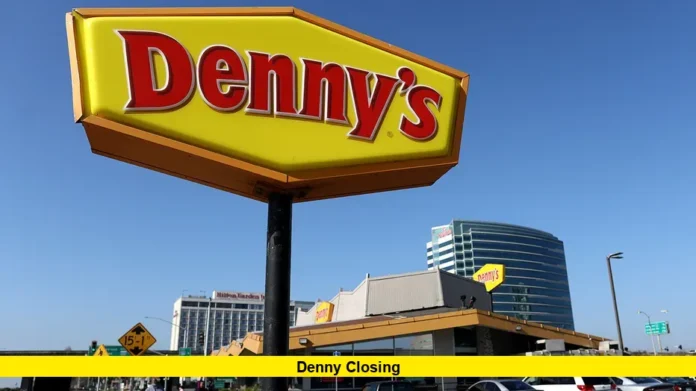

On December 9, 2025, the classic American diner chain Denny’s confirmed it will close 150 underperforming restaurants across the United States by the end of this year — a major downsizing move that underscores the challenges facing traditional sit-down dining chains in a shifting market. The phrase “denny closing” has echoed through social media and headlines as customers wonder whether their favorite late-night pancake stop is becoming a thing of the past. But Denny’s says the closures are part of a strategic recalibration — not a shutdown of the company as a whole.
What led to the decision to close 150 locations
A multi-year turnaround plan
The closures are part of a plan first publicly revealed in late 2024, when Denny’s said it would shutter 150 of its lowest-performing restaurants by the end of 2025. That plan emerged after a year of sliding revenue and shifting dining habits. By that point, the chain had already closed dozens of outlets and committed to a sweeping reduction.
In 2024 alone, Denny’s shut down 88 locations. Then, during an earnings update in early 2025, company leaders projected that another 70 to 90 restaurants — mostly underperforming and often older locations — would close during the remainder of the year. The result: 150 closures in total.
Declining customer demand and changing habits
For many of the restaurants marked for closure, consistent under-performance drove the decision. Many saw traffic fall below thresholds necessary to justify continued operation. Some had average annual unit volumes below $1.1 million — a level leadership judged unsustainable.
Part of the challenge stems from changing consumer behavior. Compared with a generation ago, fewer diners frequent 24/7, sit-down restaurants. Instead, customers increasingly choose fast-casual spots, delivery, or simpler, more convenient formats. These shifts accelerated after the pandemic and show little sign of reversing.
Moreover, many of the restaurants scheduled for closure were longtime fixtures but aging — sometimes decades old — and needed significant renovation to remain viable. Denny’s leaders noted that the cost of remodeling older restaurants, combined with low patronage, made it impractical to keep them open.
Recent developments: Acquisition and context for the closures
Private-equity buyout does not drive the closures — but timing overlaps
On November 3, 2025, Denny’s announced it would be taken private in a $620 million all-cash deal by a consortium of investors including TriArtisan Capital Advisors, Treville Capital Group, and Yadav Enterprises (one of Denny’s largest franchisees). The acquisition offers $6.25 per share to Denny’s shareholders, delivering a substantial premium over recent trading prices.
Despite public speculation that the acquisition triggered the wave of closures, company executives maintain the closings were planned earlier and are unrelated to the sale. Rather, the closures were part of a calculated effort to optimize Denny’s portfolio before and after the transition to private ownership.
The aim: Streamline now for stability and renewed growth later
According to leadership statements, the goal is to enhance long-term financial health and position the chain for “net flat to positive growth” by 2026. By shedding underperforming and outdated units, Denny’s aims to focus resources on its core, higher-performing restaurants — improving operational efficiency, reducing maintenance burdens, and giving the brand a chance to modernize.
Even as closures proceed, Denny’s says it plans to open new restaurants in stronger or emerging markets. That suggests the brand may soon shift from contraction mode to selective expansion — potentially with a leaner, more efficient footprint tailored to current diner habits.
Where and how closures are already happening
Recent high-profile shutdowns
Some closures have already stirred nostalgia and local outcry. One example: a longtime Denny’s at a Bay Area mall in Santa Rosa, California — near the Coddingtown Mall — quietly closed in late November 2025. The closure left only one remaining Denny’s location in that city, prompting longtime patrons to seek alternatives.
That particular restaurant, which had served the community for decades, displayed a short notice thanking customers and pointing them to nearby open locations — a move that many saw as emblematic of wider changes in the chain.
Widespread but selective impact
Although Denny’s hasn’t published a comprehensive nationwide map of closures, the strategy seems clear: shutter restaurants in areas where traffic and sales have declined for years, and where lease terms or physical conditions make renovation impractical. Many of the shuttered locations date back decades, underscoring the challenge of maintaining older real estate in a tight-margin industry.
At the same time, many Denny’s locations continue to thrive — particularly those in densely populated, high-traffic areas or regions with strong demand for affordable, sit-down dining. As of late 2025, the company reports slightly over 1,300 U.S. restaurants remaining in operation, down from higher counts in previous years.
What this means for diners and communities
Some local “go-to” spots may disappear for good
For fans of late-night breakfasts, all-day pancakes, or weekend family dinners at Denny’s, the closures may hit hard. In certain towns or neighborhoods — especially small or mid-sized communities — the closure of one of the last or only Denny’s may erase a familiar and convenient dining option.
Some customers have already expressed disappointment and nostalgia online, recalling how Denny’s once offered reliable late-night eats and a welcoming environment. For them, closures underscore a broader decline in the availability of 24/7 dine-in restaurants.
But the brand isn’t gone — it’s retooling
The closures do not signal the end of Denny’s. Instead, they seem to reflect a strategic shift: adapt to modern dining trends, focus on stronger markets, and recalibrate the company for long-term survival. As the chain emerges under new private ownership, we may see updates in format, menu, and service.
According to company statements, the goal isn’t contraction for the sake of shrinking, but optimization — shedding weak links so the stronger parts of the brand can grow, innovate, and remain relevant in a competitive dining landscape.
Potential changes ahead
Investors and analysts expect that under new private ownership, Denny’s could streamline operations, remodel or update some remaining restaurants, and possibly experiment with new formats tailored to changing preferences. That might include scaled-down diners, fewer mandatory 24/7 locations, simplified menus, or even increased focus on delivery and takeout — all aimed at lowering costs and matching what customers increasingly want.
Broader trends in dining reflected in Denny’s journey
Economic pressures on traditional diners
Denny’s closure wave encapsulates challenges facing many legacy sit-down chains: rising labor and supply costs, shifting post-pandemic habits, competition from fast-casual and delivery models, and decline in late-night dine-in demand. Especially for older locations with high overhead, these pressures have become unsustainable.
The company’s closure decision comes amid similar moves by other restaurant chains that are downsizing, repurposing, or rethinking their formats to stay afloat. In this environment, sticking with large, full-service restaurants — especially older ones — has become increasingly risky.
Restructuring as a survival strategy
Instead of riding out losses or gradually shrinking, Denny’s has taken a proactive approach. By identifying low-performing units and deciding early to shutter them, the company aims to reduce overhead, allocate resources more efficiently, and prepare for future growth with a leaner structure.
As the chain passes into private ownership, this kind of restructuring may become more common — particularly among dining brands still recovering from pandemic-era disruptions, inflation, and shifting consumer tastes.
What’s next for Denny’s — and what to watch for in 2026
A transitional period ahead
With the buyout expected to finalize in the first quarter of 2026, Denny’s is entering a transitional phase. The immediate priority appears to be finishing the 150-restaurant closure plan on schedule. Once that’s done, the company may begin charting the next chapter: consolidation, renovation, and selective expansion.
Possible fresh investments and new openings
Even as closures are wrapping up, Denny’s has indicated plans to open new restaurants in markets that show promise. That could mean replacing underperforming units with newer, more efficient locations — or expanding into areas where demand remains strong.
A modernized, optimized brand could resonate with customers who still value sit-down dining but expect updated experiences, cleaner design, shorter wait times, or delivery options.
Evolving concept and service models
Given broader industry trends, it would not be surprising if Denny’s experiments with different formats. They might shift away from all-day 24/7 operations, reduce menu complexity, or invest more heavily in takeout and delivery. Such changes could make the chain more resilient in a world where convenience and speed often outweigh nostalgia.
So — does “denny closing” mean the end of the chain? Not quite.
The 2025 wave of closures might feel like the end of an era for some loyal customers — but for Denny’s as a brand, the move appears to be a strategic reset. The chain is shrinking where it needs to, clearing out underperforming, aging restaurants, and making room for a leaner, more sustainable version of itself.
For many consumers, that means fewer late-night pancake breakfasts or spontaneous family dinners at their local Denny’s — especially if they live near one of the shuttered locations. But for the chain, the hope is that a more robust core set of restaurants will better weather economic headwinds, changing preferences, and evolving competition.
And with new private ownership, a streamlined footprint, and plans for selective growth, Denny’s might be aiming not just to survive — but to adapt, remain relevant, and serve a new generation of diners.
What do you think this means for the future of diner-style restaurants in America? Share your thoughts or check back soon for the latest updates.