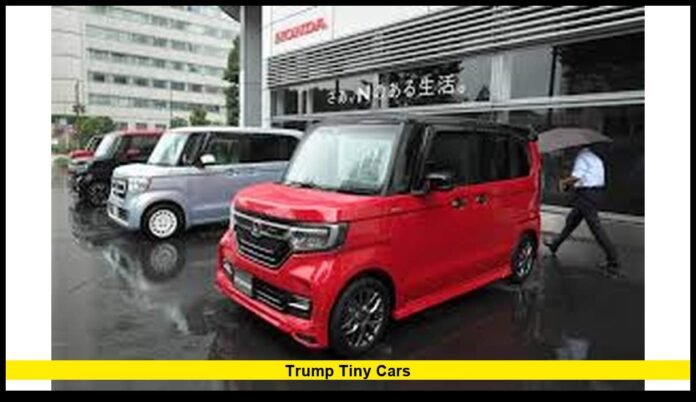

President Donald Trump’s recent call to allow trump tiny cars—ultra-compact, Japanese-style “kei” vehicles—to be built and sold in the United States has stirred a firestorm of interest across the auto industry, among regulators, and within urban communities. The reaction has ranged from excitement over potential affordability to sharp warnings about safety, regulation, and practicality. As of now, the plan remains in early stages—but it has already opened a serious debate over whether small, efficient vehicles could find a place on U.S. roads again.
In this article, we examine what these tiny vehicles are, why the Trump administration wants them here, what stands in the way, how automakers are responding, and what might happen next. We aim to give you a comprehensive, factual picture as developments continue.
What Are These “Tiny Cars”?
The tiny vehicles in question draw their roots from the class of Japanese cars known as kei cars. Kei cars are defined by strict regulations in Japan that limit their size, engine displacement, and overall power. For decades, they have offered affordable mobility to millions — small enough for narrow streets and tight parking spots, while economical in fuel and maintenance.
Typical characteristics of kei and kei-style microcars include:
- Compact dimensions — substantially smaller than typical U.S. sedans or SUVs
- Lightweight construction
- Engines under a limited displacement (in many cases less than one liter), or sometimes small electric/hybrid powertrains
- Great fuel economy, low insurance and tax costs (in Japan), and easy maneuverability in dense urban zones
Over decades, motorcycle-market-inspired microcars (including small vans, pickups, and passenger vehicles) have filled a niche in Asia and parts of Europe. Enthusiasts in the U.S. have occasionally imported older kei vehicles (especially under 25-year import exemptions), but those cars often came with legal limitations on registration, use, or highway driving.
Why the Trump Administration Is Backing Tiny Cars
The push for tiny-vehicle legalization and production under the “trump tiny cars” initiative appears motivated by several interlinked goals:
- Lower consumer vehicle costs
By encouraging smaller, simpler cars, the administration argues that new-car prices could fall — making vehicle ownership more accessible for budget-conscious buyers or city dwellers who don’t need full-size cars or SUVs. - Fuel efficiency and urban utility (for micro-versions)
For those living in cities with tight parking and heavy traffic, compact cars offer easier maneuvering, parking, and storage. If offered with hybrid or electric drivetrains, they might also reduce fuel consumption and emissions for city driving. - Expanding manufacturing options
The administration seems willing to clear regulatory barriers so that automakers — American or foreign — could manufacture kei-style vehicles domestically and sell them across the U.S. This could diversify the types of vehicles available and potentially reintroduce small-car production that largely disappeared from the U.S. market years ago. - Consumer choice narrative
The move aligns with a broader political framing: deregulation, affordability, and returning consumer choice. Tiny cars are being pitched as a low-cost, efficient alternative, particularly for urban drivers, young adults, or buyers who don’t need large family vehicles.
What’s Standing in the Way: Regulation, Safety, and Demand
Despite the enthusiasm, multiple substantial obstacles complicate the path forward for tiny cars in America. Some of the most significant:
Existing Safety and Emissions Standards
The current U.S. regulatory framework governing cars — including safety crash tests, passenger protection standards, emissions regulations, and structural requirements — was built with larger vehicles in mind. Kei-style microcars, by design, are much smaller, lighter, and less robust than modern American sedans or SUVs.
To allow their widespread sale, regulators would likely have to either carve out exceptions, rewrite multiple safety standards, or create separate classifications — a process that could take months or years.
State-by-State Registration Laws
Even if federal changes go through, state motor-vehicle departments control vehicle registration. A number of states already restrict or prohibit kei-style vehicles for street use. Some allow them only as low-speed or off-road vehicles. For a mainstream rollout, every state would have to consider updating its laws — a patchwork outcome seems highly likely.
Market Demand Has Historically Been Weak
American consumers have gravitated toward larger cars, trucks, and SUVs for decades. Previous small-car efforts — even compact and subcompact models — have often underperformed in sales. Given current consumer tastes, many analysts question whether kei-style vehicles would appeal to a broad enough audience to justify the investment.
Moreover, automakers have already shifted resources toward profitable trucks, SUVs, and high-end electric vehicles. Building tiny cars would require new engineering, marketing, and support — with uncertain return on investment.
Mixed Signals in Policy Direction
The broader policy environment complicates matters further. While tiny cars promise affordability and efficiency, the same administration has rolled back stringent fuel-economy and emissions targets. Critics argue that loosening environmental and efficiency requirements undercuts the logic of promoting small, efficient vehicles.
How Automakers and the Market Are Responding
Given the uncertainties, most major automakers and industry insiders appear cautious rather than enthusiastic. Key responses and considerations:
- Evaluating risk vs. reward: For big automakers, launching a tiny-car line would only make sense if demand exists and regulations stabilize. At present, many remain skeptical of consumer interest or long-term profitability.
- Legacy small-car failures loom large: In past decades, several manufacturers pulled out of the U.S. subcompact and compact market due to poor sales. That history makes tiny-car ventures even riskier now.
- Electric and hybrid tiny-car possibilities stir interest: Some automakers note that if kei-style vehicles came with electrified powertrains — and if charging infrastructure expands — then small vehicles could appeal more in dense urban or commuter markets.
- Importers and niche sellers watch closely: Small dealers and import businesses that have long offered older kei imports see potential. If regulations loosen, demand could spike — particularly among enthusiasts and urban commuters seeking low-cost, efficient mobility.
What Could Happen Next: Scenarios and Timelines
Based on the current situation, future developments could follow a few plausible paths:
| Time Frame | Likely Developments |
|---|---|
| Short Term (next few months) | Regulatory review begins. Agencies may propose modifications to safety and emissions standards. Public comment periods and stakeholder meetings likely. Government begins laying out guidelines or draft rules. |
| Medium Term (6–24 months) | Possible creation of a new classification or regulatory category for microcars. Automakers might begin engineering prototypes. Some states may pilot registration of small microcars or limited-use urban vehicles. Media and public debates intensify. |
| Long Term (2–5 years or more) | If regulatory, legal, and market conditions align, first U.S.-made tiny cars — possibly electric or hybrid microcars — might launch. Demand may remain niche, focusing on urban centers, commuters, or fleet/utility uses. Nationwide adoption remains uncertain. |
It’s also possible the effort stalls — given regulatory hurdles, ingrained consumer preferences, and automaker hesitancy — turning the initiative into largely symbolic rhetoric.
Potential Impact on American Drivers and Urban Areas
If tiny cars eventually catch on, their influence could be felt in several areas:
Affordability and Entry-Level Ownership
Tiny cars could provide a lower-cost entry point to vehicle ownership — especially valuable for drivers living in big cities, young adults, or low-income households. Lower sticker prices, cheaper insurance, and lower fuel or energy costs (if electric) may reduce overall cost of ownership.
Urban Mobility and Parking
Compact dimensions and lighter weight make tiny cars ideal for dense urban areas with tight parking. They could ease parking pressure, reduce traffic congestion (if replacing larger cars), and offer affordable mobility near downtowns or in crowded neighborhoods.
Environment and Energy Use (Conditional)
If kei-style cars are offered as hybrids or EVs, they could reduce fuel consumption per mile. However, the net environmental benefit would depend heavily on regulatory standards, emission rules, and whether tiny cars replace larger, less efficient vehicles — or simply add to total vehicles on the road.
Consumer Choice and Market Diversity
Introducing tiny cars would broaden the kinds of vehicles offered in America. This could reintroduce a segment long abandoned by U.S. automakers — small, efficient, city-friendly vehicles — giving shoppers more choice beyond trucks, SUVs, and large sedans.
Why Some Are Skeptical — and What Critics Say
Opponents of the tiny-car push highlight several serious concerns:
- Safety on highways and in crashes: Smaller, lighter vehicles inherently provide less crash protection. For a country accustomed to heavy, robust cars and high-speed highway travel, that’s a major worry.
- Uncertain demand and resale value: Even if tiny cars start selling, long-term resale value and market demand remain unknown. American buyers often prefer room, power, and versatility — and tiny cars may not satisfy those needs.
- Fragmentation by state laws: Even if federal regulation changes, state-by-state differences in registration and licensing could result in a patchwork of legality. For some buyers, tiny cars might work — for others, they’d be limited to off-road, low-speed, or “hobby” use.
- Mixed policy signals on emissions and fuel economy: Rolling back fuel-economy standards while promoting small cars seems contradictory. Critics argue it undermines efforts to reduce emissions or push toward electric vehicles.
Where Imported Microcars Fit In — For Now
It’s worth noting that long before this announcement, a niche community in the U.S. imported older kei and microcars under existing laws. Under the 25-year import exemption, cars older than 25 years may enter with fewer restrictions. However, registration, emissions compliance, state-level laws, and practical road-worthiness have limited their appeal.
At present, the new initiative does not immediately change those rules. For now, importers, dealers, and enthusiasts must still follow existing safety, emissions, and registration frameworks. The recent policy directive primarily targets future domestic production and sale of new tiny cars — not a radical overhaul of import laws.
That distinction matters. If regulatory and legal hurdles stall, the kei-car push may ultimately leave imports and niche microcar communities unaffected. If it succeeds, however, it could reshape how America thinks about small cars — in a more serious and mainstream way.
What to Watch for in the Coming Months
If you care about this story — whether as a prospective buyer, industry watcher, or just someone curious — these are the key developments to follow:
- Formal rulemaking from federal agencies on safety and emissions standards for microcars
- New or revised classification codes for tiny vehicles (or creation of a microcar category)
- Statements or commitments from automakers signaling engineering or production plans for tiny cars or small EVs
- State DMV actions or legislative proposals addressing registration, titling, or safety regulations for microcars
- Consumer interest data or early demand signals — especially from urban areas or budget-conscious buyers
Each of these elements will shape whether tiny cars remain a political talking point or become a real option for U.S. consumers.
Final Thoughts
The “trump tiny cars” initiative has reignited a long-dormant conversation about compact, efficient vehicles in America. It challenges established preferences for large cars and trucks — and touches on fundamental issues of safety, affordability, regulation, and environmental policy.
At this moment, the effort remains at the beginning. Significant regulatory, legal, and market hurdles lie ahead. Yet the announcement has already pushed microcars — once relegated to niche import circles — into the broader public imagination.
If you live in a city, commute daily, or simply think cars shouldn’t have to be big to be useful, this debate could matter a great deal. The coming months will show whether tiny cars remain a novelty — or become a real, regulated option for American drivers.
Would a tiny, efficient microcar fit your lifestyle or city driving needs? Let us know your thoughts below.