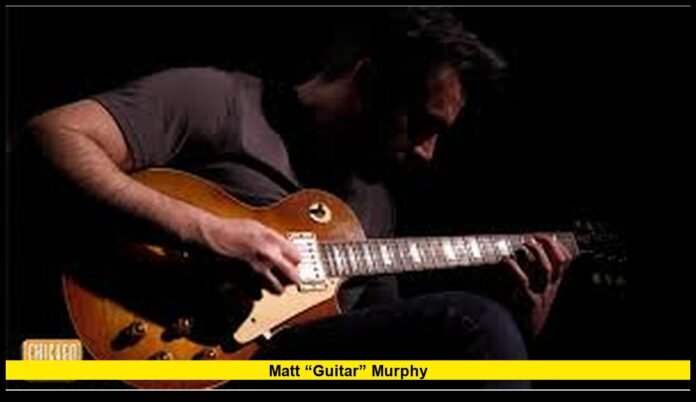

Few guitarists have left a mark on the blues as enduring as Matt “Guitar” Murphy. His name stands alongside the greats — Muddy Waters, Howlin’ Wolf, and B.B. King — yet his story remains uniquely his own. A brilliant blend of technique, soul, and showmanship made Murphy one of the defining voices of postwar blues and one of the most respected guitarists in American music.
Even in 2025, seven years after his passing, Murphy’s influence continues to ripple through the blues and rock communities. From new guitarists studying his solos online to established musicians honoring his work in live performances, his legacy remains a living part of American culture.
The Roots of a Blues Pioneer
Matt “Guitar” Murphy was born December 29, 1929, in Sunflower, Mississippi — the heartland of Delta blues. His family moved to Memphis, Tennessee, when he was a child, placing him in one of the most musically fertile environments in the country. Memphis in the 1930s and ’40s was buzzing with gospel, jazz, and the early sounds of rhythm and blues.
Murphy started playing guitar as a teenager, learning by ear from local musicians and radio broadcasts. He was deeply influenced by guitarists like T-Bone Walker, Charlie Christian, and Robert Lockwood Jr., but even early on, he developed a playing style that didn’t sound like anyone else. He had the speed and precision of a jazz player, the tone of a bluesman, and the rhythmic feel of a funk guitarist — all wrapped into one.
By his early twenties, Murphy’s reputation had already spread beyond Memphis. He was soon invited to join touring bands, setting the stage for a career that would span more than six decades.
The Breakthrough Years: Joining the Blues Elite
Murphy’s first big break came in the 1950s when he joined the band of Memphis Slim, one of the most celebrated pianists in blues history. Their collaboration produced some of the most defining recordings of the Chicago blues era, including The Comeback and Sittin’ and Cryin’ the Blues.
Playing with Slim taught Murphy how to balance technical skill with emotional storytelling. His guitar work complemented Slim’s vocals perfectly — subtle when needed, explosive when the moment called for it.
Over the next two decades, Murphy became one of the most sought-after guitarists in the business. He played alongside many of the blues greats who shaped modern music, including:
- Howlin’ Wolf
- Muddy Waters
- James Cotton
- Otis Rush
- Etta James
- Sonny Boy Williamson II
In the smoky clubs of Chicago, he developed a reputation as “the musician’s musician.” Younger guitarists would come just to watch his hands move across the fretboard — fast, clean, and effortless.
Signature Sound and Style
Matt “Guitar” Murphy’s playing style was a masterclass in balance. He had the precision of a jazz player but never lost the raw emotional weight that defines the blues. His solos carried a melodic clarity rare for the genre, marked by smooth phrasing, flawless timing, and a tone that seemed to sing.
Some of the key characteristics of his sound included:
- A crisp, articulate tone – Every note rang clear and purposeful.
- Jazz-inspired phrasing – His lines often contained unexpected chord voicings and chromatic runs.
- Tight rhythmic playing – Years of working with top-tier blues bands gave him an impeccable sense of groove.
- Dynamic control – He could shift from subtle background playing to a blazing solo within a few bars.
His versatility made him not just a sideman but an architect of the modern blues guitar vocabulary.
The Blues Brothers Era
In 1978, Matt “Guitar” Murphy reached global fame through an unexpected route — comedy television. That year, he joined The Blues Brothers Band, formed by Saturday Night Live comedians John Belushi and Dan Aykroyd.
While many saw the band as a novelty at first, the group was built around serious musicianship. Belushi and Aykroyd surrounded themselves with real professionals from the R&B world, and Murphy’s presence brought authenticity and firepower.
In the 1980 film The Blues Brothers, Murphy played himself, appearing alongside Aretha Franklin in the iconic diner scene. His role as Aretha’s guitarist and husband became one of the movie’s most memorable moments. His effortless soloing during Sweet Home Chicago and his natural stage charisma introduced him to millions of new fans.
Murphy later reprised his role in Blues Brothers 2000 (1998), performing again with the original band lineup. These appearances helped introduce classic blues to younger audiences, ensuring that Murphy’s name reached far beyond traditional blues circles.
Solo Career and Later Recordings
While Murphy was best known for his collaborations, he also built a powerful solo career. His debut album, Way Down South (1990), showcased his ability as both a guitarist and a bandleader. Unlike many session players, Murphy had a strong personal voice, blending blues, jazz, and funk with smooth, confident ease.
He followed it with The Blues Don’t Bother Me! in 1996 — a title that summed up his attitude toward music and life. The album’s title track became one of his most popular songs, later featured in Blues Brothers 2000.
Murphy’s final studio work, Lucky Charm (2000), showed an artist at peace with his legacy but still playing with the fire of his youth. Even in his seventies, his guitar work remained sharp and inventive.
During this period, he performed regularly at major U.S. festivals, including:
- The Chicago Blues Festival
- The Memphis in May Festival
- The King Biscuit Blues Festival
Audiences admired not only his skill but his humility. On stage, he often took time to praise other musicians, emphasizing that the blues was always bigger than any one performer.
Challenges and Comeback
In 2002, Murphy suffered a stroke that temporarily sidelined his performing career. For a guitarist whose hands had defined his identity, it was a devastating blow. Yet true to his resilient spirit, Murphy dedicated himself to recovery.
After years of rehabilitation, he made a remarkable return to the stage. By the mid-2000s, he was performing again, though less frequently. Fans celebrated his comeback as a symbol of perseverance — proof that passion can outlast even the hardest setbacks.
Murphy continued to make selective appearances until the final years of his life. His last public performances in the mid-2010s showed that, even in his eighties, his touch on the guitar remained as soulful and precise as ever.
Passing and Tributes
Matt “Guitar” Murphy passed away on June 15, 2018, at the age of 88. The blues world mourned deeply, with tributes pouring in from across the United States and beyond.
Musicians from Chicago, Memphis, and New Orleans gathered at tribute shows to celebrate his life. Performers such as Buddy Guy, Joe Bonamassa, and Keb’ Mo’ paid public respects, calling him a cornerstone of modern blues guitar.
Since his passing, Murphy’s legacy has only grown stronger. In 2021, he was posthumously inducted into the Blues Hall of Fame, an honor that formally recognized his lifetime contribution to the genre. His recordings have been remastered for streaming platforms, making his work accessible to new listeners worldwide.
Impact on Modern Guitarists
Murphy’s playing continues to serve as a model for blues guitarists. His blend of technical precision and deep emotional expression set a benchmark few can match. Today, his solos are studied by guitar students in classrooms and online tutorials across the country.
Modern artists often cite Murphy as an influence, including:
- Gary Clark Jr. – for his balance of blues tradition and modern sound.
- Joe Bonamassa – for his dynamic phrasing and tone.
- Susan Tedeschi – for her clean, expressive soloing style.
His impact extends beyond the blues world; rock and jazz players alike have borrowed from his phrasing and rhythm techniques.
Why His Legacy Still Matters
Matt “Guitar” Murphy’s story is more than a musician’s biography — it’s a reflection of American musical history. From the Mississippi Delta to Chicago’s blues clubs, from Hollywood films to world tours, his journey embodies the evolution of modern music itself.
He bridged cultural and generational gaps, connecting the raw emotion of early blues with the sophistication of jazz and the energy of rock and roll. His ability to adapt without losing authenticity made him a model of artistic integrity.
Today, in 2025, Murphy’s work continues to inspire festivals, tribute performances, and documentaries dedicated to preserving blues history. His name frequently appears in guitar forums and online discussions as one of the greatest players to ever pick up the instrument.
Matt “Guitar” Murphy remains an American icon — a musician whose every note carried heart, soul, and history. His sound reminds listeners that real music, like the blues itself, never fades away.