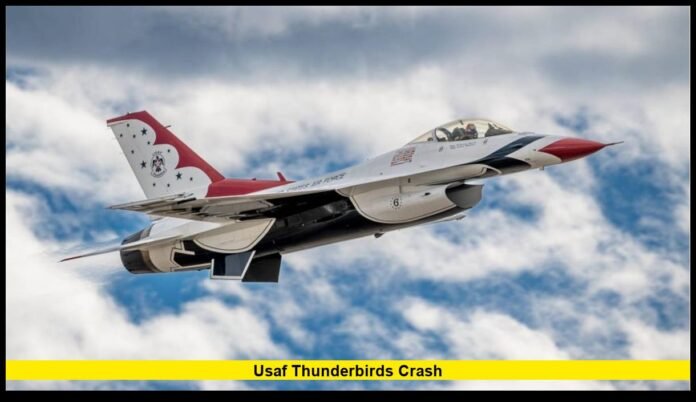

The USAF Thunderbirds crash that occurred on December 3, 2025, sent shockwaves through the aviation community and across the U.S. The incident involved an F-16C Fighting Falcon from the elite United States Air Force Thunderbirds, which went down in a remote desert region of Southern California. The pilot managed to eject safely, is receiving medical care, and is in stable condition.
Timeline of Events
- Time & Location: Around 10:45 a.m. local time, the fighter jet crashed over controlled airspace near Trona Airport in the Mojave Desert, roughly 180 miles north of Los Angeles.
- Mission Type: The jet was on a training mission — not a public demonstration or airshow flight.
- Impact Zone: The aircraft struck a dry lake bed south of the airport, in a sparsely populated region.
- Ejection & Rescue: The pilot ejected just before impact, parachuting to safety. Local fire and emergency responders — including crews from nearby facilities — rushed to the site, extinguished fires, and secured the crash area.
- Pilot Condition: Treated at a hospital for non–life-threatening injuries. Official statements confirm the pilot is stable and receiving follow-up care.
- Damage: The F-16C was destroyed on impact and is considered a total loss.
What Eyewitnesses and Media Reported
Sources at the crash site described a dramatic scene: a jet descending rapidly, followed by a parachute deploying, then a huge fireball and a plume of black smoke rising from the dry lake bed. Some witnesses heard a loud boom — consistent with a high-speed impact.
Photos and video clips circulated almost immediately, showing the final moments of the flight. The footage captures the jet in flames and the parachute carrying the pilot down to safety. Spectators in the area reported that the descent of the parachute and subsequent explosion happened within seconds.
Emergency responders stated clearly there was no danger to nearby towns; the crash occurred in remote terrain far from residential zones. Vegetation and local wildlife reportedly faced no immediate threat, though initial mitigation efforts focused on fire suppression and containment of potential fuel or debris hazards.
Who Are the Thunderbirds — and How Common Are Crashes?
The Thunderbirds are the U.S. Air Force’s official aerial demonstration squadron, formed in 1953 to showcase American air power and pilot skill. Their performances involve tight-formation flying, high-speed aerobatics, and split-second maneuvers in jet aircraft such as the F-16C Fighting Falcon.
These jets are fast, nimble, and powerful. In the hands of elite pilots, they demonstrate everything from formation loops to solo high-G passes. But such complex flying always carries inherent risk. The demands of training — particularly during the off-season when pilots rehearse maneuvers — remain intense.
Over decades, the Thunderbirds have experienced accidents, sometimes fatal. Working under high pressure, executing instantaneous decisions and G-forces, even seasoned pilots can face unexpected mechanical issues or environmental challenges. The December 3 crash underscores those risks once again.
Why This Crash Happened — What We Know (and Don’t Know Yet)
As of now, the cause of the crash remains officially under investigation. The 57th Wing Public Affairs Office has launched an inquiry. Key points:
- The training flight was cleared and occurred over restricted military airspace.
- No external interference or civilian aircraft were involved.
- There is no public evidence of weather-related problems at the time of the incident.
- Maintenance records and flight data — including communications, navigation, and aircraft systems logs — will undergo scrutiny.
- Given the remote crash site, environmental impact appears limited so far; responders confirm no immediate danger to vegetation, wildlife, or nearby communities.
It is too early to conclude if mechanical failure, pilot error, or other factors caused the crash. Until the safety board releases findings, all information remains factual and verified.
Impact on the Thunderbirds Team and Future Flights
With the loss of one F-16C, the Thunderbirds face a challenge. Their fleet includes a limited number of fighter jets — part display jets, part reserves, with some twin-seat variants used for training. Losing a display-ready aircraft reduces their operational flexibility.
However, the team often maintains spare aircraft and rotates jets through maintenance cycles. For now, future training sessions and any upcoming airshows may proceed with adjusted scheduling, assuming the investigation does not prompt a broader grounding or procedural suspension.
Pilots and squadron staff will likely review safety protocols, maintenance procedures, and ejection-seat readiness. Given the high-stakes nature of their work, this incident will almost certainly lead to a re-evaluation of training practices, risk mitigation, and pre-flight checks.
What It Means for Military Aviation and Public Perception
For military aviation observers and the general public, the crash is a stark reminder: even elite squadrons and professional pilots are not immune to danger.
- Training Risks Are Real: Demonstration teams like the Thunderbirds constantly operate at the edge of performance. Training flights — often unseen by the public — carry real hazards.
- Ejection Systems Work — Often Saving Lives: The pilot’s survival shows that modern ejection seats and emergency protocols can function under extreme conditions. But ejection is a violent and unpredictable process, and survival often comes with physical cost.
- Transparency Matters: Accurate, timely reporting of such incidents helps maintain trust. The public deserves clarity about safety, investigations, and what’s being done to prevent future tragedies.
- Resilience & Readiness: The Air Force must balance readiness with caution. Even after a crash, many missions continue — but with lessons learned. Aircraft maintenance, pilot training, and risk management may see renewed scrutiny.
Why the Location — Mojave Desert, Trona — Is Often Used for Training
The remote expanses south of Death Valley and around China Lake provide vast, restricted airspace. That makes them ideal for high-speed, high-G training flights that don’t endanger civilian populations.
Trona Airport sits within San Bernardino County, a sparsely populated area that has become a known corridor for military training sorties. The terrain — dry lake beds, open desert, minimal infrastructure — offers controlled conditions and low risk for ground damage if a jet goes down.
Because of these characteristics, agencies like the U.S. Air Force and Navy have frequently used the area for advanced training for decades. This crash marks yet another reminder of how far-reaching training operations extend beyond public airshow venues.
What Happens Next: The Investigation and Recovery Effort
The official investigation has several phases:
- Crash Site Assessment: Investigators will map the wreckage, collect debris, and document impact patterns. That includes examining the dry lake bed, scorch marks, and any hazardous material leaks.
- Flight Record & Maintenance Review: Every log from the aircraft’s maintenance history, last inspections, systems checks, and the mission’s flight data will be scrutinized.
- Ejection Seat & Pilot Health Review: Experts will evaluate how the ejection seat performed, when the pilot triggered it, and whether environmental factors — altitude, speed, G-forces — influenced the outcome. Medical evaluations will assess the pilot’s condition and recovery timeline.
- Operational Protocol Audit: The squadron may review rules for training flights, safety margins, alternate procedures, and risk controls. That could influence future scheduling or restrict certain maneuvers.
- Public & Environmental Safety Checks: Teams will ensure no hazardous fuel or parts remain in the desert. The site will be cleared and secured to prevent contamination or danger to wildlife.
Depending on findings, the Air Force may issue recommendations or changes to training operations. Transparency will be important — both for public confidence and for the safety of future missions.
Why This Matters for U.S. Air Force Morale and Public Trust
The Thunderbirds represent more than aerial spectacle. They are a symbol of precision, dedication, and the capabilities of U.S. airpower. Their performances support recruitment, patriotism, and community engagement. An incident like this can shake that image — but handled correctly, it can reaffirm trust in the system.
- The pilot’s safe ejection shows that safety systems and emergency procedures can work — even under worst-case scenarios.
- A transparent, thorough investigation underscores accountability.
- Public interest in such events shows that communities care about military operations and aviator safety.
- Learning from this crash can help prevent future accidents, protecting pilots, aircraft, and public safety.
For service members and citizens alike, this event is a reminder: excellence and danger often go hand in hand. But diligence, preparation, and respect for risk remain essential.
Reflecting on the Thunderbirds’ Legacy — And What This Moment Means
Since their inception in 1953, the Thunderbirds have flown for millions. Their close-formation loops, solo maneuvers, and precise choreography have thrilled audiences worldwide. Their jets — including the F-16C — became icons of speed, agility, and American air superiority.
But behind the spectacle lies rigorous training, discipline, and danger. Every mission — even training flights — carries risk. Every takeoff and landing demands flawless performance. For the pilots, the stakes remain high.
Today, one of those jets is gone. The pilot is alive. The investigation begins. The military aviation community watches closely. And the country remembers: what we see as performance is backed by real sacrifice, real danger, and real lives.
This incident will remain a sobering chapter in the Thunderbirds’ long history. It challenges assumptions, reminds us of risks, and underscores the value of constant vigilance.
If you’ve been following the USAF Thunderbirds crash or have questions about its implications, share your thoughts below — readers are watching closely.