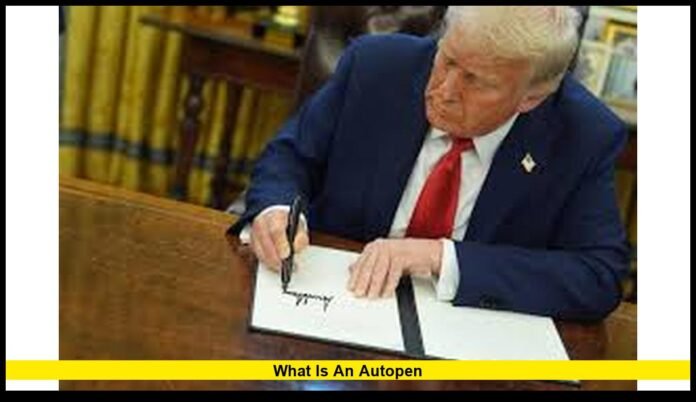

WHAT IS AN AUTOPEN has become a major topic of discussion in the United States as recent political debates have highlighted how this mechanical device is used in government settings. The machine has existed for decades, but renewed attention stems from ongoing questions about its role in signing official documents, particularly those associated with the executive branch. As of today, the public conversation continues to grow, making this the right moment to break down exactly what this device is, how it works, and why it matters in 2025.
What Exactly Is an Autopen?
An autopen is a specialized mechanical device that replicates a person’s handwritten signature using a pre-programmed template. Instead of printing or digitally overlaying an image of a signature, the autopen uses a real pen attached to a motorized arm. This arm follows a precise pattern of movements that match the original handwriting, allowing the device to physically draw the signature on paper with striking accuracy.
Because the pen itself makes contact with the page, each signature has genuine ink flow, natural pressure variation, and subtle imperfections—qualities that make it feel authentically handwritten to the touch. Modern autopens can produce hundreds or even thousands of signatures in a short time, maintaining consistency while still looking personal.
These devices are commonly used by public officials, authors, celebrities, corporate leaders, and institutions that need to sign large volumes of documents without sacrificing the appearance of authenticity. In settings where time is limited but a handwritten signature is required or expected, the autopen provides an efficient and reliable solution.
How the Autopen Works
An autopen functions through a carefully calibrated blend of mechanical precision and digital programming. The process begins with capturing the user’s authentic signature. In modern systems, this signature is converted into a detailed digital pattern that maps every curve, angle, and stroke. This stored pattern becomes the blueprint for the machine’s movements.
Once activated, the autopen uses an internal motor and a coordinated axis system to guide a mounted pen across the page. The pen doesn’t simply trace a rough outline—it follows the exact path and rhythm of the original handwriting, ensuring smooth lines, natural curves, and consistent spacing.
Most advanced autopens include several core components:
- Programmable signature memory module that stores one or multiple signature patterns
- A mounted writing instrument capable of using various pen types
- A motorized multi-axis system that controls the pen’s motion with high precision
- Adjustable pressure and speed settings designed to mimic natural variations in human handwriting
By applying real ink and maintaining lifelike pen pressure, the autopen produces signatures that appear genuinely handwritten, even when inspected closely or viewed under magnification. The result is a consistent, high-quality signature that retains the feel and texture of a manually signed document.
Why Public Figures Use Autopens
Public figures often face an overwhelming volume of documents requiring signatures each year—ranging from official letters and acknowledgments to certificates, commemorative items, and seasonal messages. Manually signing every piece would be impractical and time-consuming, especially for individuals who handle high public visibility and heavy administrative responsibilities. An autopen provides an efficient solution by producing a large number of real-ink signatures that maintain a personal touch without demanding hours of manual effort.
Some of the most common uses include:
- Signing large-scale correspondence sent to organizations, supporters, or constituents
- Issuing routine acknowledgments or ceremonial letters that require a handwritten signature
- Autographing memorabilia, photos, or giveaway items for fans or promotional events
- Handling administrative workloads in government offices, where consistent and timely documentation is essential
For routine or high-volume tasks that don’t require the individual’s direct, personal involvement, the autopen has long been seen as a practical, widely accepted tool. It allows public figures to meet public expectations efficiently while still providing documents that look and feel authentically signed.
Must Read-Trump autopen Declares End to Biden’s Autopen-Signed Orders
A Long History Behind a Modern Tool
Although the modern autopen is an advanced machine, its origins trace back more than 200 years. Early versions relied on linked pens and mechanical arms that reproduced handwriting in real time. Over the decades, improvements led to automated motors, recorded signatures, and digital storage.
By the mid-20th century, autopens had become common in government offices and in the private sector. Many U.S. presidents, as well as prominent leaders across industries, have used the device for routine tasks that would otherwise consume hours of daily handwriting.
Why Autopens Have Become a 2025 Political Issue
Although autopens have been used quietly within federal offices for decades, their role surged into national debate in 2025. Questions about the authenticity of signatures on executive orders, pardons, and high-level directives pushed the technology from a routine administrative tool into a political symbol. What had long operated behind the scenes suddenly became central to discussions about trust, presidential authority, and the limits of delegation.
The controversy intensified after recent actions and statements from former President Donald Trump. He publicly questioned whether certain documents from the previous administration were valid if they were signed using an autopen, arguing that major decisions should require a physically handwritten signature from the president. He went further by announcing plans to review, challenge, or reverse actions he claimed were signed mechanically rather than personally. These moves transformed a once-technical issue into a national discussion point, prompting lawmakers, legal experts, and the public to debate the boundaries of executive approval.
The renewed attention centers on several core themes:
Transparency: Many Americans want clarity about whether the president or a senior official personally signed important documents. When a mechanical device is used, critics argue it blurs the line between genuine personal review and delegated routine work.
Accountability: Critics claim that relying on an autopen for major decisions creates uncertainty about who actually approved the document. They argue that a mechanically applied signature may weaken the sense of ownership or involvement the signer is expected to have.
Volume of Use: Questions have emerged about how frequently autopens were used in recent years. What was once reserved for ceremonial or low-priority tasks is now suspected of being applied more widely, including to documents of significant political consequence.
Legal Status: While autopen signatures are legally valid when authorized, debate continues over what counts as proper authorization. The line between acceptable administrative convenience and potential overuse remains a central point of dispute.
Together, these concerns have elevated the autopen from an obscure office tool to a focal point in national discussions about government transparency and executive responsibility. The issue now represents more than a mechanical device; it reflects broader questions about public trust, leadership, and how presidential power should be exercised in an era where speed, technology, and political scrutiny all collide.
Are Autopen Signatures Legally Valid?
A central question in the ongoing debate is whether a document signed with an autopen carries the same legal weight as one signed by hand. In most situations, the answer is yes—provided the signature is applied with the explicit authorization of the individual whose name appears on the document.
The core legal principle is straightforward: a signature is valid if the person intends to sign the document, regardless of the method used to place the signature. Courts and government agencies have long recognized that the act of authorizing a signature is what gives it legal force, not the physical motion of the signer’s hand. Under this standard, an autopen serves as a tool to execute that intent.
This approach has been applied in various sectors, including federal government operations, business transactions, and routine administrative processes. The device itself is not the issue—what matters is whether the individual knowingly approved its use for that specific document or category of documents.
In practice, autopen-signed items can carry full legal authority as long as:
- The signer gave clear authorization
- The signature represents genuine intent to approve the document
- The process complies with any applicable laws or internal policies
Because of these principles, autopen signatures are broadly recognized as legitimate in both public and private contexts. The legal debate that fuels modern controversy is therefore less about validity and more about transparency, oversight, and how often the technology should be used in high-level decision-making.
Why Some People Object to Autopen Use
Even with long-standing legal precedent supporting autopen signatures, the device continues to draw criticism from various groups—ranging from political observers to historians and members of the general public. Their concerns are rooted not just in legality, but in symbolism, precedent, and the desire for transparency in matters of public record. Below is a deeper look at the most common objections.
- Questions About Authenticity
For collectors, historians, archivists, and researchers, authenticity is more than a technical detail—it is a core value. Many institutions rely on verifiable documentation that a signature was personally written by the individual whose name appears on the page. An autopen-produced signature, even though created with real ink, lacks the unique variations, hesitations, and subtle pressure changes found in genuine handwriting. As a result, these signatures hold less historical, financial, and archival value.
The issue becomes even more significant when the document carries cultural or political importance. A letter signed by hand might serve as a piece of history; an autopen-signed version, although still official, may be treated merely as an administrative copy. This distinction has led to long-standing caution among those who handle important historical records. - Perception of Detachment
Beyond technical authenticity, critics also argue that the use of an autopen can create a symbolic distance between the official and the action being taken. High-impact decisions such as executive orders, pardons, or national security directives require a level of seriousness and direct involvement that the public expects from leaders.
When a machine applies the signature instead of the individual, some interpret it as a lack of personal engagement or a shortcut that undermines the gravitas of the decision. Opponents emphasize that leadership involves not just authorizing actions but visibly taking ownership of them. To these critics, the autopen blurs that line. - Lack of Transparency
Transparency plays a major role in public trust. When citizens do not know whether a signature was personally written or produced mechanically, it leaves room for speculation about how involved the official actually was. Autopen use is often not disclosed unless questioned, fueling concerns that important processes may be conducted behind closed doors.
This lack of clarity can shape political narratives—especially in polarized environments. Some people worry that failure to disclose autopen use could be leveraged to obscure the signer’s role or to shift responsibility. Even when the signature is legally authorized, the ambiguity can erode confidence in the process. - Potential for Misuse
Although there are rules governing when and how autopens can be used, critics fear scenarios where those boundaries aren’t strictly followed. In theory, a device capable of producing perfect signatures could be misused to sign documents without proper authorization or oversight.
While such misuse would be both unethical and illegal, the possibility underscores the need for checks and safeguards. Some argue that without rigorous documentation—such as logging who activated the autopen, when it was used, and for what purpose—the system could be vulnerable to mistakes or intentional abuse.
These concerns contribute to calls for tighter regulation, clearer policies, or even mandated disclosures whenever an autopen is used for official documents.
Together, these objections illustrate why the autopen, despite being a long-standing administrative tool, continues to spark debate. The controversy is less about the machine itself and more about what its use represents: questions about personal involvement, government transparency, and public trust. In high-level contexts—especially in politics—symbolism can carry as much weight as procedure.
These concerns drive the ongoing national discussion and explain why the tool has become a headline-making topic.
What Is an Autopen’s Place Today?
The heightened attention surrounding autopens in 2025 underscores a broader tension between tradition, efficiency, and public trust. The device itself is neutral—neither inherently problematic nor inherently controversial. What determines its impact is the setting in which it is used and the expectations attached to that moment.
In day-to-day operations, autopens continue to serve as a practical solution for routine communications. Government offices, corporate leaders, authors, and public figures rely on them to handle the overwhelming volume of letters, acknowledgments, and ceremonial messages that would be impossible to sign manually. In these contexts, the autopen is seen as a straightforward administrative tool that maintains consistency without compromising workflow.
However, when it comes to high-stakes political or legal actions, the conversation shifts dramatically. Executive orders, pardons, security directives, and major policy documents carry intense symbolic weight. People expect these decisions to be reviewed, approved, and signed personally, not delegated to a machine—even if the authorization is legitimate. This is where transparency becomes essential. If autopens are used without clear disclosure, it can fuel doubts about how engaged the official truly was in the decision and whether the process reflects the seriousness the action requires.
As technology continues to blend with governance, the autopen sits at a crossroads between historical expectations and modern realities. Its place today is defined by trust: transparency about when it is used, clarity about why it is chosen, and confidence that the signature represents genuine approval. In an era of heightened scrutiny and rapid communication, striking that balance is more important than ever.
Conclusion
The autopen is a simple mechanical tool that has taken on outsized importance in recent political debate. Its ability to replicate handwritten signatures has made it indispensable in many settings, yet its use in high-level government actions continues to spark scrutiny. As the discussion evolves, Americans are paying closer attention than ever to how signatures are applied, who authorizes them, and what they signify in matters of public leadership.
FAQs
1. What exactly is an autopen?
An autopen is a mechanical device that reproduces a person’s signature using a stored template. Instead of printing an image, it uses a real pen mounted on a motorized arm to physically draw the signature on paper, creating a real-ink result that looks handwritten.
2. Are autopen signatures legally valid?
Yes. A signature made with an autopen is generally considered valid as long as the individual authorized its use. The determining factor is intent: if the signer directed the signature to be applied, the method used to place it—handwritten or mechanical—does not affect its legal status.
3. Why do public figures use autopens?
High-profile individuals often need to sign thousands of documents each year. Autopens help manage this volume by producing consistent, authentic-looking signatures quickly. They are commonly used for correspondence, acknowledgments, certificates, and ceremonial items.
4. Why has the autopen become controversial in 2025?
The device has attracted attention due to concerns about the authenticity of signatures on important political documents. Questions about transparency, accountability, and the volume of autopen use have sparked debate about whether it should be used for high-level actions like executive orders.
5. Do autopen signatures look different from handwritten ones?
To most people, no. Because the pen physically touches the paper, the signature has real ink flow, pressure variation, and tactile characteristics. However, experts or collectors familiar with autopen patterns can sometimes identify repeated, identical signatures.
6. Can an autopen be misused?
In theory, yes—if proper safeguards aren’t in place. Misuse could involve applying a signature without authorization. That is why strict controls, logging procedures, and oversight mechanisms are essential, especially in government settings.
7. Are autopen signatures acceptable for historical documents?
While they may be legally valid, autopen signatures often carry less historical or collectible value. Archivists and collectors typically distinguish between personally signed items and signatures produced by mechanical devices.
8. Do presidents regularly use autopens?
Presidents and senior officials have used autopens for decades, primarily for routine or ceremonial correspondence. Their use for high-impact legal documents is less common and usually draws significant public attention when it occurs.
9. How do experts detect autopen signatures?
Experts look for extremely consistent, identical signatures—something nearly impossible to replicate by hand. They may also examine stroke entry points, pressure uniformity, and repeating patterns that match known autopen templates.
10. Will autopens become more common in the future?
As workloads increase and digital tools grow more sophisticated, autopens are likely to remain part of government and corporate operations. Their acceptance will depend largely on transparent policies and clear distinctions between routine use and high-level decision-making.
Share your thoughts below and let us know how you feel about the growing debate over signature-replicating machines.