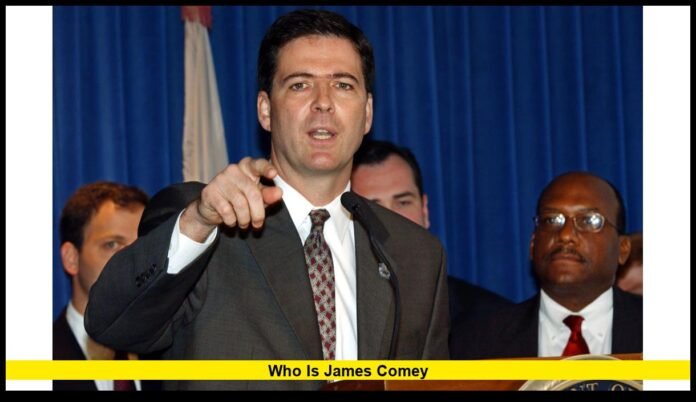

The name James Comey continues to resonate across the United States, years after his tenure at the FBI came to an abrupt and historic end. For some, he symbolizes integrity and independence. For others, his decisions during one of the most turbulent political periods in modern history remain deeply divisive.
As of 2025, Comey stands as one of the most talked-about figures in American law and politics — a man whose actions reshaped the relationship between the presidency, the FBI, and the public’s trust in federal institutions. His journey from a New York prosecutor to the nation’s top law enforcement officer tells a story of ambition, principle, and controversy that changed the course of U.S. history.
Early Life and Education
Born on December 14, 1960, in Yonkers, New York, James Brien Comey Jr. grew up in Allendale, New Jersey, where his family instilled in him a strong sense of civic duty. His father worked in the real estate business, and his mother was a homemaker.
Comey graduated from Northern Highlands Regional High School before attending the College of William & Mary, where he studied chemistry and religion. His fascination with ethics and human behavior, paired with a love for analytical thinking, led him to pursue law.
He earned his Juris Doctor degree from the University of Chicago Law School in 1985, one of the most respected institutions in the country. While there, he served on the law review and began forming the legal philosophy that would define his career — that truth and justice must always outweigh politics.
A Rising Legal Mind in New York
After law school, Comey clerked for a federal judge before joining the U.S. Attorney’s Office for the Southern District of New York. Known for its demanding cases and high standards, the office became the perfect training ground for his career in public service.
Comey quickly earned recognition for his handling of complex criminal cases, including organized crime, terrorism, and major corporate fraud. His sharp intellect, calm demeanor, and unwavering dedication caught the attention of senior officials in Washington.
By 2003, his career reached a new level when he was appointed Deputy Attorney General under President George W. Bush. It was here that Comey’s reputation for integrity and independence became firmly established.
Standing Up for the Rule of Law
One of Comey’s defining moments came in 2004, during a dramatic confrontation within the Bush administration. At the time, the Justice Department was reviewing a controversial domestic surveillance program. When Comey — then serving as Acting Attorney General while his boss was hospitalized — determined that parts of the program were unlawful, he refused to approve it.
White House officials attempted to pressure the ailing Attorney General, John Ashcroft, to sign off on the program. Comey raced to Ashcroft’s hospital room to stop the move, backed by other Justice Department leaders.
That episode became a symbol of his willingness to stand up for legal principles over political convenience. It earned him bipartisan respect and marked him as a man who would not bend under pressure — a quality that later made him both respected and controversial.
The Path to FBI Director
In 2013, President Barack Obama nominated Comey to serve as the 7th Director of the Federal Bureau of Investigation, replacing Robert Mueller. The Senate confirmed him by a wide margin, a sign of the confidence both parties had in his leadership.
As director, Comey was responsible for guiding the FBI through an era of rapid technological change and evolving national security threats. He focused heavily on cybersecurity, terrorism prevention, and modernizing the bureau’s operations.
However, his tenure would soon be defined not by his management style but by his handling of one of the most politically charged investigations in modern American history.
The Email Controversy That Defined an Election
In 2015, the FBI began investigating Hillary Clinton’s use of a private email server during her time as Secretary of State. The investigation would thrust Comey into the national spotlight.
In July 2016, he made an unprecedented public statement: while the FBI would not recommend criminal charges, Clinton’s conduct was “extremely careless.” The decision to make such a statement publicly — breaking from FBI tradition — drew sharp criticism from Democrats and some within the Justice Department.
Then, just 11 days before the presidential election, Comey notified Congress that the FBI had discovered new emails that might be relevant to the case. The announcement sent shockwaves through the political world. Clinton’s campaign said the timing unfairly influenced voters, while her opponents praised the move as a sign of transparency.
The FBI later confirmed that no new evidence warranted charges, but the damage had been done. Many political analysts believe the announcement may have influenced the outcome of the 2016 election.
Comey later explained that he faced an impossible choice: stay silent and risk misleading the public or speak up and risk controversy. He chose transparency, a decision that remains one of the most debated actions in U.S. law enforcement history.
Clashes with the Trump Administration
When Donald Trump took office in January 2017, Comey continued as FBI Director. But within months, tensions between them escalated.
The FBI was actively investigating Russian interference in the 2016 election and possible connections to the Trump campaign. The president reportedly asked Comey to pledge loyalty — something Comey declined, saying he could only promise honesty.
Their uneasy relationship worsened after Trump privately asked him to “let go” of the investigation into former National Security Adviser Michael Flynn. Comey documented these encounters in detailed memos, anticipating they might later be scrutinized.
On May 9, 2017, Trump abruptly fired Comey while he was visiting the FBI’s Los Angeles field office. The White House initially claimed the dismissal was related to his handling of the Clinton case, but Trump later acknowledged that “the Russia thing” had influenced his decision.
The firing sparked outrage in Washington and led to the appointment of Robert Mueller as Special Counsel to oversee the Russia investigation — a move that defined much of the Trump presidency.
After the Bureau: A New Chapter
After his firing, Comey stepped away from government but not from public life. He became an author, speaker, and educator, using his platform to advocate for ethics in leadership.
In 2018, he published “A Higher Loyalty: Truth, Lies, and Leadership,” a memoir that explored his time in government and his views on integrity. The book topped bestseller lists and was later adapted into a television miniseries.
Comey has since taught at multiple universities, including Howard University and Columbia Law School, focusing on justice, ethics, and leadership. He frequently participates in public discussions about democracy, emphasizing the need for strong institutions free from political interference.
Despite polarizing opinions about his past, Comey remains a respected voice on government integrity and accountability.
Where He Stands Today
As of 2025, Comey continues to speak on issues of democracy and justice but has avoided re-entering politics. He lives a quieter life with his family while remaining active in academia and public discourse.
In interviews, he has reflected on his choices during his time at the FBI, acknowledging their lasting impact on the nation. While he defends his decisions as necessary and guided by duty, he has also admitted that he underestimated the political fallout that would follow.
Even years after leaving office, Comey’s name continues to spark debate — a sign of how deeply intertwined his story is with America’s recent political history.
Legacy and Influence
James Comey’s legacy is one of complexity. He is admired by many for his courage to act independently, even when faced with immense political pressure. Yet critics argue that his decisions during the 2016 election blurred the line between law enforcement and politics.
What cannot be denied is the influence he left behind. His firing by a sitting president became a defining moment in the conversation about the limits of executive power and the importance of institutional independence.
For future FBI leaders and public officials, Comey’s story stands as both a lesson and a warning — about how one’s principles can shape history and how decisions made in moments of uncertainty can ripple through generations.
James Comey’s journey from courtroom prosecutor to one of the most controversial figures in Washington reflects the constant tension between power and principle in American life. What do you think his legacy represents — integrity, controversy, or both? Share your thoughts in the comments below and be part of the conversation.