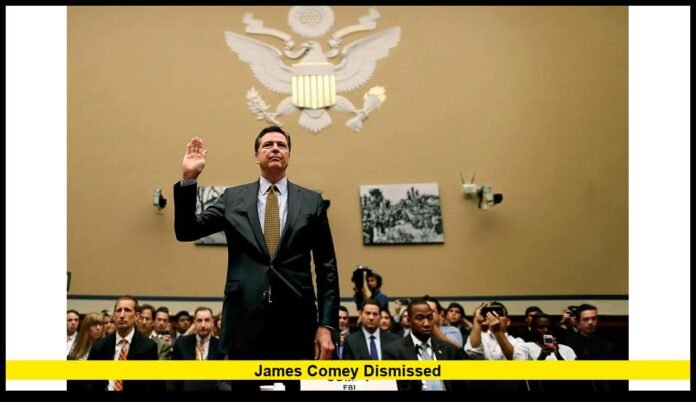

The decision that saw James Comey dismissed from his post as FBI Director in May 2017 remains one of the most talked-about moments in modern U.S. political history. It wasn’t just another personnel change — it was a political earthquake.
Comey’s sudden removal by then-President Donald Trump sent shockwaves through Washington, raising questions about presidential power, justice, and the independence of the FBI. Eight years later, its impact is still being felt across government and public debate.
Who James Comey Was Before the Controversy
James Brien Comey Jr. built a career defined by law, justice, and a fierce sense of independence. A native of Yonkers, New York, he began his professional journey as a federal prosecutor, working on major organized crime and corporate fraud cases.
His rise through the ranks was steady and impressive. By 2003, he was serving as U.S. Deputy Attorney General under President George W. Bush. During that time, Comey famously stood against a controversial surveillance program he believed overstepped the law — a decision that earned him bipartisan respect and public trust.
In 2013, President Barack Obama appointed him as the 7th Director of the Federal Bureau of Investigation (FBI). The Senate confirmed him with a near-unanimous vote, signaling confidence in his integrity and independence.
Comey’s 10-year term was meant to ensure the FBI would remain politically neutral. But within just a few years, his commitment to that principle placed him in the middle of one of the most divisive political storms in U.S. history.
The Email Investigation That Changed Everything
In 2015, the FBI opened an investigation into Hillary Clinton’s use of a private email server while serving as Secretary of State. The case quickly became a flashpoint in the 2016 presidential campaign.
Comey’s handling of the case would prove to be the first of many controversies. In July 2016, he held a press conference — an unusual move for an FBI Director — announcing that while Clinton’s conduct was “extremely careless,” the bureau would not recommend criminal charges.
Then, just 11 days before Election Day, Comey informed Congress that the FBI had reopened the investigation after finding new emails. The timing was explosive. Democrats accused him of damaging Clinton’s campaign, while Republicans said he was right to keep the public informed.
In the end, Clinton lost the election to Donald Trump — and Comey found himself at the center of partisan outrage from both sides.
A Rocky Start Under the New Administration
When Trump took office in January 2017, Comey continued as FBI Director. Initially, the two appeared to have a cordial relationship, but that didn’t last long.
The FBI was already investigating Russian interference in the 2016 election and possible links to the Trump campaign. Comey’s refusal to publicly declare that Trump was not personally under investigation reportedly frustrated the president.
Their relationship worsened further after a private dinner at the White House, where Trump allegedly asked Comey for “loyalty.” Comey responded that he could only offer “honesty.” He later documented the meeting in detailed notes — memos that would later play a key role in congressional hearings.
Behind the scenes, the tension between the White House and the FBI was escalating rapidly.
The Firing Heard Around the World
On May 9, 2017, James Comey was in Los Angeles speaking to FBI employees when he saw news reports announcing that he had been fired. At first, he thought it was a prank — until official confirmation arrived moments later.
The White House released a statement saying the president had dismissed Comey on the recommendation of Attorney General Jeff Sessions and Deputy Attorney General Rod Rosenstein. The administration argued that the firing was due to Comey’s handling of the Clinton email case.
But the narrative changed just days later. In a televised interview, Trump said he was thinking about “this Russia thing” when he decided to remove Comey. That admission turned an already controversial decision into a full-blown political crisis.
The firing raised suspicions that the president was trying to interfere with the FBI’s investigation. Members of Congress — from both parties — demanded an independent inquiry into the matter.
The Political Fallout and Mueller’s Appointment
The fallout from Comey’s firing was immediate and explosive.
Just a week later, the Justice Department appointed Robert Mueller, a former FBI Director, as Special Counsel to continue the Russia investigation. Mueller’s appointment was meant to ensure that the investigation could proceed without political interference.
Comey himself was called to testify before the Senate Intelligence Committee in June 2017. His testimony was televised live, drawing millions of viewers nationwide.
In his appearance, Comey described multiple interactions with Trump, detailing efforts to gain loyalty and to “let go” of the investigation into Michael Flynn, the president’s former National Security Adviser.
The testimony painted a picture of growing pressure on the FBI and helped set the stage for Mueller’s two-year investigation into Russian election interference and obstruction of justice.
How the Bureau Changed After the Firing
Comey’s dismissal didn’t just affect him personally — it fundamentally reshaped the FBI and its role in American democracy.
Institutional Independence:
The event reignited a national conversation about how much control a president should have over independent agencies like the FBI. Many lawmakers called for reforms to limit political influence and protect future directors from sudden removal.
Public Trust:
The incident deepened the political divide in public perception of the FBI. Many Democrats saw Comey as a symbol of integrity standing up to political pressure, while some Republicans accused him of bias.
Precedent and Oversight:
The firing served as a turning point for how Congress approached executive oversight. It led to new demands for accountability and transparency from federal agencies.
Mueller’s investigation eventually concluded in 2019, documenting Russian interference and outlining multiple instances where Trump may have attempted to obstruct justice. While Mueller did not recommend criminal charges, his report reshaped discussions about ethics and presidential power.
Life After the Bureau
After his departure, Comey transitioned into public speaking, teaching, and writing.
His 2018 memoir, “A Higher Loyalty: Truth, Lies, and Leadership,” became a national bestseller and offered a firsthand account of his time at the FBI. The book explored the challenges of leadership in a politically charged environment and the personal values that guided his decisions.
The memoir was later adapted into a miniseries, further fueling public interest in his story.
In the years since, Comey has stayed active in discussions about justice and government ethics. He has taught at universities, spoken at legal forums, and remained vocal about the need for nonpartisan law enforcement.
While he no longer holds public office, Comey’s voice continues to carry weight in national conversations about democracy and accountability.
Why the Firing Still Matters Today
More than eight years after his dismissal, the ripple effects of the event are still visible.
It changed how both political parties view the FBI. It deepened debates about presidential limits and reinforced the importance of independent institutions. And it left behind a blueprint for how future leaders — in both the executive branch and federal law enforcement — should navigate political tension.
Historians and legal scholars often point to Comey’s removal as a pivotal moment that tested America’s constitutional balance of power. It also served as a reminder of how quickly the line between justice and politics can blur.
Comey himself has said the experience reaffirmed his belief in the value of truth and transparency, even when those principles come at a personal cost.
The firing of James Comey was more than a headline — it was a turning point for the FBI and for America’s understanding of power, law, and leadership. What do you think this event revealed about the balance between politics and justice? Share your thoughts in the comments and join the discussion below.