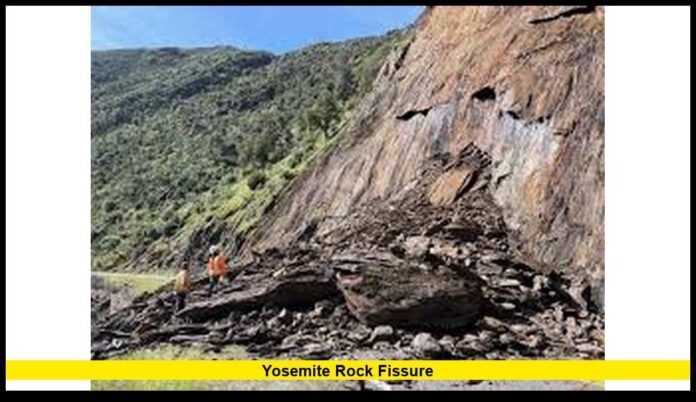

The Yosemite rock fissure that was first identified near Royal Arches continues to be a key focus for scientists and park authorities in 2025. Two years after the large crack was first discovered, it remains an active area of study, drawing both concern and fascination from climbers, geologists, and national park visitors.
As monitoring continues, Yosemite National Park officials have kept several climbing routes closed out of caution. Advanced technology now tracks every movement in the granite, providing real-time data on one of the most closely watched geological features in the park’s history.
Initial Discovery and Immediate Response
The fissure was first detected in August 2023, when climbers in Yosemite Valley reported hearing popping and cracking sounds while scaling the Royal Arches wall. Upon closer inspection, they noticed a clear separation running across the granite. Park geologists confirmed the presence of a long, visible crack that extended across several feet of solid rock, creating a potential instability in the formation.
The affected area lies near the Royal Arches route, close to the North Dome Gully, a popular exit for climbers descending from North Dome. Once the fissure was verified, Yosemite National Park immediately closed the surrounding climbing routes and nearby access trails.
The closures included some of the most famous climbs in the valley — Royal Arches Route, Serenity Crack, and North Dome Gully. The quick decision to close the area was based on the concern that even a small shift in the granite could cause a significant rockfall.
Current Status in 2025
As of November 2025, the crack remains under strict observation. The National Park Service has not reopened the closed routes due to continued signs of micro-movement within the rock structure.
Over the past two years, engineers and geologists have installed high-resolution laser scanners, strain gauges, and motion sensors to track any changes in the fissure. These tools measure subtle shifts, sometimes just millimeters wide, to determine whether the crack is widening or deepening.
So far, readings indicate that the fissure moves slightly with seasonal temperature changes — expanding in hot conditions and contracting in colder weather. These minor fluctuations are typical of granite formations exposed to the elements, but the data confirms that the area remains unstable enough to warrant continued closure.
Park officials have stated that the safety of climbers and hikers remains the top priority. While no significant movement has occurred recently, the potential for a large rockfall cannot be ruled out.
Understanding How the Crack Formed
Yosemite’s granite cliffs are world-renowned for their size, strength, and beauty — but they are also dynamic, constantly shaped by natural forces. The formation of cracks and fissures is a normal part of the park’s geological evolution.
Experts point to several main factors that likely contributed to the Royal Arches fissure:
- Temperature extremes: Yosemite experiences large day-night temperature swings. As rock heats and cools, it expands and contracts, which can eventually cause fractures.
- Water infiltration: Rainwater and snowmelt can seep into small cracks. When this water freezes, it expands, exerting pressure that widens the gap — a process called “freeze-thaw weathering.”
- Gravity and erosion: The immense weight of the granite walls puts stress on their lower sections, which can lead to slow separation over time.
- Seismic activity: Although not frequent, minor earthquakes in the Sierra Nevada can add to the stress on existing fractures.
Yosemite’s cliffs — from El Capitan to Half Dome — have always been in motion, slowly reshaping under natural conditions. The current fissure is simply one of the most visible examples of this ongoing geological process.
Why the Location Matters
The Royal Arches area sits below North Dome, one of Yosemite Valley’s most photographed features. The wall’s height, exposure, and smooth granite surface make it a favorite among climbers, but also a hotspot for rockfall.
Historically, the region has seen numerous small rockfalls, particularly during the spring and fall when temperature changes are most dramatic. What makes the 2023 fissure significant is not just its size, but its position along a popular route.
Officials determined that if the slab were to detach, debris could travel into areas where climbers and hikers frequently pass. That risk was enough for park management to enforce a strict closure — a decision that remains in place today.
Comparing Past Rockfall Events
Yosemite has experienced several notable rockfall incidents over the years, offering important context for the current situation.
- 2017 – El Capitan: A rockfall on the southeast face killed one climber and injured another, dislodging thousands of tons of granite.
- 2014 – Ahwahnee Meadow: Falling rocks damaged park facilities and led to temporary closures near Curry Village.
- 2009 – Curry Village: Multiple rockfalls prompted the permanent closure and removal of several cabins beneath unstable cliffs.
These events underscore the unpredictable nature of Yosemite’s cliffs. Even small cracks can precede major collapses, making early detection and monitoring critical.
The Royal Arches fissure, while stable for now, is being treated with the same level of caution to prevent another such incident.
Advanced Monitoring Efforts
Yosemite National Park, in collaboration with the U.S. Geological Survey (USGS) and several research universities, has deployed cutting-edge technology to study the fissure.
The monitoring program includes:
- 3D laser scanning (LiDAR): Provides detailed surface mapping to detect even millimeter-scale changes.
- Acoustic sensors: Record cracking sounds or vibrations within the granite.
- GPS and tiltmeters: Track shifts in the rock’s orientation and movement over time.
- Thermal cameras: Measure temperature variations that might affect expansion and contraction.
These combined systems transmit data in real time to geologists, who review the readings daily. This continuous surveillance has made Yosemite one of the most advanced natural laboratories for studying rock movement in the world.
Researchers hope the data collected here will improve rockfall prediction methods, not just in Yosemite but in other national parks with similar landscapes, such as Zion, Grand Canyon, and Kings Canyon.
Impact on Visitors and Climbers
For climbers, the closure of Royal Arches and surrounding routes has been disappointing. The area was home to some of Yosemite’s most accessible and classic climbs.
However, park officials and climbing organizations have worked together to ensure visitors still have plenty of options. Other climbing routes across the park — including areas on El Capitan, Cathedral Peak, and Glacier Point — remain open and fully accessible.
To help visitors navigate the closures, the park provides updated maps and advisories at entrance stations and online. Signs and ropes clearly mark restricted areas in the valley.
Hikers are also reminded to stay alert when traveling beneath cliffs, especially during early spring when thawing ice can loosen rock fragments.
Scientific Insights from the Study
The ongoing monitoring of the fissure has provided scientists with a rare opportunity to observe how granite behaves under stress. Early findings show that Yosemite’s rock formations are far more dynamic than previously believed.
Researchers have learned that:
- Even small temperature changes can produce measurable expansion and contraction in granite.
- Moisture from heavy winters increases the likelihood of new cracks forming.
- Subtle vibrations from human activity, such as climbing or nearby traffic, can influence rock behavior near fracture lines.
This knowledge is being used to refine models that predict when and where future rockfalls may occur. The data could eventually lead to early-warning systems in high-risk areas — a major breakthrough for park safety worldwide.
Climate Factors and Long-Term Implications
Climate variation has also played a role in the region’s changing rock stability. Recent winters have brought heavier snowfall followed by hotter, drier summers. These conditions create stronger freeze-thaw cycles, which speed up the weathering of exposed granite.
Experts believe that as temperatures continue to fluctuate, Yosemite could see more frequent rock movements in the decades ahead. This doesn’t mean the park is unsafe — rather, it reflects its natural evolution. Yosemite’s cliffs are living geological structures, always shifting and reshaping over time.
Park officials are working to adapt to these changes by expanding monitoring systems and keeping the public informed about safety conditions year-round.
What Visitors Should Know in 2025
Anyone planning a visit to Yosemite this season should check for updated closures before arrival. The National Park Service regularly posts information about restricted areas at trailheads and on official channels.Yosemite Rock Fissure
Visitors are advised to:
- Avoid traveling under exposed cliffs when temperatures shift rapidly.
- Respect posted signs and barriers in closed areas.
- Report any unusual rock noises, new cracks, or falling debris to park staff.
- Stay aware of surroundings during spring thaw and after heavy rainstorms.
Despite the ongoing monitoring near Royal Arches, most of Yosemite’s attractions remain open. Visitors can safely enjoy Half Dome, Yosemite Falls, and the park’s vast hiking network without disruption. Yosemite Rock Fissure
Looking Ahead
The Yosemite rock fissure continues to evolve slowly but steadily. While no major changes have occurred in recent months, experts plan to keep the area under observation for at least another year.
Future decisions about reopening the closed routes will depend entirely on geological data confirming long-term stability. Until then, scientists will continue using the fissure as a case study to improve understanding of how mountain landscapes change over time.
For visitors and researchers alike, the event serves as a reminder that Yosemite is both a natural wonder and a living, shifting environment. Yosemite Rock Fissure
Yosemite’s landscape is always transforming — and the ongoing story of this fissure proves that even the hardest rock tells a story of time and change. Have you visited the park recently? Share your thoughts or experiences in the comments below.