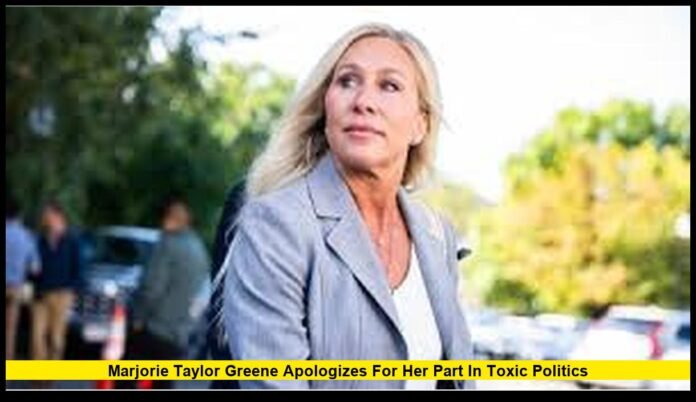

Rep. Marjorie Taylor Greene of Georgia has delivered a rare public apology when she admitted her responsibility in toxic politics during a Sunday television interview. The moment emerged amid a high-profile rupture with former President Donald Trump, escalating threats against her, and the fallout from her push for greater government transparency. Her remarks signal a turning point that’s resonating across Washington.
A watershed moment in tone and timing
On the day of the interview, Greene confronted a years-long persona built on firebrand rhetoric. With a direct tie to what she called dangerous political discourse, she said:
“I would like to say humbly, I’m sorry for taking part in the toxic politics. It’s very bad for our country.”
She emphasized she has “been working on this a lot lately … to put down the knives in politics,” and affirmed a desire to see “people be kind to one another.” In doing so, she pointed to rising threats she says have targeted her — including private security firms contacting her — after being labeled a “traitor” by Trump during their public conflict.
What led to the apology
Greene’s comments don’t arise out of thin air. Several dynamics converged:
- A public break with Trump: Once a staunch ally of Trump’s “Make America Great Again” movement, Greene found herself at odds over key issues. Her advocacy for releasing extensive files tied to convicted sex trafficker Jeffrey Epstein alarmed Trump’s allies and prompted a harsh response, including Trump revoking endorsement and launching name-calling attacks.
- Safety concerns and rhetoric backlash: Greene disclosed that she received warnings from private security firms after her name and image became central in firestorms of rhetoric. She tied her change of heart to what she described as “words used that can radicalize people … and put my life in danger.”
- Personal reflection amid chaos: Greene cited the assassination of conservative commentator Charlie Kirk as a wake-up call about the potential real-world consequences of political violence and inflammatory speech. That moment prompted her to evaluate her own role in contributing to content and tone.
- Calculated positioning: While the apology carries emotional weight, it also aligns with a broader political recalibration. With her relationship with Trump and key GOP leaders frayed, Greene may be looking to reposition herself — both rhetorically and electorally.
Detailed breakdown of the apology
During the nationally televised interview, the key elements of her apology included:
- Taking personal accountability: Greene explicitly said she accepted responsibility for her words and actions.
- Framing the problem as national: She described “toxic politics” not just as a personal misstep but as harmful to the country’s fabric.
- Offering behavior change: She pledged to model a less combative public style.
- Linking to safety: Greene connected her apology to concerns for her own security, underscoring how volatile rhetoric can cross into real threats.
- Invoking faith and forgiveness: She emphasized her Christian faith and principle of forgiveness in making the apology, suggesting the moment represents more than mere optics.
Reactions and ramifications
The public and political reaction has ranged widely:
- Some media voices praised Greene’s apology as an unusual act of self-reflection from a figure best known for provocative statements.
- Others remain skeptical, noting that long-standing patterns of incendiary rhetoric cannot be undone overnight. They question whether the apology will translate into sustained change in style or policy.
- Within the GOP, the move deepens an existing fracture. Trump’s core base may view Greene’s shift as a betrayal; party leaders will watch whether she remains aligned or drifts further.
- On the threat and safety front, Greene’s acknowledgment of risk adds weight to broader concerns about political rhetoric fueling violence or intimidation in today’s polarized climate.
Where this fits in her recent trajectory
To understand the full context, it’s helpful to consider key recent developments:
- Greene’s push for transparency around the Epstein-files put her in direct conflict with Trump’s camp. She joined a small group of House Republicans who supported bringing the full set of files forward, a move that triggered blowback from the former president and his allies.
- In the weeks preceding the apology, Greene’s public status shifted rapidly: from trusted MAGA firebrand to criticized figure in the movement. Trump publicly labeled her a “traitor,” withdrew his support, and said he would back a primary challenger in her district.
- The timing of her apology appears to coincide with this reversal in loyalties, suggesting a relationship between her changed tone and the political pressure she now faces.
Key questions the apology raises
Greene’s remarks open several important questions:
- Will she truly alter her public behavior and legislative style? Or is this a tactical repositioning ahead of political risk?
- How will Trump and his base respond in the longer term — with forgiveness, further hostility, or indifference?
- Does this moment set a precedent for others who’ve built careers on confrontational style to reconsider their tone?
- Can the acknowledgment that rhetoric has consequences spark broader change in House and Senate discourse — or will it remain an isolated moment?
Implications for U.S. politics
This episode matters beyond one congresswoman. We can see several implications:
- Rhetoric meets reality: Greene’s link between political speech and personal safety underscores the real world stakes of what might once have been treated as mere political theater.
- Party dynamics in flux: The fracture between Greene and Trump highlights deeper shifts in the Republican Party, especially between the insurgent base and party elders.
- Tone-setting matters: When a high-profile figure known for hard-line rhetoric apologizes and pledges to change, it raises the question of whether tone-setting can ripple outward.
- Accountability and transparency: Greene’s involvement in the Epstein-files push and her rhetorical shift suggest how policy moves and personal public style can intersect — and how public image can force policy pivots.
Timeline of major milestones
- Mid-November 2025: Greene presses for the release of files tied to Epstein; begins showing signs of divergence from Trump’s favored position.
- Nov. 14–15, 2025: Trump pulls support, publicly attacks Greene, calls her a “traitor,” and signals backing for a challenger in her district.
- Nov. 16, 2025: Greene appears on CNN, apologizes for her part in toxic politics, and acknowledges the role of rhetoric in jeopardizing personal safety.
- Nov. 17 + : Media and political commentators parse what the apology means, whether it signals lasting change, and how Trump’s camp will respond.
What she says she will do next
Following the apology, Greene laid out a few commitments:
- She intends to tone down the combative language and model a more civil approach to politics.
- Greene affirmed she will continue to focus on issues she sees as core: transparency, victims of trafficking, pushing back on what she views as unaccountable power.
- She said she hopes to reconcile with Trump — citing her faith and belief in forgiveness — but added she will not retract positions she believes in.
- Her remarks suggest she plans to remain an active voice in Congress, albeit with a different rhetorical posture and possibly a recalibrated political strategy.
The broader significance for the U.S. political environment
This development speaks to several broader threads:
- Public figures acknowledging their role in toxic political dynamics can create openings for change — or at least signal willingness to shift.
- The split among Republicans around Trump-aligned ideology continues to deepen; figures like Greene may help map out where fault lines run.
- The moment underscores how public political behavior and private safety concerns are entwined in today’s environment of intense polarization and online amplification.
- If Greene’s shift inspires others, we may see gradual movement toward less incendiary discourse; if it remains isolated, it may go down as a footnote.
Bottom line
Marjorie Taylor Greene’s apology for her part in toxic politics is significant not just for its content but for its context. A congresswoman long aligned with aggressive rhetoric recognized both personal responsibility and national harm. Whether this marks a genuine change or a strategic pivot remains unclear. What is clear is that in a moment when political discourse often seems untethered, such an admission stands out.
We’ll be watching how this unfolds — and we invite you to weigh in or stay updated as the story develops.