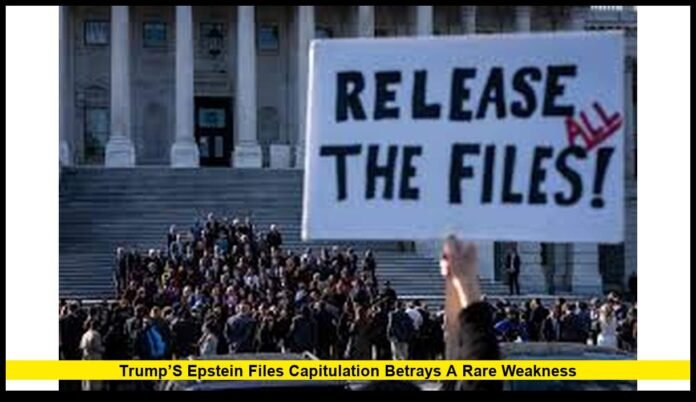

The political world has been buzzing today as analysts, lawmakers, and commentators focus on how trump’s epstein files capitulation betrays a rare weakness during a critical moment in the fight over the release of Epstein-related federal documents. The former president’s abrupt pivot has become one of the most talked-about developments of the day, raising questions about influence, internal party dynamics, and the shifting balance of power across Washington.
While Trump has survived countless political storms, this moment stands apart because it reveals pressure he could not fully control. What seemed unthinkable just weeks ago — Trump supporting a push he once dismissed — is now unfolding in real time with major implications.
A Moment That Reshapes the Conversation Around Power
For years, Trump projected an image of unwavering control. He often dictated the pace and tone of debate within his party. But this episode challenges that image more directly than many of his past controversies. His reversal is being interpreted as the result of political forces building beyond his command.
Several lawmakers were already organizing efforts to compel the release of the Epstein-related documents. Trump’s initial pushback against the legislation was firm, and he publicly rejected the idea that extensive disclosure was necessary. Yet, within a very short window, he reversed course and encouraged House Republicans to support the bill.
This shift was not seen as strategic. It was seen as reactive. That distinction is the key to understanding why critics and observers argue that his capitulation stands out as one of the rare political weaknesses he has displayed.
Why This Reversal Carries Such Heavy Weight
Political reversals happen often. What makes this one significant is the context surrounding it.
1. The Pressure Reached a Breaking Point
A bipartisan coalition had formed around the release effort, weakening the traditional political lines that Trump usually relies on. He could not control the growing push inside his own party.
2. The Public Demand Became Too Strong
Several developments had energized public calls for transparency. Lawmakers knew they had to respond. Trump may have realized that standing against that demand could hurt more than help.
3. The State of Party Unity Was in Question
Republicans appeared increasingly willing to keep moving forward with the disclosure legislation whether Trump approved or not. For someone whose political strength has been tied to loyalty, this was a notable warning sign.
4. The Timing Amplified the Vulnerability
The shift came just as the vote gained unstoppable momentum. Changing positions earlier would have seemed assertive. Doing it at the last moment instead highlighted the optics of retreat.
These elements combined to form a moment that made even Trump’s strongest supporters pause.
The Political Stakes Behind the Shift
It is not unusual for leaders to adjust their positions. But in Trump’s case, each move is scrutinized for signs of strength or weakness. His identity as a political figure has been defined by the idea that he does not bend under external pressure.
That is why today’s shift has exploded into a large narrative. It signals something deeper occurring beneath the surface — friction within the base, tension within the party, and an undeniable awareness of the growing expectation for transparency.
This moment also places Trump in a delicate political position. His critics will use the reversal to frame the moment as proof that political pressure can break through his otherwise unshakable posture. Conversely, his supporters may try to reposition the shift as an alignment with public interest. Neither group can escape the fact that timing matters, and the timing here is what marks it as capitulation.
Understanding Why Trump Chose This Moment to Retreat
There are several reasons why advisors and analysts believe Trump reversed course.
Growing Internal Party Frustration
Republicans who supported the bill had grown tired of having to publicly defend a position that many of them privately disagreed with. As more lawmakers came forward, it became impossible for Trump to keep the party unified on his earlier stance.
New Political Calculations
Trump has a keen sense of how political winds shift. Continuing to oppose the release could have harmed his standing with voters who want answers. He may have calculated that endorsing transparency was the safest route, even if it required contradicting his past statements.
The Desire to Regain Narrative Control
Instead of allowing others to paint him as blocking transparency, Trump attempted to reclaim the narrative by asserting that supporting the release aligned with his agenda. But because the pivot came late, the effort to regain control appeared reactive rather than deliberate.
A Recognition That Opposition Would Not Work
If he continued to resist, the legislation might still pass without him — a scenario that could make him look powerless. Supporting it may have seemed like the only way to avoid a worse political humiliation.
This collection of forces helps explain why many believe trump’s epstein files capitulation betrays a rare weakness that has not surfaced so visibly before.
How This Moment Fits Into the Broader Transparency Debate
The Epstein files have long represented more than a criminal case. They have become a symbol of the public’s demand for answers about institutional failures, powerful networks, and unanswered questions.
Trump’s reversal has amplified the conversation in several ways:
- It brings renewed focus to accountability.
- It highlights the growing influence of transparency movements.
- It shows that even powerful political figures must adapt to public pressure.
- It creates new expectations for how investigations are handled.
The fight for the release of Epstein-related documents is now bigger than any one political figure. Trump’s capitulation simply accelerated a movement that was already gaining national force.
How Republicans Are Reacting Behind the Scenes
Behind closed doors, Republicans are experiencing a complex mix of emotions:
Relief
Some are relieved that Trump now supports a popular measure they had already backed.
Frustration
Others are frustrated because his earlier opposition created political challenges they had to navigate for months.
Caution
Several GOP members are wary. They know that if Trump is willing to reverse one strong stance, he may reverse others. That unpredictability complicates strategy.
New Confidence
A growing faction within the party sees Trump’s shift as evidence that they can push for their own priorities without waiting for his approval.
This internal recalibration may shape the future of the Republican Party more than any single policy vote.
Why This Moment Impacts Trump’s Future Political Strategy
Trump’s brand has always been built on projecting dominance, defiance, and control. When moments appear that contradict that image, they can shift public perception in subtle ways.
He Appears More Vulnerable to External Pressure
Supporters and critics alike recognize that he bent because the political pressure had grown too large.
He Appears Less Unifying Within His Party
If Republicans no longer feel bound by his position, his influence naturally weakens.
He Appears More Reactive Than Proactive
This single difference matters because it informs how voters interpret his leadership.
He Appears More Politically Isolated
Lawmakers moved without him. Then he responded. That sequence tells a story of declining dominance.
These impressions matter during election seasons, legislative sessions, and moments when unity is required.
What This Means for the Release of Epstein-Related Documents
With Trump now backing the legislation, the path toward release is clearer. Supporters of transparency believe the next steps will include:
- Agencies identifying all unclassified files.
- The public gaining access to documents that were previously withheld.
- New analysis from legal experts and advocacy groups.
- Renewed calls for further accountability based on what the documents reveal.
- Possible pressure for additional investigations, depending on the content.
The release will not answer every question immediately, but it will offer a level of visibility the public has demanded for years.
The Long-Term Consequences of Today’s Moment
Even after the vote and the eventual document release, the political implications will linger. Trump’s reversal may be remembered as one of the rare times when political pressure overcame his usual strength.
The moment will be studied in future campaigns, leadership discussions, and strategic planning sessions. It may also:
- Influence how candidates talk about transparency.
- Shift how lawmakers position themselves during high-pressure votes.
- Encourage bipartisan cooperation in areas previously considered unlikely.
- Shape how future administrations handle sensitive files.
This moment will ripple outward for months — perhaps even years.
Final Thoughts
Today’s events show why trump’s epstein files capitulation betrays a rare weakness is the defining phrase of the moment. His decision reflects pressure points that extend beyond a single issue. It reveals a delicate balance of power, a public hungry for transparency, and a political landscape that is shifting faster than even major figures can fully control.
As this story continues to develop, one thing is certain: the public is watching closely, and the conversation around accountability is far from over.
If you have thoughts on how this reversal reshapes the political climate, feel free to share them — your perspective adds to the unfolding dialogue.
FAQ
Q1: Why is Trump’s reversal seen as a sign of weakness?
Because the timing suggests he changed position only after bipartisan pressure made his earlier stance untenable.
Q2: Will the release of the Epstein files be complete?
It will likely include extensive unclassified documents, though some information may be redacted.
Q3: How might this moment affect Trump’s standing within the GOP?
It may weaken his influence slightly, as lawmakers now know he can be pressured into shifting positions.
Disclaimer:
This article is for informational purposes only. It reflects the latest publicly available developments at the time of writing and does not provide legal, investigative, or professional conclusions.