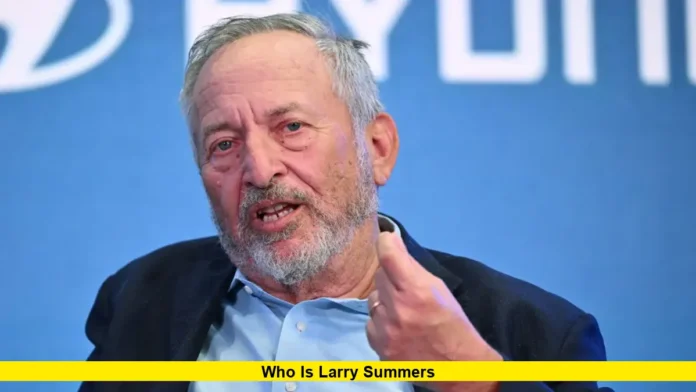

When asking “Who is Larry Summers?”, it’s not merely a question about a person—it’s about a life steeped in economics, public service, acclaim and controversy. Larry Summers is an American economist whose career spans academia, government and international finance. As of late 2025, he finds himself in the headlines again—this time amid revelations that have forced him to scale back his public roles.
Early Life & Academic Foundations
Larry Summers was born on November 30, 1954, in New Haven, Connecticut, into a family deeply embedded in the world of economics. He earned a Bachelor of Science from the Massachusetts Institute of Technology (MIT) in 1975 and completed his Ph.D. in economics at Harvard University in 1982. Soon after, he became one of the youngest tenured professors in Harvard’s history in 1983.
These early academic milestones set a foundation of high expectations. Summers established himself as a scholar of public finance, macroeconomics and international development. At the same time, his family lineage—connected to Nobel laureates and prominent economists—reinforced the sense that he belonged among the elite ranks of economic thinkers.
Public Service & Governmental Leadership
Larry Summers’s transition from academia to government was swift and consequential. In the early 1990s, he served as Chief Economist at the World Bank and later joined the U.S. Treasury Department under President Bill Clinton. His rise included the post of Under Secretary for International Affairs and then Deputy Secretary of the Treasury. In 1999, he became the 71st U.S. Secretary of the Treasury, serving until January 2001.
During that tenure he played central roles in U.S. responses to financial crises abroad and in shaping domestic economic policy. His name came to signal both influence and controversy—he backed deregulatory moves that later critics linked to systemic risks. After a stint at the Treasury, Summers returned to public service under President Barack Obama as Director of the National Economic Council from 2009 to 2011, where he helped guide U.S. policy during and after the Great Recession.
Academic Leadership at Harvard
In 2001 Larry Summers assumed the presidency of Harvard University. His time there marked a dramatic shift from government offices to one of the most prestigious academic leadership posts in the nation. He served as Harvard’s president until 2006 and also held the title of Charles W. Eliot University Professor, reflecting his continued academic stature.
However, that era was not without turbulence. his comments in 2005 about “aptitude differences” contributing to the under-representation of women in STEM fields sparked intense backlash. A lack-of-confidence vote from faculty followed, effectively ending his presidency. Yet despite that, he remained a Harvard professor and re-cemented his reputation as a heavyweight in economic policy circles.
The Latest Chapter: Stepping Back Amid Controversy
In November 2025, Larry Summers announced that he would step back from his public-facing commitments. The reason: the disclosure of email correspondence between Summers and convicted sex-offender Jeffrey Epstein. The communications, released by the U.S. House Oversight Committee, revealed exchanges spanning years and mixing personal, professional and philosophical matters. Epstein described himself as Summers’s “wing man” in some messages.
In his statement, Summers said he was “deeply ashamed” of his actions and acknowledged the pain they have caused. He affirmed his intention to fulfil his teaching duties but withdraw from other external appearances, board roles and broad public commentary. That decision has triggered intense scrutiny. Institutions like Harvard, the left-leaning think tank Center for American Progress and various media and advisory boards face pressure to reevaluate their affiliations with Summers.
Key Milestones & Timeline
| Year | Milestone | Context |
|---|---|---|
| 1999-2001 | Served as U.S. Secretary of the Treasury | Major role under the Clinton administration |
| 2001-2006 | President of Harvard University | Shifted from policy to academic leadership |
| 2009-2011 | Director of the National Economic Council | Key advisor during Obama era |
| 2025 Nov | Announcement to step back from public commitments | Triggered by revelations of links to Epstein |
Why This Matters to a U.S. Audience
For Americans, Larry Summers’s story intersects with several themes that resonate broadly:
- Economic policymaking at the highest levels: From finance crises to stimulus and global reform, Summers has been at the center.
- Accountability in powerful institutions: His recent withdrawal illustrates how networks of elite influence and conduct are under renewed public inspection.
- The changing role of public intellectuals: Summers embodied the idea that academic economists could shift seamlessly into policy and back—but his latest setback suggests elevated risks when public and private roles intertwine.
- Reputation, ethics and institutional risk: Universities, think-tanks and boards wading into associations with high-profile figures are now under pressure to ensure the values align with public scrutiny.
Major Themes and Insights from the Summers Career
- Blending academia and policy for influence
Larry Summers didn’t stay confined to lecturing or research; he repeatedly stepped into policy roles with real-world impact. That movement sharpened his voice and expanded his influence—but also exposed him to sharper criticism and scrutiny. - Deregulation and risk
Summers supported deregulation of financial markets in the late 1990s and early 2000s. For many, that aligned with the global push for liberalization and growth. For others, it laid groundwork for the vulnerabilities exposed in the 2008 crisis. - Controversy around leadership style and public statements
His Harvard presidency ended partly over comments that many found insensitive and ill-considered. The recent correspondence revelations suggest that the same mix of high intellect and questionable judgement re-emerged. - Legacy in transition
With his announced withdrawal from public roles, Larry Summers enters a new phase—less visible but still influential. How his career is reassessed will reflect both his accomplishments and his mis-steps.
What to Watch Going Forward
- Will Harvard revise Summers’s affiliation or adjust his academic role in light of the recent disclosures?
- Will institutional boards (for example his advisory or media roles) formally sever ties or update governance standards as a consequence?
- Will additional documents or disclosures further affect how Summers is publicly perceived and whether other high-profile figures in interconnected networks face similar pressure?
- What broader implications might this episode have for academia-policy transitions, especially regarding ethics, transparency and outside engagements?
A Balanced View of the Person Behind the Name
When asked “Who is Larry Summers?” it pays to remember that he is neither purely hero nor villain. He is a figure of extraordinary intellect and influence—who helped shape economic policy, led one of the world’s top universities and played key roles in global finance. At the same time, his career has included moments of mis-judgement, public rebuke and now serious reputational strain.
His recent statement of regret reveals a willingness to accept responsibility—but whether that will satisfy institutions, observers or the public remains to be seen. Even in stepping back, Summers’s story is far from over.
If you have thoughts on Larry Summers’s legacy, his recent decision, or how this may alter his influence going forward, feel free to share your views or follow how this story evolves.