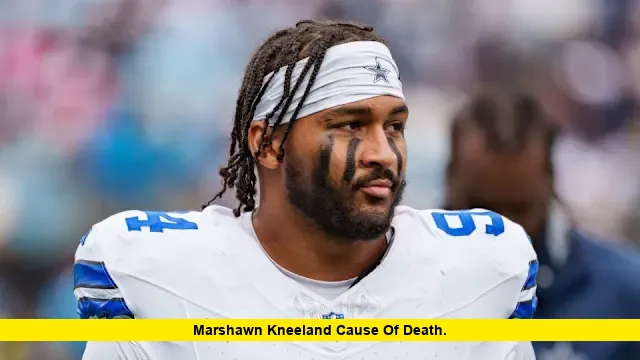

In the early hours of November 6, 2025, the cause of death for Marshawn Kneeland was confirmed as a self-inflicted gunshot wound, following a late-night traffic pursuit and vehicle crash in Frisco, Texas. The 24-year-old defensive end for the Dallas Cowboys now becomes part of a tragic narrative that continues to reverberate across the NFL and beyond.
What precedes the tragic event
On the evening of November 5, Texas law-enforcement officials responded when Kneeland’s vehicle fled a traffic stop attempt for a minor violation. The pursuit officially ended after troopers lost visual contact. Minutes later, the vehicle was discovered crashed on southbound Dallas Parkway near Warren Parkway in Frisco. Kneeland abandoned the car and fled on foot into the surrounding area.
During the ensuing search, dispatch audio captured alerts that Kneeland had sent group-text messages to loved ones saying “goodbye,” and that his girlfriend had alerted authorities he was armed and in mental crisis. Roughly three hours after the crash, at 1:31 a.m., officers located Kneeland deceased with what appeared to be a self-inflicted gunshot wound.
Detailed timeline of the incident
| Time | Event |
|---|---|
| ~10:39 p.m. | Troopers attempt to stop Kneeland’s vehicle; pursuit begins. |
| Minutes later | Vehicle located crashed and abandoned on Dallas Parkway. |
| Post-crash | Kneeland flees scene; search launched using K-9, drones, and phone ping. |
| Approx. 1:31 a.m. | Kneeland found deceased with self-inflicted gunshot wound. |
| Following morning | Dallas Cowboys and law-enforcement announce the death. |
Marshawn Kneeland’s career and context
Kneeland entered the NFL as a second-round pick in the 2024 draft out of Western Michigan Broncos. He had just begun to establish himself as a meaningful contributor on the Cowboys’ defensive line. Notably, in his second season, he scored his first NFL touchdown by recovering a blocked punt—just days before his death.
Off the field, Kneeland carried personal burdens. He lost his mother in early 2024 and had spoken of her often; he wore a keepsake necklace in her memory. Privately, friends and teammates noted that while he projected a happy, lighthearted persona, he also wrestled with inner struggles that were not always visible.
Cause of death: facts and confirmation
- The death is officially being treated as an apparent suicide.
- The medical examiner’s final ruling is still pending, but the evidence (crash, abandonment of vehicle, text goodbye, self-inflicted wound) points clearly to self-harm.
- The link between the prior pursuit/collision and Kneeland’s declining state is unquestioned: the crash was not an accident disconnected from the eventual outcome—it was part of the sequence that preceded his death.
- While many may focus on the chase or crash itself, the cause of death remains the gunshot wound and the decision behind it.
Beyond the incident: mental health and professional sports
Marshawn Kneeland’s cause of death casts a harsh spotlight on mental-health support in elite sports. The collision of several factors here is stark:
- A young athlete on the rise, months removed from his mother’s passing, already navigating grief and expectation.
- A police chase and crash late at night—risk, stress and impulsive choices converging.
- His girlfriend and close contacts raising alarms in the hours before, saying he was armed and might “end it all.”
- The NFL and his team facing the aftermath: questions about how such warning signs can be identified and addressed.
For the Cowboys organization, the NFL community, and many teams across professional sport, this isn’t just a moment of mourning—it is a moment for reflection on how talent, support systems, personal pain and public performance intersect. Kneeland’s storey reminds us that for some athletes, the pressure cooker is very real.
The aftermath: reaction, grief, and legacy
In the days since his death was confirmed, the impact has been felt widely:
- His team memorialized him; players and staff openly wept, turning his locker area into a tribute space.
- Fans and media outlets called for deeper mental-health awareness; many praised the openness and vulnerability shown by teammates in their grief.
- The fact that his death came just days after his first NFL touchdown adds a tragic and especially poignant layer—an athlete seemingly on the brink of a breakout moment, lost too soon.
- For family, friends and loved ones, the void is profound: a son, a partner, a teammate, grieving, unfinished business everywhere.
Why this story matters beyond football
While the key phrase “Marshawn Kneeland cause of death” anchors this article, it is more than just a headline—it touches on themes that resonate broadly:
- Mental-health stigma: The fact that Kneeland’s private struggles emerged only after a crisis highlights how silent mental pain can be.
- Athlete-life vulnerability: Publicly, professional athletes seem invincible; privately, they are still human, still fragile.
- Crisis response: The events show a breakdown point where alarms were raised (text messages, chase, crash), yet the tragedy still unfolded. This raises questions about preventive measures, team protocols, public-figure mental-health care.
- Loss and legacy: The loss of a young life reminds us how fleeting opportunity can be, and how important it is to reach out early, openly, unashamedly.
In Summary
Marshawn Kneeland’s cause of death has been firmly established: a self-inflicted gunshot wound following a chain of events including a police pursuit and a vehicle crash. The 24-year-old’s passing is a moment of deep sorrow for the Dallas Cowboys, the NFL community, and countless others who believed in his ascent. It is also a deeply serious wake-up call about the hidden mental and emotional challenges faced by young athletes every day.
If you or someone you know is in crisis or grappling with thoughts of self-harm, please call or text 988 in the U.S.—help is available.
Thank you for reading this detailed update. Please feel free to comment below or stay tuned for any further developments.