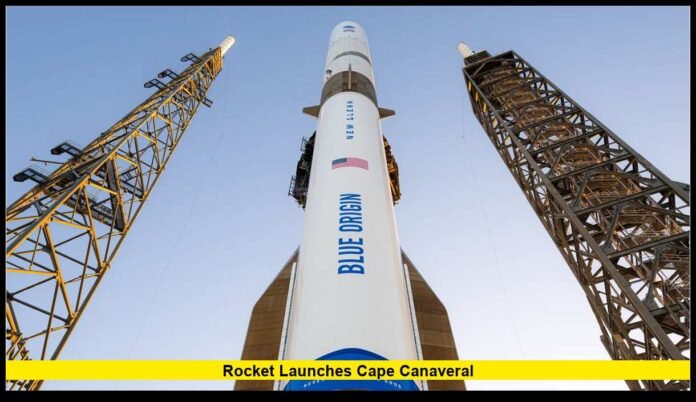

The latest wave of rocket launches Cape Canaveral have brought remarkable milestones to Florida’s Space Coast this week. On November 13, 2025, New Glenn—operated by Blue Origin—lifted off from Cape Canaveral Space Force Station at 3:55 p.m. EST, carrying twin NASA spacecraft as part of the ESCAPADE mission. The mission achieved full success, including the first-ever ocean barge landing of New Glenn’s first stage.
Another key launch occurred on November 14, 2025, when SpaceX’s Falcon 9 lifted from the region with 29 Starlink V2 Mini satellites aboard—as part of a pair of launches in under four hours, marking one of SpaceX’s quickest turnarounds at Cape Canaveral.
Bold New Lift-Offs and Reusable Rockets
Blue Origin’s New Glenn Breaks New Ground
- Launch date/time: November 13, 2025 at 3:55 PM EST from LC-36 at Cape Canaveral Space Force Station.
- Payload: The ESCAPADE twin-spacecraft, designed to study how Mars lost its atmosphere and the effects of solar eruptions.
- Reusable milestone: The first stage (SN002-1) successfully landed on the barge “Jacklyn” in the Atlantic—marking the first for a non-SpaceX heavy-lift rocket.
- Significance: This launch signals a maturation in heavy-lift, reusable rocketry beyond SpaceX’s domain, moving the industry forward on the Space Coast.
SpaceX’s Rapid Successive Starlink Launches
- Launch 1: November 14, 2025 at 10:08 PM EST from Launch Complex 39A at NASA’s Kennedy Space Center (adjacent to Cape Canaveral).
- Launch 2: November 15, 2025 at 1:44 AM EST from Launch Complex 40 at Cape Canaveral Space Force Station.
- Both carried 29 Starlink V2 Mini satellites each.
- Turnaround: Approximately 3 hours 35 minutes between liftoffs—the second-quickest turnaround on Cape launches for SpaceX.
- Booster reuse: The booster for Starlink 6-89 (B1092) had flown 8 times; the booster for Starlink 6-85 (B1078) had flown 24 times, demonstrating deep reuse.
Why These Launches Matter to U.S. Audiences
- Strategic infrastructure: Frequent launches at Cape Canaveral sustain U.S. leadership in satellite deployment and space-transport capability.
- Reuse and cost-effectiveness: Both New Glenn and Falcon 9 demonstrate first-stage recovery, helping lower launch costs and boosting sustainability.
- Future missions for Earth & Mars: ESCAPADE will help deepen our understanding of Mars’ atmospheric history, while Starlink expands global internet coverage—both missions anchored at launches on U.S. soil.
- Industry competition: The Cape region continues as a battleground for launch providers, pushing innovation and reliability.
- Space-Coast economy and visibility: These launches attract tourism, media attention, and investment to the Florida coastline and beyond.
Launch Timeline at a Glance
| Date | Vehicle | Site | Payload | Highlights |
|---|---|---|---|---|
| Nov 13 2025 | New Glenn | LC-36, Cape Canaveral Space Force Station | ESCAPADE twin Mars orbiters | First-ever landing of NG heavy-lift stage |
| Nov 14 2025 | Falcon 9 | LC-39A, Kennedy Space Center | 29 × Starlink V2 Mini | Builds Starlink constellation |
| Nov 15 2025 | Falcon 9 | LC-40, Cape Canaveral Space Force Station | 29 × Starlink V2 Mini | ~3.6 hrs after prior Starlink launch |
What’s Next on the Horizon for Cape Canaveral
- The public launch schedule lists an upcoming Starlink 6-94 Falcon 9 mission from Cape Canaveral, with window opening November 18, 2025.
- The launch complex LC-36 (used by New Glenn) is being positioned for increased cadence of heavy-lift flights.
- Continued improvements in reusability and turnaround may drive down costs and increase launch frequency from the Cape region.
Implications for Enthusiasts & Stakeholders
For U.S. readers interested in being part of the moment, the following points matter:
- Watching live launches: The “Space Coast Launches” platform highlights live feeds and viewing vantage tips.
- Local impact: Launches create economic and educational opportunities; communities near Cape Canaveral benefit from increased tourism and STEM visibility.
- Commercial vs. Government missions: The mix of private (SpaceX, Blue Origin) and government-associated missions illustrates a diversified launch ecosystem in the U.S.
- Technology progression: Launch cadence and reuse provide real-world metrics of how quickly U.S. launch capability is accelerating.
With Cape Canaveral playing host to back-to-back landmark launches — from the New Glenn heavy-lift breakthrough to rapid-fire Starlink Falcon 9 launches — the era of U.S. launch leadership is clearly in the fast lane. Stay tuned for the next countdown and let us know your favorite launch moment below!