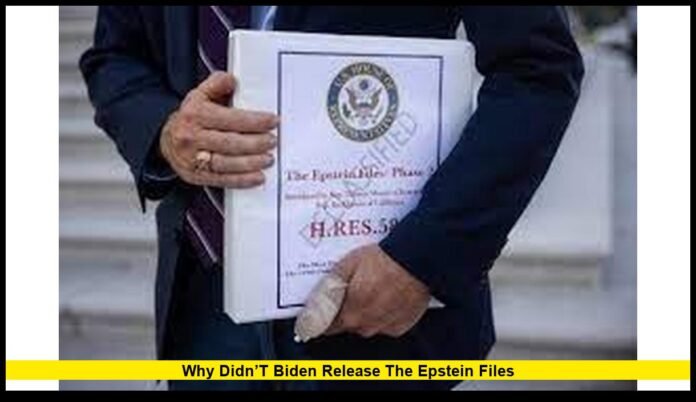

Because the Epstein files are controlled by courts and the Justice Department—not the president—so Joe Biden couldn’t legally release them.
The question “why didn’t Biden release the Epstein files” has been one of the most searched political phrases across the United States in recent months. As the Jeffrey Epstein scandal continues to haunt public discourse, many Americans are asking why President Joe Biden’s administration didn’t take steps to make all of Epstein’s records, contacts, and federal investigation files fully public.
While a portion of the documents has been unsealed by courts and congressional committees, the vast majority remain hidden — locked away by the Department of Justice (DOJ) under multiple layers of legal and privacy protections. Understanding why this happened requires a closer look at U.S. law, federal process, and the sensitive nature of the Epstein case itself.
This article breaks down the facts behind the issue, separating speculation from verifiable reality and explaining in clear terms why the Epstein files remain unreleased under President Biden’s administration.
Latest Update (Feb 2026)
In late January and early February 2026, the U.S. Department of Justice released roughly 3.5 million pages of Epstein-related records, including images and videos, to comply with federal transparency requirements.
The disclosure drew criticism from lawmakers and survivors, who argued the material was incomplete or poorly redacted, with some unredacted victim details leading to removals and legal challenges.
Meanwhile, United States Congress continues oversight efforts to obtain fuller, unredacted access, a process governed by courts and DOJ procedures rather than the White House.

Who Is Joe Biden
Joe Biden (born November 20, 1942) is an American politician who served as the 46th President of the United States from 2021 to 2025. A member of the Democratic Party, he previously served as Vice President under Barack Obama from 2009 to 2017 and was a U.S. Senator from Delaware for 36 years (1973–2009).
Biden began his political career at a young age, becoming one of the youngest senators in U.S. history at 30. During his long Senate tenure, he chaired key committees, including the Senate Foreign Relations Committee and the Judiciary Committee.
As president, Biden focused on COVID-19 recovery, economic rebuilding, infrastructure modernization, climate initiatives, and strengthening international alliances. Major legislation during his term included the Infrastructure Investment and Jobs Act, the Inflation Reduction Act, and the CHIPS and Science Act.
With decades of public service, Biden remains one of the most experienced figures in modern American politics.
What Exactly Are the Epstein Files?
The term “Epstein files” refers to a vast and complex archive of documents, evidence, and testimony connected to the criminal activities of Jeffrey Epstein — the financier whose alleged sex-trafficking network involved minors, influential business leaders, political figures, and global elites. These files are not a single unified document. Instead, they are a patchwork of materials gathered over nearly two decades by federal agencies, state prosecutors, intelligence officials, civil attorneys, and investigative journalists.
At its core, the Epstein file system represents everything the government and courts have collected about Epstein’s operations: how he recruited victims, how he evaded law-enforcement scrutiny for years, and which individuals may have facilitated, benefited from, or participated in his crimes. While pieces of this information have been released to the public in waves, most of it remains behind legal barriers — fueling ongoing public demand for transparency.
FBI Investigation Reports (2005–2019)
The earliest components of the Epstein files trace back to local police reports in Palm Beach, which eventually triggered FBI involvement in 2005. The bureau opened what later became a long-running investigation spanning multiple states and involving hundreds of leads.
These FBI records include:
- Interviews with victims who described being recruited as minors
- Notes from employees, pilots, drivers, security personnel, and household staff
- Documentation relating to Epstein’s private plane manifests and his “black book” of contacts
- Internal assessments, risk evaluations, and investigative summaries
- Communications between field offices in New York, Miami, and Washington D.C.
Many of these materials remain classified because they were part of active criminal investigations that continued long after Epstein’s controversial 2008 plea deal and even up until his 2019 arrest.
Grand Jury Testimony and Sealed Depositions

Separate from law-enforcement documents, the Epstein files also include sealed grand jury materials, which cannot be released without a judge’s explicit authorization. These transcripts contain:
- Testimony from victims who were minors at the time
- Sworn statements from employees who witnessed suspicious activities
- Depositions from individuals accused of facilitating Epstein’s operations
- Evidence presented during early attempts to prosecute Epstein before the 2008 deal shut the process down
Grand jury materials are among the most heavily restricted, protected by long-standing federal rules designed to safeguard both victims and individuals who were investigated but never charged.
Financial Records and Offshore Transactions
Another major component of the Epstein files consists of complex financial documents, including:
- Bank records showing Epstein’s movement of funds across multiple jurisdictions
- Offshore account information connected to the U.S. Virgin Islands, Switzerland, and the Caribbean
- Wire transfers linked to settlement payments, “grants,” or unexplained financial gifts
- Tax filings tied to Epstein’s various foundations and shell companies
- Records of property purchases, trusts, and hidden assets
These financial trails are crucial because prosecutors have long believed that Epstein used money not only to fund his lifestyle but also to maintain loyalty, exert influence, and silence potential whistleblowers.
Property Search Results, Photos, and Surveillance Evidence
When federal agents raided Epstein’s Manhattan townhouse and other properties, they seized a massive volume of physical and digital evidence, including:
- Hard drives containing thousands of photographs
- CDs and labeled folders with names of individuals
- Hidden safes containing documents related to property transactions and passports
- Video surveillance footage from inside the residence
- Logs of visitors and staff movements
This evidence, some of which has been referenced in court filings, forms one of the most sensitive portions of the Epstein files because it may reveal the identities of people who visited Epstein’s properties or were present during criminal activity.
Names of Potential Witnesses, Associates, and Alleged Accomplices
Perhaps the most controversial aspect of the Epstein files is the list of names connected to his world. These include:
- Potential witnesses
- Former employees and contractors
- Business associates
- High-profile individuals who flew on Epstein’s private aircraft
- People who visited his island, ranch, or Manhattan townhouse
- Individuals accused by victims of facilitating or participating in abuse
Much of this information is sealed, redacted, or kept confidential pending review by courts to prevent the release of unverified allegations — a major point of tension between advocates for transparency and officials who caution against defamation risks.
Why Most Epstein Files Remain Sealed
Even after Epstein’s death, the bulk of his files remain locked behind federal court orders for several key reasons:
- Victim Privacy: Many survivors were minors at the time of the abuse. Releasing unredacted materials could cause severe emotional and psychological harm.
- Ongoing Legal Matters: Some individuals connected to the Epstein network are still under investigation or involved in related civil cases. Releasing sensitive files could compromise those proceedings.
- Classified or Sensitive Information: Because Epstein interacted with billionaires, scientists, global officials, and intelligence-linked individuals, certain documents fall under national security protections.
- Court Procedures and Legal Standards: Federal courts typically err on the side of caution when evidence involves minors, sealed testimony, or ongoing investigations.
Why Many Expected a Shift Under President Biden
When President Biden took office, segments of the public expected greater transparency regarding the Epstein files. This expectation stemmed partly from:
- Pressure from activists demanding government accountability
- Growing distrust in the handling of Epstein’s earlier prosecution
- Belief that a new administration might revisit the secrecy surrounding the 2008 plea deal and the 2019 investigation
However, legal and procedural barriers — not political decisions — ultimately prevented any large-scale declassification. Federal judges, not presidents, control sealed court records. And agencies like the FBI cannot release files connected to open or sensitive investigations without court approval.
As a result, the Epstein files remain one of the most tightly guarded collections of documents in modern American criminal history — and their partial secrecy continues to fuel public skepticism, frustration, and speculation.
Why Didn’t Biden Release the Epstein Files?
The issue is not simply political — it’s rooted in law, confidentiality, and the independence of the Justice Department. Despite public perception, a U.S. president does not have unilateral authority to declassify or release evidence from criminal cases, especially when such material includes grand jury testimony or victim information protected by federal privacy statutes.
Here are the primary reasons the Biden administration did not release the Epstein files:
1. Federal Grand Jury Secrecy Laws
Under Rule 6(e) of the Federal Rules of Criminal Procedure, grand jury information cannot be made public unless a federal judge authorizes its release. This means all testimony, transcripts, and exhibits from grand jury proceedings related to Epstein are legally sealed — and not even the President can order their disclosure without a court order.
Violating grand jury secrecy laws can result in criminal penalties for prosecutors or officials involved. This legal protection exists to safeguard witnesses, ongoing investigations, and the integrity of the justice system.
2. Victim Protection and Privacy Laws
Epstein’s crimes involved minors and young women whose identities are protected under federal victim privacy laws, including the Crime Victims’ Rights Act (CVRA). Releasing unredacted documents could expose those survivors to public scrutiny, harassment, or retraumatization.
In multiple statements, the DOJ emphasized that protecting victim confidentiality was a top priority. Many victims gave statements under assurances that their names and personal details would never become public. Revealing the full files could legally and ethically violate those agreements.
3. Ongoing Civil and Criminal Proceedings
Even though Epstein died in August 2019, litigation involving his associates, his estate, and institutions tied to him continues today. Civil suits against financial firms, such as JPMorgan Chase and Deutsche Bank, remained active during Biden’s presidency, and those cases referenced sealed documents from Epstein’s investigations.
Releasing those materials prematurely could have interfered with active proceedings. In 2023, for example, the U.S. Virgin Islands settled with JPMorgan Chase for $105 million, alleging that the bank enabled Epstein’s trafficking operations. The DOJ argued that public release during litigation could have compromised due process.
4. Independence of the Department of Justice
Since his campaign in 2020, Joe Biden repeatedly promised that his administration would not interfere with DOJ investigations — a sharp contrast to the politicization of the department seen in previous administrations.
That promise meant that Attorney General Merrick Garland had full autonomy over decisions involving sensitive cases, including Epstein’s. The DOJ determined that most Epstein files could not be disclosed under current law, citing the ongoing need to protect uncharged individuals, witnesses, and victims.
The White House therefore did not intervene or direct any release, leaving the decision entirely within the DOJ’s jurisdiction.
5. Legal Limitation on Presidential Power
Contrary to popular belief, the President cannot simply declassify or release evidence gathered during federal criminal investigations. These are governed by separate branches of government — the judiciary and the Justice Department.
Even if Biden had publicly requested their release, the courts would still have to approve. The files are not “classified” in the national security sense — they are sealed legal evidence, which falls under judicial authority, not executive control.
READ ALSO–EPSTEIN EMAILS LEAKED
What Did Biden’s Administration Actually Release?
Although the Biden administration did not deliver the sweeping transparency many Americans hoped for, it did oversee several noteworthy developments that added new information to the public record. These actions came through a mix of court orders, congressional reviews, and victim-support initiatives — each contributing small but meaningful pieces to the broader understanding of Epstein’s network.
Court-Ordered Document Releases (2022–2024)
During Biden’s term, federal judges authorized the unsealing of dozens of previously sealed civil court files related to Jeffrey Epstein and Ghislaine Maxwell. These releases came gradually, often after years of legal battles by media organizations and public-interest groups.
The newly unsealed materials included:
- Depositions from key witnesses and individuals in Epstein’s inner circle
- Email exchanges and written correspondence referenced in the Maxwell trial
- Flight logs and travel records from Epstein’s private jets
- Affidavits describing recruitment methods, household operations, and staff roles
- Additional pages from Epstein’s personal “black book”
While these documents did not expose the dramatic revelations some expected, they did offer fresh details about Epstein’s network, including how he maintained influence, funded his operations, and interacted with high-profile visitors.
Congressional Review of DOJ Files (2025)
In early 2025, one of the most significant developments occurred when the House Oversight Committee obtained access to more than 33,000 pages of Department of Justice documents connected to Epstein. This included internal memos, investigative summaries, correspondence between federal agencies, and various redacted case materials.
However, despite the sheer volume of documents, lawmakers were quick to note:
- A large portion of the files were heavily redacted
- Many names and identifying details were removed to comply with privacy laws
- Some sections were withheld entirely due to ongoing legal matters or national security restrictions
This review was meant to determine whether the DOJ mishandled any part of the Epstein investigations, but it did not lead to a public release of the unredacted materials — leaving most of the original records under tight control.
Continued Support for the Victim Compensation Program
Another notable action during Biden’s term was the administration’s backing of the Epstein Victims’ Compensation Program, which continued making payouts to survivors. The program ultimately distributed more than $120 million, a significant step toward acknowledging the harm done to dozens of women who were abused as minors.
This initiative provided:
- Financial compensation for survivors who came forward
- Confidential processing to protect victim identities
- A structured system for validating claims and supporting restitution
Though not directly related to document transparency, this program represented one of the most concrete forms of government action during Biden’s presidency.
Why the Releases Fell Short of Public Expectations
Despite these steps, many Americans felt that Biden’s administration did not bring meaningful clarity to the Epstein case. Much of the public hoped for what they called “the Epstein list” — a supposed client roster of powerful figures who allegedly participated in or enabled Epstein’s activities.
Officials, however, repeatedly emphasized that:
- No formal or verified “client list” exists within DOJ records
- Many names circulating online are speculative and not supported by evidence
- Releasing unverified allegations could violate privacy laws and harm ongoing legal proceedings
This disconnect between public expectation and legal reality continues to drive debates about transparency, government accountability, and what information should ultimately be made public.
Political Fallout and Public Reaction
The limited disclosure of Epstein-related materials during Biden’s presidency triggered intense public frustration and became one of the most politically sensitive transparency debates of the decade. Rather than calming speculation, the partial releases only heightened suspicion and created a vacuum that conspiracy theories quickly filled. For many Americans, the lack of full access to the Epstein files felt like yet another example of institutions protecting the powerful at the expense of truth.
Growing Public Distrust and Viral Speculation
Across social media platforms, millions of people voiced the belief that crucial information was being deliberately withheld. Much of the public narrative centered on the idea that the files contained the names of influential figures — from billionaires to political leaders — who may have interacted with Epstein. Although courts and federal agencies repeatedly explained that no official “client list” exists, distrust in the explanation only accelerated.
This environment allowed rumors to flourish, driven by:
- Conflicting statements from political leaders
- Years of secrecy surrounding the case
- Epstein’s known associations with high-profile individuals
- The unexplained gaps in earlier investigations
- The sudden release of partial documents without context
The result was a sustained wave of skepticism, with the public demanding more answers than the government was legally able to provide.
Republican Criticism and Calls for Full Declassification
Republican lawmakers seized on the unsealed files as a symbol of what they viewed as the administration’s failure to prioritize transparency. Several high-profile members of Congress argued that the only way to restore public confidence was to fully declassify the FBI’s investigative records, including all sealed depositions and grand jury materials.
Key criticisms included:
- Claims that the DOJ was dragging its feet
- Accusations that elites were being shielded
- Warnings that partial disclosure undermined accountability
- Allegations that the administration was slow-walking document releases for political reasons
Hearings and press briefings throughout 2023–2025 repeatedly showcased heated exchanges, with some lawmakers insisting that “justice requires sunlight” and pressing for deadlines to unseal the remaining files.
The Biden Administration’s Defense: Procedure Over Politics
Biden officials pushed back strongly against accusations of concealment. They emphasized that federal law — not politics — was the primary obstacle to releasing the documents. According to administration statements, many records could not legally be disclosed because they involved:
- Minors whose identities must be protected
- Individuals never charged with any crime
- Active or pending investigations
- Evidence obtained through sealed court orders
- Sensitive materials potentially tied to national security
The administration consistently argued that reckless disclosure could violate privacy laws, jeopardize prosecutions, and retraumatize survivors who had already endured years of legal exposure.
Why the Issue Remains Politically Damaging
Despite these explanations, the refusal to unseal the full Epstein files has remained a persistent political liability. The issue has repeatedly surfaced in election debates, congressional forums, and campaign speeches. Critics on both sides — though especially within the Republican Party — have used the controversy to highlight broader concerns about government secrecy and institutional distrust.
The political damage stems from several factors:
- Long-standing public suspicion surrounding Epstein’s connections
- The perception that elites receive special protection
- The lack of definitive closure because many files remain sealed
- The ongoing expectation that future administrations may reveal more
- The symbolic power of the Epstein case as a test of governmental honesty
As a result, the Epstein files have become more than a legal matter — they have become a cultural flashpoint that continues to shape debates about transparency, corruption, and the credibility of federal institutions.
The Broader Impact on Public Trust
The Epstein scandal — and the persistent secrecy surrounding key documents — has had a profound effect on how Americans view federal institutions, particularly those responsible for justice, accountability, and transparency. Even for individuals who were not closely following the case, the ongoing withholding of files has become a symbol of a larger, deeply rooted problem: the belief that systems of power operate differently for the wealthy and well-connected.
A Deepening Divide Between the Public and Institutions
Surveys and online discussions throughout the 2020s show a growing perception that the government selectively discloses information, especially when influential individuals are involved. The Epstein case amplified that feeling dramatically. To many citizens, the idea that documents concerning a known sex trafficker remain sealed — even after his death — reinforces fears of an unequal justice system.
This perception is fueled by:
- The long timeline of the Epstein investigation
- The unusually lenient 2008 plea deal
- Years of sealed records, redactions, and restricted access
- High-profile names orbiting Epstein’s social and business circles
- Multiple administrations failing to provide complete transparency
The cumulative effect is a public increasingly convinced that the truth is being withheld for reasons that benefit the elite, not survivors or the pursuit of justice.
“Why Didn’t Biden Release the Epstein Files?”—A Symbol of Frustration
The question “why didn’t Biden release the Epstein files” has become shorthand for a broader cultural frustration. It expresses not only anger over one case but deeper concerns about:
- Elite accountability: Whether powerful individuals are ever held to the same legal standards as average citizens
- Government secrecy: How information is classified, sealed, or withheld in high-profile cases
- Institutional trust: The belief that agencies like the DOJ and FBI lack transparency when it matters most
Even though legal experts repeatedly explain the procedural barriers preventing full disclosure, the public’s emotional response remains anchored in a sense of betrayal — the feeling that the truth is always just out of reach.
The Ongoing Conflict Between Privacy, Legality, and Transparency
The core issue is that the justice system must balance three competing priorities:
- Privacy for minors and survivors
- Legality, including court orders, sealed testimony, and ongoing investigations
- Transparency, which the public demands, especially in cases involving systemic abuse
In Epstein’s case, these priorities collide. Courts insist that unsealing everything would violate the privacy of victims. Activists argue that secrecy only protects the powerful. Lawmakers debate which redactions are necessary and which are excessive. Meanwhile, the public sees a lack of clarity as evidence of something being hidden.
Growing Calls for Reform and Legislative Action
The controversy has fueled a new movement among transparency advocates, legal reformers, and anti-trafficking organizations. Many are urging Congress to reconsider how sealed records are handled in cases involving:
- Human trafficking
- Child exploitation
- Serial predatory behavior
- High-profile or high-risk defendants
- Situations where public interest outweighs privacy concerns
Proposed reforms include:
- Clearer legal frameworks for redacting and releasing sensitive materials
- Time-based expiration guidelines for sealed records
- Independent review panels to oversee high-profile document releases
- Expanded protections for survivors who choose to remain anonymous
These proposals reflect a growing consensus that the current system — built decades ago for very different types of cases — is not equipped for global scandals like the Epstein saga.
Read also-Epstein emails say Trump ‘knew about the girls’; new House Democrat pledges file release
A Public Still Waiting for Answers
In the end, the controversy over the Epstein files is not simply about documents. It represents a crisis of confidence in institutions that claim to serve justice but often appear to protect the powerful. Until more clarity is provided or meaningful reform is enacted, the question of what truly lies within the Epstein files will continue to shape public skepticism and political debate.
Could the Files Ever Be Released?
There is still a possibility that the Epstein files could become public in the future. After all related civil and criminal cases conclude, the DOJ or federal courts could approve redacted releases under Freedom of Information Act (FOIA) requests.
Some legal experts have suggested that, once privacy and victim safety concerns are fully addressed, portions of the files — particularly financial documents and travel logs — could be declassified for historical and accountability purposes.
However, this process could take years. Federal courts move cautiously, especially in cases tied to sexual exploitation and ongoing civil litigation.
The Reality Behind the “Client List” Myth
Much of the public’s frustration stems from rumors about a “client list” naming powerful figures who visited Epstein’s properties or participated in his illegal activities. However, law enforcement sources and court filings confirm that no such official list exists.
The misunderstanding arose because investigators seized Epstein’s flight logs, address books, and contact databases — but those items contained thousands of names, many of whom had no connection to criminal conduct. Federal authorities have repeatedly stated that inclusion in those records does not imply guilt or participation in wrongdoing.
This distinction is crucial — releasing unverified names without context could create false accusations and potential defamation lawsuits, another reason the DOJ has avoided blanket disclosure.
Conclusion: The Legal and Moral Balance
In the end, the question of why Biden didn’t release the Epstein files has a complex answer. It is not about protecting Epstein’s friends or political allies — it is about the intricate balance between justice, privacy, and law.
The Biden administration chose to uphold legal restrictions rather than risk violating court orders or victim protections. While that decision angered many Americans seeking truth and accountability, it was grounded in constitutional limits and legal precedent.
Still, the story is far from over. The Epstein files continue to symbolize both the fight for transparency and the failures of the justice system. Whether they are ever fully released remains uncertain, but the public’s demand for answers has not faded.
If you believe the Epstein files should be made public or have thoughts on how the U.S. government should handle such cases, share your opinion below — your voice helps keep accountability alive.