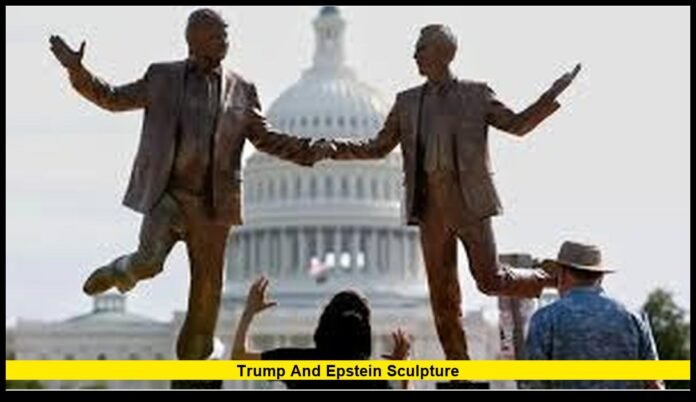

A controversial new installation titled the Trump and Epstein sculpture has taken center stage in Washington, D.C., reigniting heated debates about power, art, and the blurred boundaries between political commentary and provocation. The sculpture, depicting former President Donald Trump and the late financier Jeffrey Epstein holding hands, was mysteriously erected on the National Mall last month.
The life-sized bronze-toned artwork appeared overnight near the U.S. Capitol, captivating onlookers and generating thousands of social media reactions within hours. Created by an anonymous collective known as The Secret Handshake, the piece has become a lightning rod for public discourse, forcing Americans to once again confront questions about privilege, accountability, and the lingering shadow of Epstein’s legacy.
A Detailed Look at the Trump and Epstein Sculpture
Standing nearly seven feet tall, the Trump and Epstein sculpture presents both men in formal attire, smiling broadly and grasping hands in a staged pose of friendship. The plaque beneath reads:
“In celebration of lifelong friendship and shared values. Dedicated to those who believe power has no conscience.”
The installation’s polished bronze-like finish and meticulously detailed expressions give it a striking realism that contrasts with its satirical intent. The figures’ exaggerated smiles and slightly caricatured features hint at irony, mocking the ways public image and political power often sanitize uncomfortable truths.
The sculpture’s title, “Best Friends Forever”, is meant to echo the performative nature of elite relationships — partnerships that often persist in public view even as moral scandals unfold in private.
How and Why the Sculpture Appeared
The sculpture was first discovered by joggers and early-morning commuters on September 23, 2025, at the eastern end of the National Mall.
According to initial statements from The Secret Handshake, the installation was placed overnight “to challenge selective memory” and “encourage citizens to confront what history chooses to forget.”
Within hours, photos flooded social media platforms under hashtags such as #TrumpEpsteinSculpture and #ArtForAccountability, generating millions of impressions.
By noon, the National Park Service (NPS) had cordoned off the sculpture, citing “permit discrepancies.” Yet the controversy only fueled more public attention. Within 48 hours, activists, journalists, and political commentators had transformed the artwork into a national talking point.
The Backstory: Why Trump and Epstein Remain Intertwined
The Trump and Epstein sculpture draws directly from real-life historical context. Trump and Epstein’s relationship, though often downplayed in recent years, was well-documented during the 1990s and early 2000s. Both were fixtures in elite social circles, photographed together at private parties and charity events.
In a 2002 interview with New York Magazine, Trump described Epstein as “a terrific guy” who liked “beautiful women, many of them on the younger side.” This quote, later resurfacing in legal proceedings and media reports, has been used repeatedly to highlight Trump’s proximity to Epstein’s world of influence and scandal.
Epstein’s arrest in 2019 for sex trafficking of minors and his subsequent death in federal custody only deepened public interest in his relationships with powerful men. Trump later distanced himself, claiming he had a “falling out” with Epstein years earlier.
The sculpture, according to the artists, seeks to “materialize the contradictions” of such narratives — portraying how connections in politics and wealth often defy moral accountability.
Art as Protest: The Message Behind the Installation
The Trump and Epstein sculpture is more than a representation of two men; it’s a symbolic confrontation with society’s tolerance for selective justice.
The artist collective behind the project explained that their goal was not to accuse individuals of crimes but to question the culture of complicity surrounding power.
“We don’t sculpt guilt — we sculpt silence,” their statement read. “The handshake is not friendship; it’s protection. Every hand that holds power is joined by another that enables it.”
The installation’s “Friendship Month” plaque, inscribed with flowery cursive and surrounded by fake roses, adds a sharp layer of satire. It references the public’s tendency to romanticize leadership, even when figures of authority are implicated in corruption or misconduct.
Official Response from Authorities
The National Park Service initially removed the sculpture on September 24, claiming the display lacked proper authorization. The decision drew immediate criticism from free speech advocates and art organizations who argued that it represented protected political expression.
Under mounting public pressure, the NPS reinstated the piece on October 2, granting a five-day temporary permit under the federal public art policy.
During its reinstatement period, the sculpture became a magnet for both tourists and protestors. Lines of visitors waited to photograph it, while Trump supporters demanded its removal, calling it “an act of defamation.”
The NPS eventually removed the sculpture again on October 7, citing the expiration of its temporary permit. Despite its short life on display, the sculpture’s digital footprint continues to grow.
Political Reaction: Divided Views in Washington
The White House Stance
A spokesperson for former President Trump condemned the sculpture as “malicious political theater.” They asserted that Trump had no meaningful connection to Epstein beyond casual acquaintance and accused “radical activists” of weaponizing art for partisan attacks.
The statement read:
“This so-called sculpture is nothing more than fake art created by extremists seeking media attention. President Trump stands for truth and accountability — not the lies of the political left.”
Democratic Response
Several Democratic lawmakers defended the piece as legitimate artistic expression. Representative Alexandria Ocasio-Cortez (D-NY) tweeted, “Art is meant to provoke. When powerful men fear sculpture more than subpoenas, it says everything.”
Others in the Democratic caucus used the moment to renew calls for transparency in the still-sealed “Epstein files,” urging the Justice Department to release remaining court records and correspondence related to Epstein’s network.
Public Reactions: A Nation Divided
Public opinion about the Trump and Epstein sculpture remains polarized.
Supporters of the Artwork
Many Americans, particularly advocates for victims of Epstein’s crimes, see the sculpture as a powerful visual protest. Survivor groups praised the work for keeping attention on a case that many feel remains unresolved.
A Florida-based advocacy organization for survivors of sexual exploitation stated:
“This sculpture ensures that people do not forget. Art can speak the truth when institutions remain silent.”
Critics of the Artwork
Meanwhile, Trump loyalists and conservative commentators called the sculpture offensive and disrespectful. Some claimed it exploited victims’ pain for political theater.
Right-wing pundits also questioned whether public land should host installations that explicitly criticize a former president. Calls for tightening regulations on political art displays in Washington have since intensified.
Symbolism and Artistic Interpretation
Every element of the Trump and Epstein sculpture carries deliberate symbolism:
- The Bronze Finish: Suggests permanence, implying that the consequences of the past cannot be erased.
- The Handshake: Represents complicity, where both figures benefit from silence.
- The Grins: Serve as commentary on performative innocence and media-crafted charm.
- The Pedestal: Elevates the figures—literally and metaphorically—highlighting how wealth and power often shield wrongdoing.
Art critics argue that the sculpture’s strength lies in its ambiguity. It doesn’t accuse; it mirrors society’s tolerance for moral gray zones.
Cultural Impact and Legacy
Though physically removed, the Trump and Epstein sculpture’s cultural impact endures. Replicas have appeared in other cities — Los Angeles, Chicago, and Miami — each displaying QR codes linking to resources for victims of abuse and corruption reporting hotlines.
The Washington installation also inspired over 300 independent articles, podcast discussions, and late-night show segments. Art galleries across the country have approached The Secret Handshake for future collaborations, signaling a renewed demand for provocative political art.
The sculpture now stands as part of a growing movement in public art that merges activism, irony, and political accountability. It joins a lineage of protest pieces such as:
- “The Naked Trump” statues of 2016.
- “Fearless Girl” facing Wall Street’s bull.
- The “We Are Watching You” projection in Geneva criticizing global surveillance.
Each demonstrates how public art can transcend its medium to become a statement about the times.
Social Media and Global Attention
The sculpture’s virality transcended borders. Major international media outlets covered it, while social networks became the main platform for debate. Within 72 hours, posts under #TrumpEpsteinSculpture amassed over 25 million views on X (formerly Twitter) and Instagram combined.
Prominent cultural figures, including actors and artists, weighed in. Actress Alyssa Milano called it “a work of genius,” while conservative commentator Ben Shapiro labeled it “a grotesque smear disguised as art.”
The discussion extended overseas, with art critics in the UK and Germany comparing the piece to politically charged European memorials that confront controversial leaders.
What the Trump and Epstein Sculpture Means for Public Art in America
The controversy surrounding this installation underscores an ongoing cultural tension: Can public art be politically critical without being censored?
The United States has a long history of artists using public space to challenge authority, but few pieces in recent years have struck such a raw nerve. The sculpture pushes the boundaries of how art interacts with politics, truth, and collective memory.
Whether praised or condemned, it succeeded in what all protest art aims to do — spark a conversation that transcends the artwork itself.
Conclusion
The Trump and Epstein sculpture is more than a visual installation—it is a national mirror. Through bronze figures and biting satire, it forces Americans to confront questions that linger long after Epstein’s death and Trump’s presidency: Who gets to control the narrative? Who gets held accountable? And how do power and privilege rewrite history?
For some, it’s an offensive attack. For others, it’s an act of artistic courage. But for everyone who’s seen it—online or in person—it’s impossible to ignore.
Do you believe art like this helps hold powerful figures accountable, or does it go too far? Share your thoughts below and stay informed as the debate continues across America.