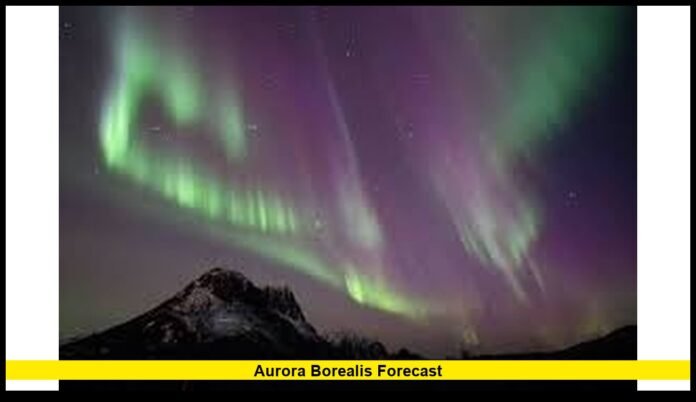

A spectacular celestial event is unfolding this week, as the latest aurora borealis forecast indicates strong potential for northern lights visibility across a large portion of the United States. Driven by an unusually powerful geomagnetic storm, this phenomenon could transform the skies into glowing shades of green, pink, and purple — and not just in Alaska or Canada, but deep into the continental U.S.
Astronomers and space weather experts have confirmed that a severe (G4-level) geomagnetic storm is now active, triggered by a major coronal mass ejection (CME) from the Sun earlier this week. As solar particles stream toward Earth’s magnetic field, skywatchers are preparing for what could be one of the most widespread aurora events of the year.
What’s Behind the Aurora Borealis Forecast
The aurora borealis, or northern lights, occurs when charged solar particles collide with gases high in Earth’s atmosphere. These collisions release photons — tiny packets of light — that illuminate the sky in colorful displays. The intensity and reach of these lights depend on the strength of solar activity.
This week’s aurora borealis forecast is particularly strong because of an X-class solar flare — one of the most powerful categories of solar eruptions. The flare originated from a large, highly active sunspot region that has been closely monitored by NASA and the National Oceanic and Atmospheric Administration (NOAA). When the flare erupted, it sent a wave of plasma and magnetized particles hurtling toward Earth at speeds exceeding 1.5 million miles per hour.
As these particles interact with Earth’s magnetic field, they create disturbances known as geomagnetic storms. The current storm, rated G4 on a scale of G1 to G5, is strong enough to produce visible auroras far south of their normal range — possibly reaching states like Iowa, Pennsylvania, and Oregon.
Current Aurora Borealis Forecast and Geographic Range
According to NOAA’s Space Weather Prediction Center (SWPC), tonight’s aurora borealis forecast shows an expanded “auroral oval” — the zone where lights are visible — stretching much farther south than usual.
Expected Visibility Range:
- High probability: Alaska, northern Canada, North Dakota, Minnesota, Wisconsin, and Michigan.
- Moderate probability: Montana, Washington, Oregon, Iowa, and New England states including Maine and Vermont.
- Possible low-horizon visibility: Northern Illinois, Indiana, Ohio, and Pennsylvania.
For those in southern states, even if the aurora isn’t bright overhead, a faint green or pink glow may appear on the northern horizon if skies are clear and light pollution is minimal.
Best Time to Watch the Aurora Borealis Tonight
Experts agree that the ideal viewing period is between 10:00 PM and 2:00 AM local time, when Earth’s magnetic field is most directly aligned with incoming solar particles. The display may intensify suddenly, fade, and then reappear — so patience is key.
If you’re heading out to watch the aurora:
- Check local forecasts for cloud cover and visibility conditions.
- Move away from city lights — light pollution can easily wash out the display.
- Look toward the northern horizon rather than overhead, especially in mid-latitude regions.
- Bring warm clothing and allow your eyes at least 15 minutes to adjust to darkness.
In areas with darker skies, like rural parts of the Midwest or mountain regions in the Northwest, the aurora could appear as glowing arcs or moving waves of color that shift and pulse across the night sky.
Colors and Patterns to Expect
The colors and patterns of the aurora depend on the type of gas molecules involved and the altitude where the collisions occur:
| Color | Cause | Altitude Range | Typical Appearance |
|---|---|---|---|
| Green | Oxygen molecules | 60–150 miles | Brightest and most common color, appearing as soft glows or arcs |
| Red | High-altitude oxygen | Above 150 miles | Often faint; can appear above green auroras |
| Purple/Pink | Nitrogen molecules | Below 60 miles | Short-lived flashes or borders of green ribbons |
| Blue | Ionized nitrogen | 60–90 miles | Rare, seen in strong storms |
Tonight’s geomagnetic conditions could produce all of these colors, particularly the vivid greens and pinks often captured in time-lapse photography.
How to Photograph the Northern Lights
The aurora is one of the most photogenic natural phenomena — and with a few basic techniques, even amateurs can capture stunning shots.
Photography Tips:
- Use a tripod: Stability is essential for long-exposure photography.
- Manual settings: Set ISO between 800 and 1600, aperture around f/2.8 to f/4, and exposure between 5–15 seconds.
- Turn off flash and autofocus: Use manual focus set to infinity.
- Check your framing: Include foreground elements like trees, water, or mountains for dramatic perspective.
- For smartphones: Use “Night Mode” or a long-exposure app, and keep the device steady for 5–10 seconds.
Pro tip: Even when the aurora looks faint to the naked eye, a long exposure can reveal its hidden color and structure.
Understanding the Kp Index
The Kp index measures geomagnetic activity on a scale from 0 (calm) to 9 (extreme). A higher Kp index means stronger auroras visible farther south. For context:
| Kp Index | Expected Visibility |
|---|---|
| 3–4 | Only far-northern U.S. states |
| 5–6 | Northern tier and upper Midwest |
| 7–8 | Mid-latitude states (PA, OR, IA) |
| 9 | Visible as far south as Texas and Florida |
Tonight’s Kp index is predicted to reach 7 or higher, placing large portions of the U.S. within the potential viewing zone.
Safety and Comfort for Night Skywatchers
While watching the aurora is perfectly safe, a few precautions can make the experience more comfortable and enjoyable:
- Dress warmly: Late-night temperatures can drop quickly.
- Pack essentials: Bring snacks, hot drinks, and a flashlight with a red lens to protect your night vision.
- Stay aware of surroundings: If traveling to rural or isolated areas, go with others and avoid dangerous terrain.
- Check powerlines and roads: Strong geomagnetic storms can occasionally disrupt GPS or local communications.
Unlike solar eclipses, auroras are safe to view with the naked eye — no special eyewear required.
Why This Event Is Especially Notable
This week’s aurora borealis forecast marks one of the strongest in recent years, driven by heightened solar activity as the Sun approaches the peak of its 11-year cycle. Scientists refer to this period as the Solar Maximum, a time when the Sun’s magnetic field reverses and produces more frequent flares and CMEs.
During solar maximum, Earth experiences a surge in auroral events. That means this current storm could be one of several major aurora opportunities over the next 12–18 months.
Additionally, the storm’s intensity has already sparked visible auroras across northern Europe and Canada — with reports of pink and violet hues appearing even in typically southern regions like Germany and Scotland. This suggests the U.S. could experience equally impressive displays overnight.
Regional Weather and Viewing Conditions
Even the strongest aurora won’t be visible if clouds obscure the sky. Here’s a quick look at conditions across key U.S. regions tonight:
- Midwest: Mostly clear skies over Minnesota, Wisconsin, and Michigan — excellent viewing chances.
- Northeast: Partial clouds over New York and Pennsylvania; possible breaks overnight.
- Pacific Northwest: Some cloud cover expected in Oregon and Washington, but clearer inland.
- Rocky Mountains: Clear to partly cloudy — great conditions for states like Montana and Idaho.
- Northern Plains: Clear skies across North Dakota and South Dakota, making for near-ideal visibility.
Technology and Science Impact
While most people view geomagnetic storms for their beauty, they also have scientific and practical implications. A storm of this magnitude can cause temporary disruptions in GPS systems, radio communication, and satellite operations. However, experts emphasize that such effects are typically short-lived and do not pose major risks to the public.
At the same time, scientists use these events to study the interaction between solar wind and Earth’s magnetic field — critical for understanding space weather and protecting modern infrastructure.
The Beauty of the Aurora: Nature’s Light Show
For centuries, the aurora borealis has inspired awe and wonder. Indigenous peoples of the Arctic, including Inuit and Sámi cultures, saw the lights as the spirits of ancestors dancing across the sky. Today, scientists can explain the physics, but the emotional impact remains timeless.
There’s something extraordinary about standing under a sky that glows and moves with color — a reminder that Earth is part of a vast, dynamic system powered by the Sun. Tonight’s storm is one of those rare chances for people across the U.S. to experience that connection firsthand.
What Comes Next
Even after this storm subsides, more auroral activity is likely in the coming weeks. The Sun continues to show strong magnetic activity, meaning additional CMEs could reach Earth soon. As we move through late 2025 and into 2026, forecasters expect frequent aurora sightings across the Northern Hemisphere.
For anyone who misses tonight’s event, this solar cycle offers plenty more opportunities. Keeping an eye on NOAA’s space weather alerts or aurora-tracking apps can help enthusiasts plan their next stargazing adventure.
Final Thoughts
This week’s aurora borealis forecast promises a dazzling show that could paint the U.S. night sky in brilliant color. Whether you’re in Alaska, the Midwest, or the Northeast, tonight offers a rare chance to see one of nature’s most breathtaking displays — no telescope required.
If you catch a glimpse of the northern lights tonight, share your experience in the comments below — let others know where the sky lit up and what colors you saw!