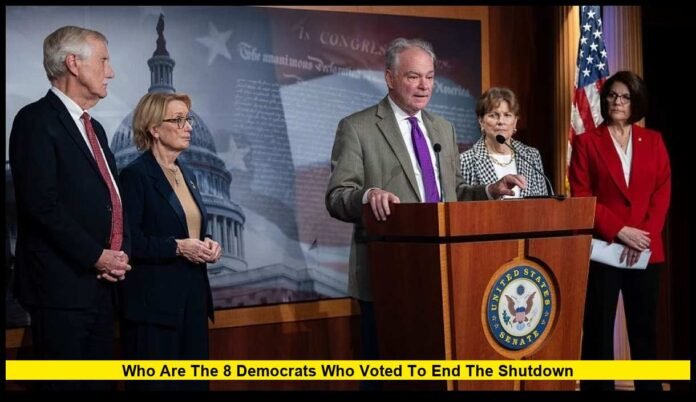

The recent end to the long-running federal government shutdown brought relief across the United States — and sparked major political waves in Washington. The key question many Americans are asking is: who are the 8 Democrats who voted to end the shutdown?
After more than 40 days of frozen paychecks, closed agencies, and rising frustration nationwide, eight Democratic-aligned senators crossed party lines to vote with Republicans to reopen the government. Their decision not only ended the standoff but also revealed deep divisions within their own party.
This detailed analysis breaks down who these eight senators are, why they voted the way they did, what was included in the funding bill, and how their actions may reshape U.S. politics in the months to come.
The Vote That Broke the Deadlock
The federal government shutdown that began in early October 2025 dragged into its sixth week, disrupting essential services, delaying federal payments, and straining families nationwide. Pressure mounted on lawmakers from both sides to find a solution.
Late on November 9, 2025, the Senate held a crucial procedural vote to advance a bipartisan bill aimed at funding the government and ending the shutdown. The motion required 60 votes to proceed — a threshold that Republicans alone could not reach.
That’s when eight members of the Democratic caucus broke with their leadership and sided with Republicans. Their votes made the difference, moving the bill forward and paving the way for the government’s reopening.
The final vote tally was 60–40, and the moment marked a dramatic turning point in a shutdown that had paralyzed Washington for over a month.
Who Are the 8 Democrats Who Voted to End the Shutdown
Here’s the full list of Democratic-aligned senators who supported the measure:
- Catherine Cortez Masto (D–Nevada)
- Jacky Rosen (D–Nevada)
- Maggie Hassan (D–New Hampshire)
- Jeanne Shaheen (D–New Hampshire)
- Tim Kaine (D–Virginia)
- John Fetterman (D–Pennsylvania)
- Dick Durbin (D–Illinois)
- Angus King (I–Maine, caucuses with Democrats)
These eight lawmakers became the deciding factor in moving the shutdown-ending deal forward, sparking immediate debate about party loyalty, political courage, and priorities.
Why These Democrats Broke Ranks
While each senator had unique motivations, several common factors influenced their decisions.
1. Mounting Pressure from Constituents
The shutdown’s economic impact hit home in many of their states.
- In Nevada, federal contractors, hospitality workers, and small businesses felt the strain as tourism-dependent income slowed.
- In Virginia, a state with one of the largest concentrations of federal employees, missed paychecks created financial emergencies.
- In New Hampshire and Maine, rural communities saw delays in benefits such as food assistance and healthcare reimbursements.
These senators faced growing calls from constituents demanding action to end the stalemate, even if it required bipartisan cooperation.
2. Protecting Federal Workers and Vital Services
Senators like Tim Kaine and John Fetterman made it clear that their priority was ensuring federal workers were paid and government services resumed. The bill guaranteed:
- Back pay for furloughed workers.
- Reinstatement for those temporarily laid off.
- Immediate restoration of essential government functions, including food aid, health insurance support, and airport operations.
These protections were viewed as essential, especially for middle-class families living paycheck to paycheck.
3. Political Pragmatism and State Realities
Several of these senators represent states with centrist or swing electorates. They understood that prolonged gridlock risked alienating independent voters who value results over rhetoric.
For instance, Catherine Cortez Masto and Jacky Rosen of Nevada argued that ending the shutdown was necessary to protect working families. Similarly, Maggie Hassan and Jeanne Shaheen of New Hampshire emphasized that continuing the standoff only deepened the hardship for their constituents.
4. Strategic Compromise Over Idealism
The Democratic leadership wanted to tie the reopening of the government to a long-term extension of Affordable Care Act (ACA) premium subsidies — a move Republicans opposed. The eight Democrats who voted to reopen the government believed a better strategy was to separate the two issues: reopen first, negotiate health-care subsidies next.
Their reasoning was simple — every additional day of shutdown meant more financial pain for Americans.
Inside the Senate: A Tense and Emotional Vote
The late-night Senate session was tense. Many Democrats stood firm behind their leadership, arguing that the deal on the table lacked sufficient guarantees for healthcare protections. Others, however, said the party could not afford to keep the government shuttered.
When the final votes were counted, the chamber fell into a brief silence — then erupted in a mix of applause and quiet outrage.
Some progressives accused the eight senators of “breaking faith” with their party, while moderates praised them for prioritizing “people over politics.”
For the eight senators, it was a moment of difficult choice — balancing loyalty, pragmatism, and public duty.
What the Funding Bill Includes
The bill that passed the Senate and moved toward final approval was primarily a continuing resolution, designed to keep the government funded temporarily while lawmakers worked on a broader budget agreement.
Key provisions included:
- Full reopening of all federal agencies and departments.
- Back pay for all furloughed federal employees and contractors.
- Restoration of suspended benefits such as SNAP and WIC.
- Temporary funding extension through January 2026.
- A commitment to revisit Affordable Care Act subsidies in December 2025.
While not a sweeping reform package, the bill was seen as a lifeline for millions affected by the shutdown.
The Fallout Within the Democratic Party
Internal Friction and Backlash
The decision by eight senators to vote with Republicans immediately triggered backlash within the Democratic ranks. Progressive lawmakers called it a “surrender,” arguing that Democrats gave up valuable leverage for too little in return.
Party leadership faced a difficult balancing act — defending unity while acknowledging the real-world consequences of a prolonged shutdown. Some Democrats privately admitted that while they disagreed with the vote, they understood the pressure their colleagues faced.
The Moderate-Progressive Divide
This vote has highlighted an ongoing fault line in the Democratic Party: the divide between its moderate and progressive wings. Moderates emphasize results and bipartisan solutions, while progressives push for unwavering adherence to party principles and policy goals.
The eight senators’ votes may signal a broader shift toward pragmatic governance, especially among Democrats representing competitive states.
Public Reaction: Relief and Debate
Reactions across the country were mixed but passionate.
- Federal employees celebrated the vote, knowing that long-overdue paychecks were finally on the way.
- Small business owners dependent on government contracts expressed gratitude that work could resume.
- Progressive activists, however, voiced disappointment that Democrats compromised on ACA subsidies and other social protections.
Public opinion polls following the vote suggested most Americans supported reopening the government, regardless of which party initiated the deal. The message was clear: voters wanted relief, not rhetoric.
Political Implications Moving Forward
1. The 2026 Midterm Calculations
The decision by these eight Democrats could have long-term electoral consequences.
- In swing states like Nevada, Pennsylvania, and New Hampshire, their votes may bolster their reputations as practical problem-solvers.
- In solidly blue states, however, progressives may target some of them with primary challenges, arguing they “caved” too easily.
2. Party Strategy Reevaluation
The Democratic Party will need to reassess how it approaches budget standoffs and shutdown negotiations in the future. The episode revealed both the power of moderate voices and the risks of internal fragmentation.
3. A Test of Leadership
Senate and House Democratic leaders now face a test: can they maintain unity in future budget negotiations while allowing room for political independence among their members?
Why This Vote Matters
The question of who are the 8 Democrats who voted to end the shutdown goes beyond simple names. It represents a defining moment in modern American politics — one where principle, pragmatism, and pressure collided.
The vote reflects:
- The complexity of governing in a divided Congress.
- The real-life impact of political gridlock on millions of Americans.
- The courage — and risk — of breaking with party leadership in pursuit of immediate relief for citizens.
The eight senators who supported the deal may face criticism from within their party, but they have also positioned themselves as voices for action in times of crisis.
Table: Breakdown of the Eight Senators and Their Stated Priorities
| Senator | State | Primary Motivation for Vote |
|---|---|---|
| Catherine Cortez Masto | Nevada | Reopen government to relieve hardship for working families. |
| Jacky Rosen | Nevada | Prioritized bipartisanship and relief for small businesses. |
| Maggie Hassan | New Hampshire | Cited rising costs and instability for middle-class households. |
| Jeanne Shaheen | New Hampshire | Believed reopening was a first step to protecting healthcare later. |
| Tim Kaine | Virginia | Focused on protecting federal workers and ensuring back pay. |
| John Fetterman | Pennsylvania | Condemned political brinkmanship and demanded government restoration. |
| Dick Durbin | Illinois | Acknowledged imperfection but emphasized duty to end the stalemate. |
| Angus King | Maine | Urged practical action to restore stability across government. |
What Comes Next
As the bill moves through final approval and the government resumes operations, attention shifts to upcoming negotiations over health care subsidies and the long-term federal budget.
The promised December vote on ACA premium tax credits will be a crucial moment. If Democrats succeed in passing the measure, the eight senators’ gamble will look justified. If not, critics will claim they gave up too soon.
Meanwhile, voters will be watching closely to see whether the reopening leads to meaningful cooperation or simply delays another shutdown showdown in early 2026.
A Defining Moment in Modern Governance
This episode will be remembered as a case study in political compromise. The decision by these eight Democrats may have saved millions of Americans from further hardship — but it also reopened debates about the price of bipartisanship.
Their votes broke the deadlock, restored government stability, and perhaps reshaped the tone of future negotiations in Washington. But it also underscored an enduring truth: in a deeply divided Congress, even small acts of defiance can carry enormous consequences.
The eight Democrats who voted to end the shutdown took a stand — one that will define their legacies and influence the course of U.S. politics well beyond 2025.
What do you think — were they right to prioritize compromise over confrontation? Share your thoughts below and stay updated on every new development.
FAQ
Q1: Who are the 8 Democrats who voted to end the shutdown?
They are Catherine Cortez Masto, Jacky Rosen, Maggie Hassan, Jeanne Shaheen, Tim Kaine, John Fetterman, Dick Durbin, and Angus King.
Q2: Why did they break from their party?
They said the ongoing shutdown was harming families, workers, and the economy, and that reopening the government was more urgent than continued political posturing.
Q3: Does this vote guarantee future cooperation in Congress?
Not necessarily. While it showed that bipartisanship is possible, it also deepened divisions within the Democratic Party, making future negotiations more complex.
Disclaimer:
This article is written for informational and educational purposes only. It does not promote, endorse, or criticize any political figure or policy. All details reflect the situation as of November 11, 2025.