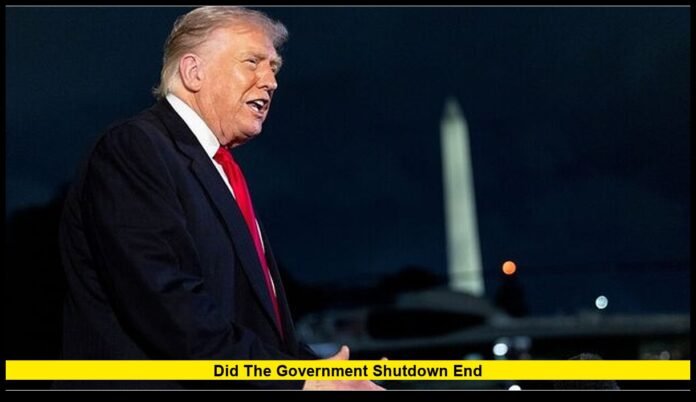

The question “Did the government shutdown end” has been at the center of national attention as the United States moves toward resolving what has become its longest federal funding lapse in modern history. As of November 10, 2025, the shutdown has not officially ended, but progress has been made. The Senate voted 60-40 on November 9 to advance a bipartisan funding bill that could bring the shutdown to a close within days if approved by the House and signed by President Donald Trump.
Senate Vote Marks Major Step Toward Ending the Shutdown
In a significant development, the U.S. Senate passed a procedural motion to move forward with a funding measure that would keep the government operating through January 30, 2026. This vote signals a potential turning point in a shutdown that has stretched past 40 days, disrupting millions of lives and halting key federal services.
The funding bill includes:
- Temporary funding for major federal agencies.
- Provisions ensuring back pay for federal employees and military personnel.
- Full-year appropriations for areas such as veterans affairs, agriculture, and military construction.
This vote represents the first bipartisan breakthrough after weeks of partisan stalemate and economic strain across multiple sectors.
Why the Government Shutdown Hasn’t Officially Ended
Despite the Senate’s progress, the answer to “Did the government shutdown end” remains no—at least for now. The legislation must still pass the House of Representatives before reaching President Trump’s desk for signature.
Several factors are delaying the official reopening:
- Some lawmakers in the House are pushing for additional amendments before final passage.
- Debate continues over health-care funding, particularly the extension of Affordable Care Act (ACA) premium subsidies.
- Even after approval, government agencies will require time to restore normal operations following weeks of disruption.
Until the House vote and presidential approval occur, federal employees remain in limbo, and many public services continue to operate at limited capacity.
A Timeline of Key Events
| Date | Event |
|---|---|
| October 1, 2025 | Government funding expired, triggering the current shutdown. |
| October–November 2025 | Multiple funding bills failed in both chambers, extending the shutdown to over 40 days. |
| November 9, 2025 | Senate advanced a bipartisan bill to fund the government through early 2026. |
| November 10, 2025 | House members notified to prepare for an upcoming vote on the Senate bill. |
This timeline highlights how prolonged negotiations and political divides have delayed relief for federal workers and American families dependent on federal programs.
Major Issues Behind the Deadlock
The shutdown was primarily driven by disputes over federal spending priorities and health-care funding. The main points of contention include:
- Affordable Care Act subsidies: Democrats sought to extend these subsidies, while some Republicans opposed additional funding without offsetting cuts.
- Spending reductions: Fiscal conservatives demanded stricter limits on discretionary spending, while moderates urged a more balanced approach.
- Program impacts: Agencies overseeing food assistance programs, national parks, and transportation saw widespread disruptions. The SNAP food-aid program experienced payment delays, and air travel was affected by staffing shortages among federal workers.
The standoff reflects deeper ideological differences in Congress over how to manage long-term budget priorities and social program funding.
Impact on Federal Workers and Public Services
The ongoing shutdown has had a substantial human and economic toll. Hundreds of thousands of federal employees have missed paychecks, and agencies have been forced to suspend or scale back essential operations.
- Federal employees: Many remain furloughed or working without pay, awaiting the eventual passage of back pay provisions.
- Public services: Passport applications, housing assistance, and loan programs have slowed considerably.
- Travel and transportation: TSA and FAA staff shortages caused delays at major airports.
- Economy: Small businesses that depend on federal contracts or tourism around national parks have reported significant revenue losses.
The longer the shutdown lasts, the deeper its economic effects become—particularly for lower-income families and local economies dependent on government spending.
What Happens Next
With the Senate’s approval secured, attention now shifts entirely to the House of Representatives. Lawmakers are expected to vote on the funding bill within the next few days. If passed, it will be sent to President Trump for final approval.
If the president signs the bill:
- Federal employees will receive back pay.
- Government agencies will reopen and resume normal operations.
- Essential services like SNAP, veterans’ programs, and national parks will return to full capacity.
If the bill stalls, however, the shutdown could continue, extending economic uncertainty and political pressure on both parties.
How Close Are We to the End?
Although the shutdown is not officially over, the recent Senate vote marks the most promising progress yet. Both parties appear motivated to avoid extending the crisis further, especially as public frustration grows. Once the House votes and the president signs the measure, the government could reopen within 24 to 48 hours.
Still, challenges remain. Lawmakers will need to revisit long-term spending priorities in early 2026, meaning another budget showdown could be possible if deeper fiscal issues remain unresolved.
The Bottom Line
So, did the government shutdown end? Not yet — but it is on the verge of concluding. The Senate’s action on November 9 represents a crucial breakthrough after weeks of political gridlock. The House is now the final hurdle before government operations can resume, restoring stability for federal employees and millions of Americans affected by the shutdown.
The coming days will determine whether Washington can finally bring this historic shutdown to an official close.
What do you think about the ongoing shutdown situation? Share your views below and let us know how it’s affecting you or your community.