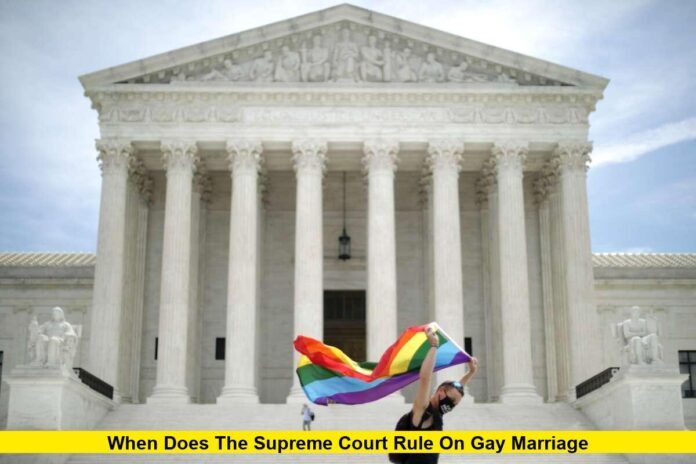

The question “when does the Supreme Court rule on gay marriage” has become one of renewed public interest in 2025 as discussions about the landmark Obergefell v. Hodges decision continue to surface. Same-sex marriage was legalized nationwide in 2015, but recent petitions and social debates have brought the issue back into national focus.
The Landmark Ruling: 2015 and Its Lasting Impact
In June 2015, the Supreme Court issued its historic ruling in Obergefell v. Hodges, holding that same-sex couples have a constitutional right to marry. This 5–4 decision effectively made same-sex marriage legal across all 50 states and required states to recognize marriages performed elsewhere.
The decision transformed American family law, ensuring that same-sex couples had equal access to marriage rights, protections, and benefits under the Fourteenth Amendment. It also overruled state bans and constitutional amendments that had previously restricted marriage to heterosexual couples.
Ten years later, the Obergefell decision remains a cornerstone of LGBTQ+ civil rights, symbolizing both progress and equality before the law. However, political shifts and legal petitions have prompted renewed scrutiny over whether the Supreme Court might revisit the ruling.
Current Status: Will the Supreme Court Rule Again?
As of November 2025, the Supreme Court has not issued any new ruling on same-sex marriage. The existing precedent from 2015 remains in full force, meaning that same-sex marriage continues to be legal and recognized nationwide.
However, earlier in 2025, a formal petition was filed asking the Court to reconsider the Obergefell decision. The case stems from claims that the ruling conflicts with states’ rights and religious freedom protections. The petition argues that the 2015 decision was constitutionally overreaching and should be reviewed under a new legal lens.
The Supreme Court is currently reviewing whether it will accept that petition for a full hearing. This decision — whether to grant or deny review — is expected during the current term. If the Court chooses to hear the case, oral arguments would likely take place in 2026, with a potential ruling later that year.
Until then, there is no new date scheduled for a Supreme Court ruling on gay marriage. The original Obergefell ruling remains the standing law of the land.
Understanding How Supreme Court Review Works
The Supreme Court does not automatically rule on every case submitted. Petitioners must request the Court to hear a case by filing a petition for a writ of certiorari. At least four justices must agree to hear the case.
Once a petition is granted, the case is placed on the Court’s docket. Oral arguments are scheduled months in advance, followed by private deliberations among the justices. The Court’s decision is typically announced at the end of its term, which runs from October through late June of the following year.
In the context of same-sex marriage, if the Court were to grant review in 2025, the earliest possible ruling would likely be announced around June 2026 — mirroring the typical pattern of major civil rights decisions being released at the end of a term.
Marriage Equality and Federal Protections
Even if the Supreme Court were to revisit the Obergefell precedent, same-sex couples currently have added protection through the Respect for Marriage Act, signed into law in 2022.
This federal law requires the federal government and all states to recognize marriages validly performed in other states, regardless of the sex, race, or national origin of the spouses. This means that even if Obergefell were overturned, same-sex couples would still retain federal recognition of their marriages, though state licensing laws could vary.
The Respect for Marriage Act was introduced to safeguard marriage equality in response to concerns that future Supreme Court decisions could revisit previous rulings.
Key Dates and Milestones
| Year | Event |
|---|---|
| 2015 | Supreme Court legalizes same-sex marriage nationwide in Obergefell v. Hodges. |
| 2022 | Respect for Marriage Act signed, reinforcing federal recognition of all marriages. |
| 2025 | Petition filed urging the Court to reconsider the Obergefell ruling. |
| 2026 (Possible) | Potential year for new oral arguments or decisions if SCOTUS agrees to review. |
Public and Political Response
The possibility of a new Supreme Court review has reignited political and social debate across the country. Civil rights advocates emphasize the importance of preserving marriage equality as a fundamental right, while some groups continue to challenge the legal reasoning behind Obergefell.
Public opinion polls show that the vast majority of Americans support same-sex marriage, with approval rates above 70%. Support is strong among younger generations, while opposition has declined steadily over the past decade.
Political analysts suggest that even if the Supreme Court were to reconsider aspects of the 2015 decision, a full reversal would face immense public backlash and logistical challenges at both state and federal levels.
What’s Next?
The key question — when does the Supreme Court rule on gay marriage — currently depends on whether the Court decides to revisit the issue. The process unfolds in stages:
- Petition Review: The Court decides whether to accept the case.
- Briefing and Oral Arguments: If accepted, both sides present written and oral arguments.
- Deliberation: The justices meet privately to discuss and vote.
- Decision: The ruling is announced, typically by June of the following term.
As of today, the Court has not agreed to hear any new same-sex marriage cases, meaning the 2015 Obergefell decision continues to define marriage equality in the U.S.
The Broader Significance
Marriage equality remains one of the defining civil rights victories in modern American history. The Supreme Court’s 2015 decision did more than legalize same-sex marriage — it redefined the constitutional understanding of equal protection.
The continued debate reflects deeper questions about the balance between individual rights, state powers, and religious freedoms. Regardless of future rulings, the social and cultural shift brought about by Obergefell has proven enduring.
In conclusion, the Supreme Court has not set a new date to rule on gay marriage. The 2015 Obergefell v. Hodges decision remains the law of the land, ensuring that same-sex marriage is recognized across the United States. However, ongoing petitions and political discussions mean that this topic could reappear before the Court in the near future.
Stay tuned for verified updates as the Court announces whether it will take up the issue again. What are your thoughts on the possibility of the Supreme Court revisiting this landmark ruling? Share your opinion below.