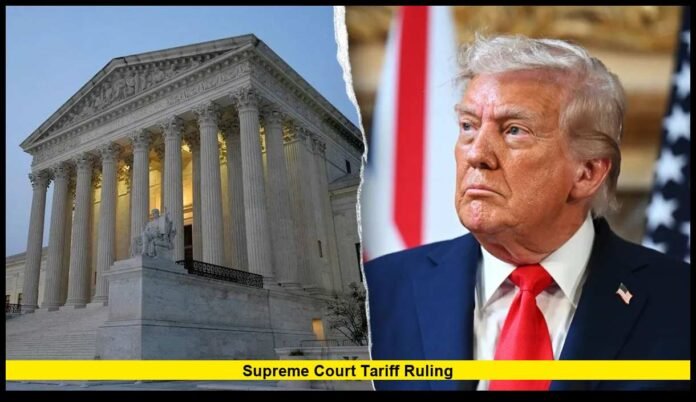

In a significant development, the Supreme Court tariff ruling has drawn national attention as the justices weigh the limits of presidential authority to impose import tariffs using emergency-powers statutes. The case, which centers on tariffs enacted under the International Emergency Economic Powers Act (IEEPA), could redefine how trade power is shared between the executive branch and Congress.
Latest Updates
As of November 2025, the Supreme Court has completed oral arguments on the legality of broad tariffs imposed through executive action. Several justices expressed skepticism about whether IEEPA, a statute designed for targeted economic sanctions, can be used to levy sweeping import duties on foreign nations. The decision, expected by early 2026, is anticipated to have a profound impact on trade law, executive authority, and U.S. foreign commerce policy.
The ruling could determine whether future presidents may rely on emergency statutes to adjust trade policy without congressional approval. Legal experts say it is one of the most consequential trade cases to reach the high court in decades, potentially reshaping the balance of power in U.S. governance.
Why the Case Matters
The case before the Supreme Court stems from tariffs enacted under an emergency declaration, claiming national security and economic threats from global imports. Critics argue that such use of IEEPA violates the Constitution’s separation of powers, since the authority to regulate commerce with foreign nations belongs primarily to Congress.
Key points at stake include:
- Whether the President can impose tariffs unilaterally under IEEPA.
- Whether the law, as written, provides clear authority for such tariffs.
- Whether Congress must play a more active role in defining trade policy.
A lower court earlier ruled that the tariffs exceeded the President’s statutory authority, describing them as “ultra vires” — beyond the scope of lawful power. That decision was appealed and is now under Supreme Court review.
Key Legal Issues Under Review
- Statutory Authority
The Supreme Court must decide whether IEEPA — primarily enacted to address national security and financial emergencies — allows the President to impose tariffs as a form of economic leverage. - Major Questions and Non-Delegation
Another major issue is whether Congress delegated too much legislative power to the executive branch. The “major questions” doctrine argues that decisions of vast political or economic significance must come from Congress, not through administrative or executive interpretation. - Constitutional Role of Congress
The Constitution grants Congress the power to “regulate commerce with foreign nations.” The justices must decide whether the President overstepped this boundary by using emergency powers for general tariff policy rather than targeted sanctions.
Timeline of the Dispute
| Date | Event |
|---|---|
| April 2025 | President announced new import tariffs invoking emergency powers under IEEPA. |
| May 2025 | A federal court ruled the tariffs unlawful, stating the executive branch lacked authority to impose them. |
| June 2025 | The administration appealed the decision, allowing tariffs to remain temporarily in effect. |
| November 2025 | The Supreme Court heard oral arguments on the case. A final ruling is pending. |
Potential Outcomes and Implications
- If the Supreme Court Upholds the Tariffs:
The President’s ability to impose tariffs under emergency powers will be expanded. This outcome would give the executive branch greater independence in trade matters, potentially bypassing congressional oversight in future crises. - If the Supreme Court Invalidates the Tariffs:
The decision would reaffirm Congress’s constitutional authority over trade. It would also limit the scope of emergency powers, signaling that sweeping economic measures require legislative approval. - Broader Impact:
- The ruling could influence how future presidents handle trade disputes or sanctions.
- Businesses relying on imported goods could face continued uncertainty until the Court’s opinion clarifies the limits of tariff authority.
- International partners will closely watch the decision, as it may affect global trade stability and U.S. credibility in negotiations.
Impact on Stakeholders
- Small Businesses:
Import-reliant industries have reported increased costs due to fluctuating tariffs. Many small firms argue that unpredictable policy shifts harm competitiveness and supply chain stability. - Manufacturers and Retailers:
A restrictive decision could lower import costs and restore predictability. Conversely, an expansive ruling could embolden future administrations to use tariffs more aggressively, raising prices for raw materials and finished goods. - Economists and Legal Scholars:
Experts view this case as a landmark in defining the boundaries of executive power. It could shape how future courts interpret the non-delegation doctrine and the extent of presidential discretion in economic policymaking. - International Relations:
The ruling will likely influence diplomatic and trade strategies with key partners. A narrow ruling against the tariffs could reassure allies that U.S. trade policy remains bound by legislative oversight.
Current Status
The Supreme Court has not yet issued its decision. The arguments have concluded, and the justices are expected to deliberate through the end of the year. A final opinion could arrive as soon as December 2025 or early 2026.
Observers note that the tone of questioning during arguments suggests a divided bench. Some conservative justices appeared sympathetic to executive flexibility, while others expressed concern about unchecked presidential power.
Whatever the outcome, the Supreme Court tariff ruling will likely redefine the limits of emergency powers and the constitutional balance between the President and Congress in managing U.S. trade policy.
Looking Ahead
The final ruling could have ripple effects across multiple policy areas — including sanctions, national security, and climate-related trade measures. Both policymakers and businesses are preparing for potential adjustments depending on how the justices interpret IEEPA and executive authority.
Many analysts believe Congress may respond by revising the statute to clarify when and how the President may impose tariffs under emergency declarations. This could create a more defined framework for future administrations and reduce the likelihood of constitutional conflicts.
The Supreme Court tariff ruling represents more than a single legal dispute — it is a test of how far executive power can reach in shaping America’s economic destiny.
The decision will shape U.S. trade policy and political power for years to come — stay tuned, and share your thoughts on what this ruling could mean for America’s future.