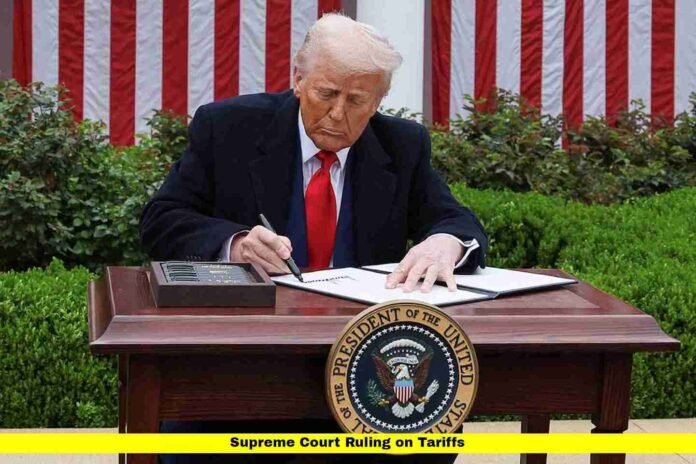

The supreme court ruling on tariffs has captured national attention as the justices weigh whether the executive branch can impose sweeping import tariffs without congressional approval. This case, which challenges the scope of presidential power under the International Emergency Economic Powers Act (IEEPA), could redefine how the United States handles trade policy. In early November 2025, the Supreme Court questioned the legality of tariffs imposed during the Trump administration, sparking intense debate across the political and economic landscape.
What the Court Hearing Revealed
During the recent Supreme Court hearing, justices expressed clear skepticism about whether a president has the authority to impose tariffs under emergency economic powers. Chief Justice John Roberts and several others pointed out that the IEEPA—used as the legal foundation for these tariffs—does not explicitly mention tariffs or duties. This raised concerns about whether the executive branch had overstepped the boundaries of its constitutional powers.
The government argued that the tariffs in question were regulatory rather than revenue-raising, claiming they were intended to protect national interests rather than generate income. However, several justices questioned this justification, noting that such measures still have major financial and trade consequences. Legal experts believe the outcome of this case could shape the future of executive authority, determining how much power presidents have to unilaterally set trade policies without congressional input.
Observers from both political sides agreed that the ruling could have far-reaching consequences. If the Supreme Court rules that the tariffs were illegal, it would set a precedent limiting presidential discretion in trade and potentially invalidate other executive-based economic actions.
Potential Impacts for Trade and Business
The potential implications of this ruling extend far beyond Washington. Businesses, consumers, and international trading partners are closely watching the outcome, knowing it could reshape the U.S. trade environment.
If the Supreme Court strikes down the tariffs, companies affected by import duties may seek refunds for billions of dollars paid under the tariff system. This would create administrative and logistical challenges for federal agencies managing trade revenue. It could also trigger a wave of refund claims and new compliance requirements for U.S. Customs and Border Protection.
Internationally, the uncertainty surrounding U.S. tariff authority could impact negotiations with key partners like China, India, and Mexico. Countries that had structured trade agreements or retaliatory measures around existing tariffs may have to renegotiate terms. This ripple effect could delay trade deals and alter global market stability.
Domestically, consumers might see shifts in pricing as import costs fluctuate. A ruling that limits tariff power could lower costs on certain goods but might also reduce leverage for U.S. negotiators during trade disputes. In short, the decision will influence not just businesses but everyday economic realities for millions of Americans.
Timeline of Key Milestones
The case challenging presidential tariff powers has unfolded over several years, involving multiple court rulings and appeals.
In May 2025, a federal trade court found that many of the tariffs enacted under emergency powers exceeded legal boundaries. That decision argued that the president had overstepped authority by bypassing congressional approval. The administration quickly appealed, insisting that the tariffs were justified under national security concerns.
By August 2025, the appeals court upheld much of the lower court’s decision but delayed enforcement to allow the Supreme Court to review the issue. On November 6, 2025, the Supreme Court heard oral arguments and signaled doubt about the legality of the executive’s actions. A final decision is expected sometime in early 2026.
Each phase of this case reflects the ongoing tension between Congress’s constitutional trade authority and the president’s growing influence in setting economic policy. It has become one of the most closely watched legal battles of the year.
The Legal Questions at the Heart of the Case
At the center of this landmark case are fundamental legal and constitutional questions. The first revolves around statutory authority—specifically, whether the IEEPA grants a president the power to impose tariffs during an economic emergency. Enacted in 1977, the IEEPA allows the president to regulate commerce to deal with national threats, but it never explicitly authorizes tariffs. Justices questioned whether stretching this law to include tariffs aligns with legislative intent.
Another issue is Congressional Power. The U.S. Constitution clearly grants Congress the power to impose taxes and regulate trade. Critics argue that the tariffs in question bypassed Congress entirely, undermining the system of checks and balances designed to prevent executive overreach.
A third key principle is the Major Questions Doctrine, a legal standard requiring that significant economic or political decisions be explicitly authorized by Congress. Several justices suggested that imposing nationwide tariffs with global impact qualifies as a “major question,” meaning it should not fall under vague statutory language or presidential discretion.
Together, these questions highlight the tension between swift executive action and the constitutional limits of power. The court’s decision will likely establish new guidelines for how future administrations can manage economic crises.
What Happens Next
Following the November 2025 hearing, the justices will deliberate and issue a ruling in the coming months. Legal experts expect a decision in early 2026. In the meantime, trade officials and business leaders are preparing for various possible outcomes.
If the court sides against the executive branch, the decision could invalidate some of the tariffs still in effect. This would require federal agencies to create mechanisms for refunding duties collected under the now-illegal tariffs. It could also force Congress to take a more active role in trade legislation, potentially passing new laws to clarify presidential powers under emergency economic acts.
On the other hand, if the court upholds the tariffs, it would strengthen executive authority and give future presidents greater flexibility to use trade measures as a policy tool. This outcome could unsettle global markets by confirming that the U.S. president can unilaterally impose tariffs without congressional consent.
Either way, the decision will have a profound effect on global trade stability, as partners reassess how they engage with U.S. economic policy.
Why This Matters to Everyone
While the issue may seem confined to legal circles, the supreme court ruling on tariffs affects everyone—from major corporations to everyday consumers. Tariffs influence prices on imported goods like electronics, automobiles, and food products. If tariffs are reduced or overturned, consumers could benefit from lower prices. Conversely, if tariffs remain or expand, they could raise costs on everyday items.
For businesses, clarity on the limits of presidential power is crucial for long-term planning. Manufacturers and importers rely on predictable trade policies to set production targets, pricing, and employment strategies. Constant shifts in tariff authority can lead to uncertainty, reduced investment, and volatile markets.
On a broader scale, the case also carries political and constitutional weight. It defines how much power the executive branch holds over economic policy—a debate that has grown increasingly relevant in today’s globalized and politically polarized environment.
The ruling will not just affect trade but could influence future cases related to presidential powers in areas such as environmental regulation, energy policy, and digital commerce. It represents a defining moment for how the U.S. balances fast decision-making in times of crisis with the democratic principles of legislative oversight.
Final Thoughts
The supreme court ruling on tariffs marks one of the most significant legal moments in recent years. It’s more than a trade issue—it’s about the boundaries of presidential authority and the role of Congress in safeguarding economic balance.
As the justices deliberate, industries, economists, and policymakers await a decision that could reshape U.S. trade policy for decades. Whether the court limits executive tariff powers or upholds them, the outcome will influence global markets and the way America conducts international commerce.
In the end, this case is a reminder that constitutional questions often have real-world consequences. The verdict will determine not just who controls trade policy but also how power itself is distributed in the American system. What are your thoughts on this historic case? Share your perspective and stay tuned as the nation awaits the court’s final decision.