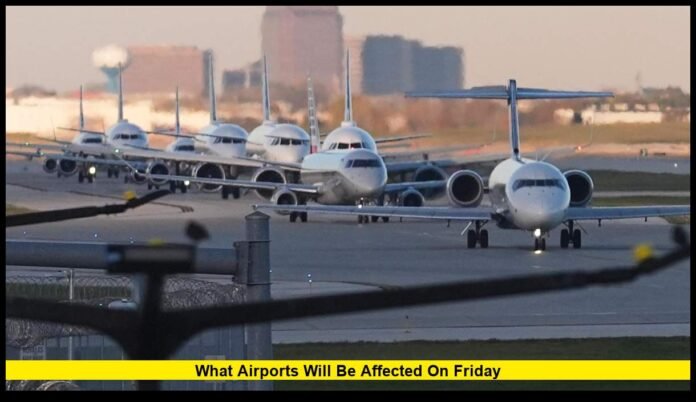

If you’re wondering what airports will be affected on Friday, the Federal Aviation Administration (FAA) has released a detailed advisory for Friday, November 8, 2025, forecasting significant flight disruptions across multiple regions of the United States. A powerful winter storm system moving across the Midwest and Northeast — combined with heavy rain and thunderstorms in the South — is expected to cause widespread delays and cancellations.
Travelers should brace for one of the busiest and most challenging travel days of the fall season. The latest FAA and National Weather Service (NWS) reports show that several major U.S. airports, including Chicago O’Hare, New York’s JFK, Atlanta Hartsfield-Jackson, and Boston Logan, are likely to face operational slowdowns due to weather and air traffic congestion.
Here’s a complete breakdown of the current forecasts, the airports most likely to be affected, and what passengers can do to minimize disruptions.
FAA and Weather Overview for Friday, November 8, 2025
The FAA’s Air Traffic Control System Command Center (ATCSCC) is closely monitoring a large storm system that is expected to bring snow, wind, and ice to northern states while sparking thunderstorms and low visibility in southern regions.
The National Weather Service has issued Winter Storm Warnings for at least eight states, stretching from Colorado to Maine, along with Severe Thunderstorm Watches across the Southeast. This combination of weather patterns will create delays at both departure and arrival airports.
Key weather highlights for Friday:
- Heavy snow and freezing rain in the Midwest and Northeast.
- Strong crosswinds up to 45 mph affecting runway operations in Boston, Chicago, and New York.
- Thunderstorms in Texas, Georgia, and the Carolinas causing flight holds and reroutes.
- Fog and coastal winds expected in California and the Pacific Northwest during the early morning hours.
Overall, travelers should expect multi-hour delays, particularly during peak travel times between 7 a.m. and 2 p.m. local time.
List of Major Airports Expected to Be Affected
Based on FAA and NWS forecasts, the following airports are most likely to experience disruptions on Friday:
| Region | Airports Impacted | Primary Cause of Delay |
|---|---|---|
| Northeast | JFK (NY), LaGuardia (NY), Newark (NJ), Boston Logan (MA), Philadelphia (PA) | Snow, freezing rain, and 50 mph gusts. |
| Midwest | Chicago O’Hare (IL), Chicago Midway (IL), Detroit Metro (MI), Minneapolis–St. Paul (MN) | Heavy snow, strong winds, runway closures. |
| South & Southeast | Atlanta Hartsfield-Jackson (GA), Charlotte Douglas (NC), Dallas/Fort Worth (TX), Nashville (TN) | Thunderstorms and low visibility. |
| West Coast | Los Angeles (CA), San Francisco (CA), Seattle (WA), Portland (OR) | Morning fog, coastal winds, and low ceilings. |
The FAA Command Center has already issued potential Ground Delay Programs (GDPs) for several of these airports, meaning departing flights could be held at their origin until weather improves.
Midwest: Snow and Strong Winds Disrupting Operations
The Midwest is expected to experience the most severe weather impacts, with snow accumulations of 4–8 inches in parts of Illinois, Wisconsin, and Michigan. The heaviest snow will fall around Chicago O’Hare International Airport (ORD), where strong crosswinds may lead to temporary runway closures and longer taxi times.
Detroit Metropolitan Airport (DTW) and Minneapolis–St. Paul International (MSP) are also expected to face multiple rounds of de-icing and limited visibility, causing delays to ripple throughout the national network.
Airlines have preemptively canceled some regional flights to free up aircraft and staff for major hubs once conditions improve.
Northeast: Icy Conditions and High Winds Threaten Morning Flights
In the Northeast, a surge of cold Arctic air will meet the leading edge of the storm, producing snow, sleet, and freezing rain from Pennsylvania through New England. Airports such as New York’s JFK and LaGuardia, Newark Liberty International, and Boston Logan International are bracing for high winds that could exceed 50 mph along the coast.
These conditions are likely to force runway configuration changes, ground stops, and de-icing delays throughout the day.
Philadelphia International (PHL) could also experience reduced visibility from snow early Friday morning before transitioning to rain in the afternoon.
Passengers flying out of the Northeast are urged to check flight statuses before leaving for the airport, as schedule adjustments and cancellations are already being reported.
South and Southeast: Thunderstorms and Lightning Holds
While northern states deal with snow, the South and Southeast will see heavy rain and scattered thunderstorms throughout Friday. The FAA is warning of potential lightning-induced ground stops at Atlanta Hartsfield-Jackson International (ATL) — the nation’s busiest airport.
Charlotte Douglas (CLT) and Dallas/Fort Worth (DFW) could also face storm-related disruptions, with forecasts calling for brief but intense thunderstorms and reduced visibility.
Flight delays in this region will likely have a cascading effect across the national system, as many connecting flights pass through these hubs.
West Coast: Fog, Winds, and Maintenance Work
On the West Coast, weather-related slowdowns will primarily come from dense morning fog and crosswinds. San Francisco International (SFO) and Los Angeles International (LAX) are expected to experience reduced visibility during early departures.
Meanwhile, Seattle-Tacoma (SEA) and Portland International (PDX) could see moderate rainfall and gusty coastal winds through midday.
Additionally, ongoing runway maintenance at LAX and taxiway resurfacing in Denver (DEN) are expected to cause minor scheduling delays, particularly for connecting flights heading east.
FAA Operational Response
The FAA has activated its Air Traffic Flow Management (ATFM) system to help maintain order amid expected disruptions. This includes:
- Ground Delay Programs (GDPs) for high-traffic airports such as Chicago, Newark, and Boston.
- Flight re-routes to avoid severe weather cells over the Midwest and Atlantic regions.
- Airspace flow control for busy corridors in the Northeast and Southeast.
- Increased staffing levels at regional Air Traffic Control centers in Chicago, Atlanta, and Washington.
Airlines are coordinating with the FAA to adjust flight schedules and reduce congestion during peak weather periods.
Airline Travel Waivers and Passenger Options
To help travelers manage the chaos, major airlines have announced weather waivers allowing passengers to change their flights without penalty.
Current Waivers (as of Thursday night):
- American Airlines: Free changes for travelers flying through Chicago, Boston, New York, or Dallas.
- Delta Air Lines: Waivers for flights through Atlanta, Minneapolis, and New York.
- United Airlines: Rebooking options for Chicago, Newark, and Cleveland routes.
- Southwest Airlines: Flexible travel options for passengers flying through Denver, Nashville, and Dallas.
- JetBlue Airways: Waivers for Boston, JFK, and LaGuardia flights.
Travelers are encouraged to use airline mobile apps for quick rebooking, as call centers are expected to experience high wait times on Friday.
Tips for Travelers on Friday
Flying on a day with widespread weather disruption requires extra preparation. Here are some essential tips to navigate Friday’s expected challenges:
- Check flight status frequently: Use your airline’s app or the FAA’s delay tracker for real-time updates.
- Arrive early: Get to the airport at least 3 hours before departure to allow for security and check-in delays.
- Keep essentials handy: Pack medications, chargers, and personal items in your carry-on in case of unexpected cancellations.
- Sign up for alerts: Airline text and email notifications can save valuable time if gate changes or delays occur.
- Be flexible: Consider rescheduling for Saturday or Sunday if travel plans allow.
- Expect longer wait times: Security lines and boarding processes will likely move slower due to staffing and weather impacts.
Regional Delay Forecast Summary
| Region | Expected Conditions | Delay Risk |
|---|---|---|
| Northeast | Snow, ice, and strong winds | High |
| Midwest | Heavy snow and freezing temps | Very High |
| South/Southeast | Thunderstorms and wind | Moderate to High |
| West Coast | Fog and coastal wind | Moderate |
Weekend Outlook and Recovery
The worst of the storm system is expected to move off the East Coast by late Friday night, with gradual improvements beginning Saturday morning. However, residual delays and crew shortages could cause lingering disruptions through Sunday, particularly at major hubs like Chicago, Newark, and Atlanta.
Airlines are preparing to add supplemental flights over the weekend to help re-accommodate stranded passengers.
The Bottom Line
For anyone asking what airports will be affected on Friday, the answer is clear — major hubs across the Midwest, Northeast, and South will face widespread weather-related disruptions. From snow in Chicago to thunderstorms in Atlanta, travelers should anticipate significant delays and prepare accordingly.
Are you flying this Friday? Share your travel updates, experiences, or advice in the comments below to help other passengers stay informed.