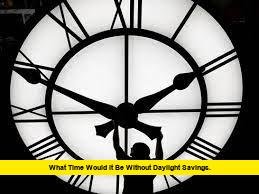

Every November, millions of Americans ask the same question: what time would it be without daylight savings? As of today, November 2, 2025, the United States has just shifted from Daylight Saving Time (DST) back to standard time — meaning clocks have been turned back one hour. If daylight savings didn’t exist, the time right now would be exactly one hour earlier during the months when DST is usually observed.
Understanding Daylight Saving Time
Daylight Saving Time is the practice of setting clocks one hour ahead during the warmer months to extend evening daylight and reduce energy use. It starts in spring and ends in fall, affecting almost every state in the U.S. The goal is to make better use of natural daylight, giving people more light during evening hours.
However, if daylight saving time were never implemented, Americans would stay on standard time year-round. That means every clock reading during the DST period would be one hour earlier. For example, if your clock says 8 p.m. during daylight savings, it would actually be 7 p.m. without it.
Current Status in the U.S.
As of 2025, most states in the U.S. still observe the clock change twice a year — once in March when we “spring forward,” and again in November when we “fall back.” The transition officially occurs at 2:00 a.m. local time, when clocks are set one hour earlier to 1:00 a.m.
A handful of states and territories, including Hawaii, most of Arizona, Puerto Rico, Guam, and American Samoa, do not observe daylight savings at all. These areas remain on standard time all year long, meaning they never have to adjust their clocks or wonder what time it would be without daylight savings — because for them, it already is.
What Time Would It Be Without Daylight Savings?
The simplest way to answer this question is by understanding the direct one-hour difference. Here’s a quick reference:
| Current Time (During DST) | Time Without Daylight Savings (Standard Time) |
|---|---|
| 12:00 a.m. (midnight) | 11:00 p.m. |
| 6:00 a.m. | 5:00 a.m. |
| 12:00 p.m. (noon) | 11:00 a.m. |
| 6:00 p.m. | 5:00 p.m. |
| 10:00 p.m. | 9:00 p.m. |
So, if it’s currently 8 p.m. during Daylight Saving Time, the time without it would be 7 p.m. in standard time.
Why It Feels Different
People often notice that sunsets come earlier in the evening once we return to standard time. Without daylight savings, that earlier sunset would remain consistent all year long.
For instance:
- In New York, sunset would occur around 4:30 p.m. in December and around 7:30 p.m. in June.
- In Los Angeles, sunset would happen around 4:45 p.m. in winter and 7:45 p.m. in summer.
Without daylight savings, mornings would feel brighter earlier, but evenings would darken sooner. The trade-off depends on whether people prefer lighter mornings or longer evenings.
The Debate Over Ending Daylight Savings
Across the country, there’s been ongoing debate about whether to keep or eliminate the practice. Some lawmakers advocate for permanent standard time, arguing that it’s healthier for sleep and overall well-being. Others support permanent daylight saving time, which keeps evenings brighter throughout the year.
The Sunshine Protection Act, a proposed federal bill, would make daylight saving time permanent nationwide. Although it passed the U.S. Senate in 2022, it has not yet become law. That means the biannual clock changes remain in effect for now.
If permanent daylight saving time were adopted, clocks would remain in the “spring forward” position all year. In that case, the question “what time would it be without daylight savings” would have a simple answer — it would always be one hour earlier than the permanent time.
Effects on Daily Life
Without daylight savings, life would adjust in subtle but noticeable ways:
- Work and School: Morning commutes would start in brighter conditions, but evenings would darken earlier, affecting after-school activities and outdoor plans.
- Health and Sleep: Studies show that keeping a consistent time year-round may reduce disruptions to the body’s circadian rhythm.
- Energy Use: Modern data suggests that energy savings from DST are smaller than in the past due to widespread air conditioning and artificial lighting.
- Safety: Traffic accident rates tend to spike immediately after the spring time change, so eliminating the switch could improve safety during transition periods.
States Taking Action
Several states, including Florida, Texas, Oregon, and California, have passed laws supporting year-round daylight saving time. However, federal approval is still required before those laws can take effect. Until Congress changes the national standard, the twice-yearly clock changes will continue.
If these laws were enacted, the U.S. could see a patchwork of time zones unless federal law makes a unified adjustment. That’s why, for now, the question “what time would it be without daylight savings” remains theoretical in most states — but very real in those that never adopted the change to begin with.
Quick Recap
- Without daylight savings, the current time would be one hour earlier during DST months.
- Most of the U.S. continues to change clocks twice yearly.
- Hawaii, most of Arizona, and U.S. territories stay on standard time all year.
- The Sunshine Protection Act could change the system if passed by Congress.
- The issue remains a balance between brighter mornings, longer evenings, and maintaining consistent routines.
In short: If daylight savings didn’t exist, Americans would wake up and go to bed under a slightly different rhythm — one that stayed consistent year-round, an hour behind the current daylight saving schedule.
In your area, what would you prefer — brighter mornings or longer evenings? Share your thoughts below and stay updated as this national discussion continues.