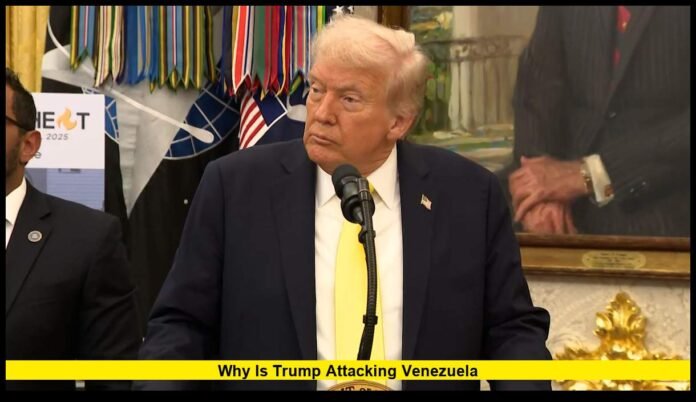

The question “why is Trump attacking Venezuela?” has reemerged in the spotlight as former U.S. President Donald Trump intensifies his rhetoric against the government of Venezuelan President Nicolás Maduro. As of November 2025, Trump has revived his familiar tough stance on Venezuela, accusing its leadership of corruption, aligning with America’s adversaries, and contributing to the U.S. migration crisis. His remarks, delivered at recent campaign rallies and interviews, have fueled debate over whether his attacks are rooted in foreign policy conviction or political strategy ahead of the 2026 elections.
Trump’s Renewed Focus on Venezuela in 2025
In multiple campaign events this fall, Trump has sharply criticized President Joe Biden’s handling of Venezuela, calling the administration “weak” for easing sanctions on the South American nation’s oil sector. Speaking to supporters in Miami, Florida, a state with a large Venezuelan diaspora, Trump declared:
“Joe Biden has given power and profit to one of the world’s most corrupt dictatorships. He’s made Venezuela rich again while American energy workers suffer.”
These remarks came after the Biden administration’s partial sanctions relief deal, which began in 2023 and allowed limited Venezuelan oil exports in exchange for promises of democratic reforms. Trump argues that these concessions have strengthened Maduro’s control while doing little to restore democracy.
His criticism fits a broader theme in his campaign: portraying himself as the candidate of “American strength” who would stand up to authoritarian governments and defend U.S. interests abroad.
Historical Context: The Long U.S.-Venezuela Rift
To understand why Trump continues to attack Venezuela, it’s important to look at the history of U.S.-Venezuelan relations.
For over two decades, Venezuela has been a focal point of tension between Washington and Latin America’s socialist movements. The friction began in 1999 when Hugo Chávez came to power, embracing socialist reforms and forming alliances with Cuba, Russia, and China. His successor, Nicolás Maduro, took office in 2013 and continued Chávez’s anti-U.S. rhetoric while presiding over a deepening economic collapse.
Under Trump’s presidency (2017–2021), the U.S. adopted one of its harshest policies toward Venezuela in modern history:
- Severe economic sanctions targeting the country’s oil industry and government officials.
- Diplomatic recognition of opposition leader Juan Guaidó as Venezuela’s legitimate president in 2019.
- Public threats that “all options are on the table,” including potential military measures.
These policies isolated Venezuela internationally but also deepened the country’s economic crisis, leading to massive shortages and record-level migration.
The Current Situation in Venezuela
As of 2025, Venezuela remains under Maduro’s control. Despite minor economic recovery due to higher oil prices, the country faces widespread poverty, inflation, and political repression.
Over 7.7 million Venezuelans have fled the country, making it one of the world’s largest migration crises. The U.S. has become a key destination for many of these migrants, straining border resources and shaping the domestic debate over immigration.
Trump has repeatedly linked this migration wave to the Biden administration’s foreign policy, claiming that easing restrictions on Venezuela’s oil exports has empowered Maduro while creating new migration challenges for the U.S.
In an October 2025 interview, Trump said:
“Venezuela’s dictatorship is collapsing, and instead of fixing it, Biden sends them money. That’s why millions are coming to our border.”
Energy Politics: Oil, Sanctions, and Power
Energy is one of the biggest reasons Trump continues to attack Venezuela. The country holds the world’s largest proven oil reserves, yet its output has drastically fallen due to corruption, mismanagement, and years of sanctions.
Under Trump’s administration, the U.S. imposed a full oil embargo in 2019, cutting off Venezuela from global markets. This move was meant to pressure Maduro but also increased global oil prices.
When President Biden relaxed sanctions in 2023, American companies like Chevron resumed limited operations in Venezuela, boosting the country’s oil exports. Trump’s campaign has used this policy shift as a political weapon, claiming it helps fund an authoritarian regime.
Trump’s message to voters has been clear:
- The U.S. should boost domestic oil production instead of buying from foreign dictatorships.
- Sanctions relief rewards “anti-American regimes” while hurting American workers.
- Restoring “energy independence” would eliminate the need for Venezuelan oil altogether.
Energy experts, however, note that the U.S. continues to import oil from multiple countries to stabilize global supply chains and prices. Still, Trump’s hardline message resonates strongly with voters in energy-producing states like Texas, Louisiana, and Alaska.
Migration and Border Security: Trump’s Political Leverage
Beyond energy, migration is another reason behind Trump’s renewed attacks.
Venezuela’s economic collapse has triggered a mass exodus of refugees, many of whom have traveled through Central America to the southern U.S. border. Over the past year, the number of Venezuelan asylum seekers entering the U.S. has significantly increased, putting pressure on border patrol resources and sparking partisan debates over immigration reform.
Trump has connected this directly to his campaign promises, arguing that his administration would stop the flow of migrants and impose strict asylum restrictions.
At a rally in Arizona, Trump told supporters:
“We’re seeing thousands coming from Venezuela every month — people escaping socialism. We’ll protect our borders, and we’ll protect America from failed socialist states.”
This messaging aligns with his broader anti-immigration stance, framing the Venezuela crisis as evidence of the dangers of “weak border policy” and “failed socialist governance.”
Geopolitical Tensions: Russia, China, and Iran in the Mix
Trump’s criticism of Venezuela also taps into growing global power struggles. In 2025, Venezuela has deepened its partnerships with Russia, China, and Iran, receiving military support and investment in exchange for oil and strategic access.
Recent reports suggest that China has expanded its role in Venezuela’s oil infrastructure, while Russian advisors continue to assist in defense coordination. These alliances worry Washington policymakers, who see them as a direct challenge to U.S. influence in Latin America.
Trump has seized on this issue, warning that Venezuela could become a “proxy base” for adversaries in the Western Hemisphere. At a rally in Dallas, he stated:
“Venezuela is letting Russia and China plant their flags right in our backyard — and Biden is too weak to stop it.”
By linking Venezuela’s alliances to broader global threats, Trump positions himself as the leader who can confront foreign adversaries and “restore American strength.”
Florida and the Latino Vote: Domestic Politics at Play
Florida plays a critical role in explaining why Trump is attacking Venezuela so forcefully. The state is home to hundreds of thousands of Venezuelan immigrants, many of whom fled the Maduro regime.
For these communities, anti-Maduro rhetoric resonates deeply. Trump’s tough stance has historically earned him strong support among Venezuelan, Cuban, and Nicaraguan voters, who share anti-socialist sentiments.
In the 2020 election, Trump carried Florida largely due to overwhelming backing from Latino voters with roots in socialist or authoritarian-ruled countries. His campaign appears to be doubling down on that strategy ahead of the 2026 elections.
At his Miami rally, Trump directly addressed Venezuelan-Americans:
“You know the pain of socialism. You’ve lived it. You understand better than anyone why we must stop it here.”
This emotional appeal continues to strengthen his base among immigrant communities that associate socialism with hardship and repression.
Venezuela’s Response to Trump’s Attacks
The Venezuelan government has dismissed Trump’s remarks as “imperialist propaganda.” In a statement from Caracas, Maduro’s administration accused the former president of “reviving the failed interventionist policies” that caused suffering for millions of Venezuelans.
State media outlets in Venezuela claim Trump’s comments are designed to “distract Americans from their own political and economic problems.” Despite these criticisms, the Maduro government continues limited back-channel talks with Washington on energy trade and sanctions, signaling a complex relationship that neither side can easily sever.
International Reactions and Latin American Response
Across Latin America, reactions to Trump’s statements have been mixed. Some right-leaning governments, particularly in Colombia and Ecuador, share concerns about Venezuela’s authoritarian rule and migration crisis. However, others view Trump’s rhetoric as overly aggressive and reminiscent of Cold War–era U.S. interventions in the region.
Global analysts note that Trump’s harsh tone may appeal to his political base but could complicate U.S. diplomatic efforts if he returns to power. Venezuela’s allies — Russia, China, and Iran — have used his remarks to portray the U.S. as a “bully state” meddling in Latin America’s affairs.
The Bigger Picture: Trump’s Political Messaging Strategy
Ultimately, Trump’s attacks on Venezuela are about more than just foreign policy — they’re about politics at home.
By targeting Venezuela, Trump taps into three key campaign themes:
- Anti-socialism: Framing Democrats as sympathetic to socialist regimes.
- Strong borders: Using Venezuela’s migration crisis to bolster his immigration agenda.
- Energy independence: Criticizing Biden’s reliance on foreign oil to rally working-class voters.
These issues unify his conservative base while appealing to moderate voters concerned about security and global stability.
Conclusion: Venezuela as a Mirror of Trump’s 2025 Agenda
So, why is Trump attacking Venezuela now? It’s a combination of ideology, strategy, and timing. Venezuela’s authoritarian government provides the perfect target for Trump to contrast his brand of strength with what he portrays as Biden’s weakness. It allows him to link foreign policy, migration, and energy into one clear narrative that resonates with American voters.
While the future of U.S.-Venezuela relations remains uncertain, Trump’s renewed focus ensures the issue will remain part of America’s political conversation well into the 2026 campaign.
What’s your take on Trump’s renewed criticism of Venezuela? Do you see it as genuine policy concern or campaign strategy? Share your thoughts in the comments below!