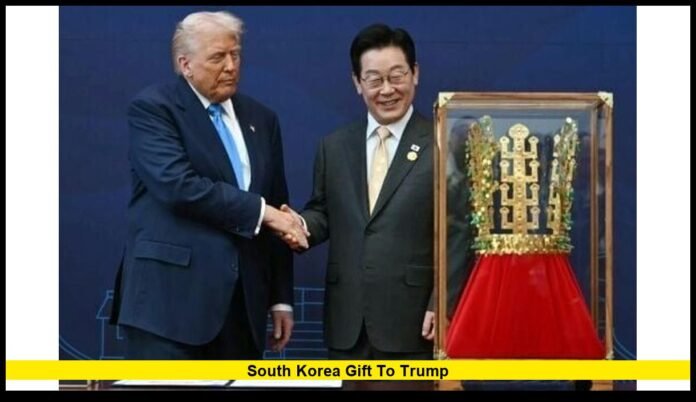

The moment the “South Korea gift to Trump” made headlines began the instant Donald Trump landed in the city of Gyeongju on October 29, 2025. His host, South Korean President Lee Jae‑myung, presented him with an ornate replica of an ancient royal crown alongside the country’s highest civilian honor—the Grand Order of Mugunghwa. The grand gesture underscored more than ceremony; it marked a pivotal moment in U.S.–Korea trade and defense relations.
A Regal Welcome with Real Stakes
From the red-carpet arrival to the synchronized military band playing “YMCA” and a 21-gun salute, Trump’s reception in South Korea was not subtle. The “South Korea gift to Trump” stood out for its bold cultural symbolism. The crown wasn’t just a gift—it was a statement. Crafted in the style of the Silla dynasty’s gold crowns, it embodied “peace on the Korean Peninsula,” according to Korean officials. Meanwhile, the Grand Order of Mugunghwa has traditionally been reserved only for Korean heads of state—making Trump the first U.S. president to receive it.
Behind the pageantry, the visit was packed with negotiations. Seoul and Washington were locked in talks over a $350 billion Korean investment into the U.S. economy—and the possible lowering of U.S. auto tariffs that severely affect Korean manufacturers. So the crown, medal, and lavish welcome were part of a wider diplomatic strategy: to shore up alliance ties and find a breakthrough in trade deadlock.
Gift Details & Symbolism
- The Crown: A replica of a gold crown from the Silla kingdom (7th-10th century), originally unearthed in the Cheonmachong tomb in Gyeongju. The original features towering gold prongs and delicate leaf-shaped ornaments. The replica symbolizes continuity—historic peace and a new era of cooperation.
- The Medal: The Grand Order of Mugunghwa, named after South Korea’s national flower (the hibiscus), represents the highest civilian honor in Korea. Presenting it to Trump signals the depth of the alliance.
- The Setting: Gyeongju, once the capital of the Silla kingdom, housed the ceremony. The choice of location added cultural weight and historical resonance.
The gift wasn’t mere souvenir-level—it was designed as a message. It showed South Korea’s recognition of Trump’s role in prior discussions with Kim Jong Un and cemented South Korea’s commitment to leaning into the U.S. partnership.
Why This Gift Matters for U.S. Audiences
For American readers, the “South Korea gift to Trump” matters on multiple fronts. First, it shows how diplomatic gifts can carry serious weight. This wasn’t a generic plaque—it was a culturally loaded artifact meant to align with Trump’s known taste for spectacle. Second, the gift came paired with concrete policy shifts:
- Negotiations over lowering U.S. auto tariffs on Korean vehicles and parts from 25 % to 15 %.
- Korea’s pledged investment of $350 billion into the U.S., including $200 billion in direct cash commitments and $150 billion in shipbuilding cooperation.
- A heightened defense conversation: Mention of nuclear-powered submarine cooperation and continued U.S.–Korea military alignment.
These factors mean the gesture wasn’t only symbolic; it was tactical. For U.S. companies, auto workers, and national security watchers, what unfolds after the gift could matter more than the gift itself.
Public Reaction and Political Undercurrents
Even as the ceremony displayed unity, domestic reaction in South Korea was mixed. Protesters in Seoul rallied under chants like “No Kings,” criticizing both the opulence and perceived deference in the presentation. The “gift to Trump” thus became part of a broader national debate about sovereignty, alliance dependency, and Korea’s place between the U.S. and China.
In the U.S., the moment is likely to spark discussion around the balance of symbolism and substance. Commentators may question: Does receiving such an ornate gift strengthen or complicate the U.S. position? Does the spectacle overshadow the real progress—or lack thereof—on trade and defense implementation?
The Trade and Investment Context
The timing of the “South Korea gift to Trump” cannot be separated from the broader economic agenda. The Trump administration—and Seoul—entered this meeting with unresolved issues:
- A framework agreed in July for Korea to make large-scale investments in the U.S. economy in return for tariff relief.
- The key stumbling block: how those investments would be structured and the timeline for U.S. auto tariff reductions.
- Days before the gift ceremony, South Korea’s policy chief reported “dramatic progress” toward resolving investment structure disputes.
In other words, the gift came at what both sides considered a make-or-break moment. Seoul hopes that by aligning culturally and diplomatically, it will gain leverage in securing favorable terms.
Security and Alliance Implications
Beyond trade, the gesture feeds into long-term defense and geopolitical strategy:
- South Korea’s alliance with the U.S. remains central amid threats from North Korea, growing Chinese power, and regional instability.
- By linking the gift with security discussions—like South Korea’s request for submarine capabilities—the ceremony signaled an appetite for deeper cooperation.
- For American audiences, the message is that South Korea is actively reinforcing its commitment to the U.S. partnership.
Thus, the ceremonial crown is not divorced from defense diplomacy. Instead, it frames the wider narrative: culture meets strategy.
Critiques and Risks
Despite the spectacle, there are risks tied to this kind of lavish diplomacy:
- Perception of Reciprocity: Critics may argue that presenting such an elaborate gift places South Korea in a position of deference.
- Symbol Over Substance: If the announced trade and investment deals fail to materialize or face delays, the ceremony could be viewed as empty pageantry.
- Political Backlash: Both sides risk push-back—from Korean citizens protesting perceived imbalance, and from U.S. watchdogs questioning alliance costs and bilateral leverage.
These downsides mean that the “South Korea gift to Trump” will be judged in hindsight not only by how visually striking it was, but by how effectively it translated into real outcomes.
What to Monitor Going Forward
If you’re tracking this story from the U.S., here are key indicators to watch:
- Formal agreement sign-off: Will the $350 billion investment and tariff reduction deal be signed—and when?
- Implementation details: How will the investment be structured? Will jobs be created in the U.S.? Are Korean auto exports treated as promised?
- Defense collaboration: Will South Korea receive the requested submarine-nuclear fuel permissions? Any announcements of joint programs?
- Public sentiment shifts: Will Korean protests or domestic dissent grow? Will this affect future bilateral cooperation?
- Media framing in the U.S.: Will this crown gift be seen as a clever diplomatic tactic, or will it draw criticism for excess?
The gift headline is one thing; the follow-through is another.
Why the Crown Moment May Define This Era
In international diplomacy, gestures can matter as much as words. The “South Korea gift to Trump” blends legacy and leverage:
- Legacy: By using a cultural relic rooted in the Silla dynasty and placing it in Washington’s orbit, Korea taps history to frame today’s alliance as enduring.
- Leverage: The moment sets the tone—an alliance not simply of convenience but of ceremony, signaling that South Korea values the U.S. connection deeply enough to echo its partner’s style.
- Visibility: For domestic and international audiences alike, the crown moment becomes a sound-bite, photo-op, and talking point—ensuring this visit will be referenced long after.
When foreign policy intersects with spectacle, it often helps shape public perception just as much as policy itself. That means the gift may become an emblem for how U.S.–Korea relations are viewed in years to come.
In closing, the “South Korea gift to Trump” wasn’t just about a golden crown—it was a statement of intent, a diplomatic strategy in motion, and a vivid example of how culture and policy intersect on the world stage. What truly matters now is whether the symbolism will match the substance.
Feel free to weigh in below—what do you make of this bold gesture and its potential impact on U.S.–Korea relations?