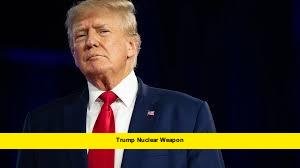

President Donald Trump has ordered the Pentagon to begin preparations for the first U.S. nuclear weapons tests since 1992, marking a dramatic shift in American defense strategy. The Trump nuclear weapon directive comes amid growing concerns about the expanding nuclear capabilities of Russia and China, and it signals a clear break from decades of restraint under prior administrations.
Trump’s announcement was delivered during a briefing in Washington, D.C., where he emphasized that the United States “will no longer sit back while others develop and test nuclear systems unchecked.” The decision effectively ends the 33-year moratorium that began after the Cold War, when the U.S. conducted its last underground test at the Nevada Test Site in September 1992.
A Historic Policy Reversal
This order marks the first time in over three decades that a U.S. president has authorized the Department of Defense to pursue active nuclear testing. While subcritical tests—non-explosive experiments on plutonium—have continued under U.S. supervision, no full-scale explosive test has been conducted since the early 1990s.
According to administration officials, the directive calls for the Pentagon and the National Nuclear Security Administration (NNSA) to “assess immediate test readiness.” The move is part of a broader defense modernization strategy that includes developing advanced missile systems and reinforcing America’s deterrence posture.
Trump stated that the United States must “match and surpass” the capabilities of rival nations. He claimed that both Russia and China have been conducting nuclear-related tests in recent years, violating the spirit of global arms control treaties.
Read Also-Trump Fentanyl China – Tariff Cut Marks New Chapter in U.S.–China Trade Relations
Timing and Global Context
The timing of the decision is particularly significant. The announcement came just days before Trump’s scheduled meeting with Chinese President Xi Jinping in Busan, South Korea. Analysts say the move may have been intended as a show of strength ahead of diplomatic negotiations.
The decision follows months of intelligence assessments suggesting that Russia has increased its nuclear testing activity, including the development of new missile systems and hypersonic warheads. China, meanwhile, has been expanding its arsenal and testing advanced nuclear delivery platforms.
This growing competition among major powers has raised fears of a new global arms race, one not seen since the Cold War era.
Why Trump Made This Move
Trump framed the policy shift as a matter of fairness and security. “If Russia and China are testing, the United States must do the same,” he said. “We’re not going to be the only country following outdated agreements while others break them.”
According to defense sources, the President’s team believes renewed testing could help validate new warhead designs, improve confidence in aging stockpiles, and reinforce deterrence credibility.
Supporters within the administration argue that test readiness is vital for maintaining military dominance and ensuring U.S. nuclear reliability. Critics, however, warn that the move could trigger widespread instability.
The Legal and Technical Landscape
While the U.S. never ratified the Comprehensive Nuclear-Test-Ban Treaty (CTBT), it has observed the treaty’s principles for more than three decades. Resuming nuclear testing could unravel existing global non-proliferation efforts and invite retaliatory testing by other nuclear-armed states.
Technically, experts say it would take between 24 and 36 months to prepare for a full-scale nuclear test. The Nevada National Security Site remains the most likely location for such activity, though Trump has not confirmed where the first test might occur.
The directive reportedly instructs defense agencies to accelerate readiness assessments, modernize testing infrastructure, and develop contingency plans for underground detonations if deemed necessary.
Reactions and Concerns
The international response has been swift and cautious. Several allied nations have expressed concern that the move could weaken long-standing arms control norms and heighten tensions with rival powers.
Domestically, the decision has drawn mixed reactions from lawmakers. Supporters from Trump’s political base praise the move as “a return to American strength,” while opponents describe it as “reckless brinkmanship” that risks reigniting global nuclear competition.
Defense analysts warn that resuming testing may provoke adversaries to follow suit, potentially undoing decades of progress in arms reduction and verification. Environmental and scientific groups have also raised alarms about the potential contamination risks and health impacts associated with renewed underground detonations.
Implications for U.S. Defense Strategy
Trump’s directive signals a shift toward a more assertive nuclear posture. It aligns with his administration’s broader emphasis on rebuilding U.S. military power and reducing reliance on international agreements perceived as limiting American autonomy.
Key elements of this new posture include:
- Modernization of nuclear forces: Upgrading missile systems and warheads to improve accuracy and survivability.
- Strategic competition: Matching adversaries’ nuclear advancements through technological innovation and deterrence.
- Expanded test readiness: Ensuring the Pentagon can conduct tests “at any time if necessary.”
- Reassessment of treaties: Reevaluating the relevance of arms control agreements in the face of new threats.
If implemented fully, these steps could redefine the global balance of power and challenge the long-standing non-proliferation regime that has shaped international security since the end of the Cold War.
Potential Risks and Unanswered Questions
While the Trump nuclear weapon directive has electrified Washington, many details remain unclear.
Key questions include:
- When and where will the first test take place?
- Will the testing involve explosive or subcritical methods?
- How will Congress fund the reactivation of dormant facilities?
- What will the global diplomatic fallout look like?
These uncertainties highlight the complexity of reviving a testing program that has been inactive for over three decades. The environmental, financial, and strategic implications will likely dominate U.S. defense discussions in the months ahead.
What Comes Next
The Pentagon is expected to release further guidance on implementation within the next few weeks. Preparations could include infrastructure inspections, test site reactivation, and technical readiness assessments.
If testing proceeds, the U.S. could become the first nation to conduct an explosive nuclear test in the 21st century, effectively signaling the dawn of a new nuclear era. The move would likely redefine not only America’s defense landscape but also the geopolitical balance of power worldwide.
The Trump nuclear weapon decision underscores a defining moment in U.S. defense history — one that could either strengthen deterrence or rekindle a global arms race. For now, the world watches closely as the Pentagon begins the complex process of implementing this unprecedented order.
What do you think about this decision? Share your views and stay tuned for further updates as this historic development unfolds.