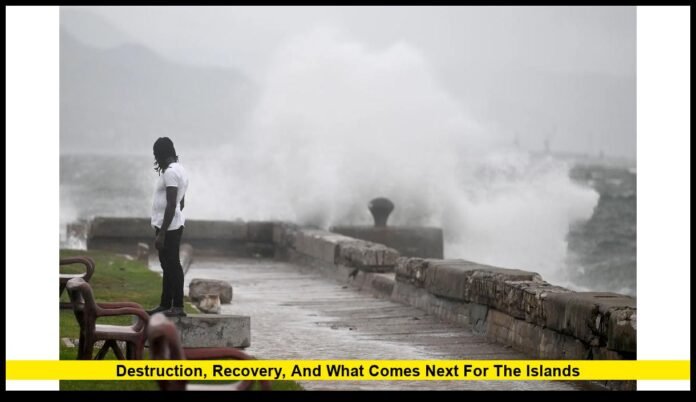

The Turks and Caicos Hurricane Melissa has left a lasting mark on the Caribbean, reshaping coastlines, flooding towns, and testing the strength of local communities. The powerful storm — which intensified into a Category 3 hurricane over the weekend — tore through the Turks and Caicos Islands on its way toward the open Atlantic, bringing devastating winds and torrential rain.
According to the National Hurricane Center (NHC), Hurricane Melissa reached peak sustained winds of 120 mph (195 km/h) before beginning to weaken offshore. Though it has now moved away from the islands, its impact continues to be felt across the region. Thousands of residents remain without power, infrastructure damage is widespread, and recovery efforts are only just beginning.
How the Turks and Caicos Faced Hurricane Melissa
The Turks and Caicos Hurricane Melissa struck the island chain late Sunday night into Monday morning. Residents in Grand Turk, Providenciales, and South Caicos experienced some of the storm’s most destructive conditions — hurricane-force winds, intense rainfall, and coastal flooding that pushed seawater far inland.
Local emergency services worked through the night as roofs were ripped off homes, trees fell across power lines, and communication networks went down.
Governor Dileeni Daniel-Selvaratnam addressed residents early Monday, saying:
“Our people have shown incredible strength. The government and international partners are coordinating immediate relief, and we will rebuild stronger than before.”
The storm caused significant coastal erosion, particularly along Grace Bay Beach, a world-famous tourist destination. Authorities have since declared a state of emergency, urging residents to avoid floodwaters due to contamination and debris hazards.
The Path and Power of Hurricane Melissa
Meteorologists began tracking Hurricane Melissa more than a week before it reached the Caribbean. It developed from a tropical wave that moved off Africa’s west coast, quickly gaining strength as it traveled across warm Atlantic waters.
By the time it approached the Turks and Caicos, Melissa had rapidly intensified into a Category 3 hurricane, with a well-defined eye and an expanding wind field. According to the NHC’s 5 p.m. advisory on Monday:
- Location: 140 miles northeast of Grand Turk
- Maximum sustained winds: 120 mph
- Movement: North-northeast at 14 mph
- Pressure: 956 millibars
While Melissa spared the U.S. mainland from direct impact, its sheer power generated large ocean swells and dangerous surf conditions stretching from Florida to the Carolinas.
The storm’s intensification was a textbook case of “rapid strengthening,” a phenomenon that scientists say is becoming more common as ocean temperatures rise.
“The Atlantic this year is exceptionally warm,” said Dr. Lisa Ramirez, a senior meteorologist at the NHC. “Storms like Melissa feed off that energy, turning what could have been a minor system into a major hurricane in less than 48 hours.”
Life on the Ground: Damage and Disruption
In the wake of the Turks and Caicos Hurricane Melissa, communities across the islands are struggling to recover.
- Electricity: Roughly 80% of residents lost power during the storm, and crews are working around the clock to restore service.
- Transportation: Flooding damaged several main roads, especially near Blue Hills and Leeward Highway in Providenciales.
- Communication: Cellular service remains limited in some areas. Emergency responders are relying on satellite networks for coordination.
- Tourism: Resorts sustained varying levels of damage, but most report no serious injuries among guests.
Photos and videos shared on social media show submerged vehicles, destroyed docks, and houses reduced to rubble. Many residents describe the storm as one of the worst they’ve seen in years.
“We could hear the wind howling like a freight train,” said Angela Dean, a resident of Grand Turk. “The roof started shaking, and we just prayed it wouldn’t blow off.”
Relief and Recovery Efforts Begin
Humanitarian aid has started flowing into the Turks and Caicos from neighboring territories and international partners. The Royal Navy deployed vessels carrying generators, medical teams, and food supplies, while the U.S. Agency for International Development (USAID) pledged emergency assistance to support rebuilding efforts.
The British Red Cross and local volunteer organizations are setting up temporary shelters and distributing bottled water, hygiene kits, and tarpaulins.
According to the DDME (Department of Disaster Management and Emergencies), priority recovery tasks include:
- Clearing major roadways of debris
- Restoring electricity and communications
- Repairing hospitals and schools
- Providing mental health support for affected families
The government has also launched a “Rebuild Turks and Caicos” initiative, focusing on long-term resilience, improved drainage systems, and stronger building standards for coastal regions.
Economic Impact: Tourism and Infrastructure
The Turks and Caicos Islands depend heavily on tourism, which accounts for over 40% of GDP. After Hurricane Melissa, the short-term effects on the tourism sector are severe.
Several resorts have closed temporarily for repairs, and flights from Miami, Fort Lauderdale, and Atlanta were suspended during the storm. Although the Providenciales International Airport reopened Tuesday afternoon, officials expect delays for at least several more days as cleanup continues.
Tourism Minister Josephine Connolly expressed optimism that the islands will recover quickly.
“Our tourism industry is resilient. We’ve faced hurricanes before, and every time, we come back stronger. Safety and restoration are our top priorities.”
Experts predict that the overall cost of recovery could exceed $400 million USD, factoring in infrastructure repairs and lost revenue.
The Science Behind the Storm
Meteorologists emphasize that Hurricane Melissa illustrates how climate change is intensifying storms in the Atlantic basin. Warmer sea surface temperatures provide more energy for developing systems, while shifting wind patterns can prolong their lifespan.
In the case of Melissa, ocean temperatures near the Caribbean were approximately 2°F above average, allowing rapid strengthening.
This pattern mirrors what scientists call “hyperactive” hurricane seasons — those featuring multiple major hurricanes forming in quick succession.
The 2025 Atlantic hurricane season has already produced 16 named storms and 8 hurricanes, making it one of the most active seasons in recent history.
“We’re seeing more frequent and stronger hurricanes,” said Dr. Peter Caldwell, a NOAA climatologist. “This underscores the need for coastal preparedness and investment in resilient infrastructure.”
U.S. Impacts: Dangerous Surf and Weather Warnings
While the Turks and Caicos experienced direct devastation, the U.S. East Coast is dealing with secondary effects from Hurricane Melissa.
The National Weather Service (NWS) issued high-surf advisories from South Florida through North Carolina. Lifeguards in Miami Beach, Daytona, and Myrtle Beach have reported multiple rescues due to rip currents.
In addition, Melissa’s outer circulation is interacting with a cold front over the Southeast, producing scattered thunderstorms and gusty winds in coastal Georgia and the Carolinas.
The U.S. Coast Guard has warned boaters and fishermen to exercise caution as swells remain hazardous through the weekend.
International Response and Coordination
The international community has shown solidarity with the Turks and Caicos in the aftermath of Hurricane Melissa. The United Nations Office for the Coordination of Humanitarian Affairs (OCHA) confirmed that disaster response teams are on standby to support recovery.
Neighboring Caribbean nations, including the Bahamas and Dominican Republic, have also offered logistical support. Emergency flights carrying medical supplies have arrived in Grand Turk, while local volunteers assist with cleanup operations.
The collaboration underscores how regional partnerships are vital in the face of increasingly powerful hurricanes.
Trump’s Microsoft Comment Dominates U.S. Headlines
As news of Hurricane Melissa spread, former President Donald Trump once again made headlines for unrelated remarks about corporate politics. During a Florida event, Trump urged Microsoft to “fire Lisa Monaco,” the company’s Global Affairs President, accusing her of bias from her time in government.
Though the comments are unrelated to the storm, they gained traction across social media, highlighting how political controversies continue to intersect with major news events.
Microsoft declined to comment directly but reaffirmed its support for Monaco, noting her leadership in cybersecurity and international relations. The moment served as another reminder of how fast the U.S. news cycle moves — even as regions like the Caribbean face real crises on the ground.
What Comes Next for the Turks and Caicos
Recovery from Hurricane Melissa will take months, possibly years, depending on the extent of structural damage. Government agencies have already begun assessing which areas require full rebuilding versus minor repair.
Infrastructure teams are prioritizing:
- Restoring clean water access to all districts
- Rebuilding coastal defenses such as seawalls
- Improving early warning systems for future storms
Experts say this recovery period could also be an opportunity to enhance storm resilience through smarter urban planning.
“Reconstruction is about more than rebuilding what was lost,” said Emma Saunders, a disaster recovery expert. “It’s about adapting to the climate realities we now face.”
Conclusion
The Turks and Caicos Hurricane Melissa serves as both a warning and a testament to resilience. The storm’s destructive path reminds us of the growing power of modern hurricanes, fueled by warming oceans and unpredictable weather patterns. Yet, it also highlights the strength of the people who endure and rebuild after each disaster.
As relief efforts continue, the Turks and Caicos community — with support from global partners — is determined to recover and prepare for whatever storms the future may bring.
What are your thoughts on how the Caribbean can better prepare for storms like Hurricane Melissa? Share your views below and join the conversation on climate resilience and recovery.