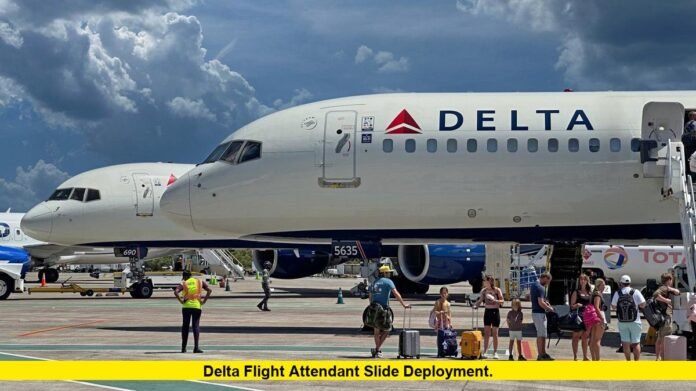

The recent delta flight attendant slide deployment incident occurred on October 25, 2025, when a flight attendant at Delta Air Lines inadvertently triggered an emergency evacuation slide at Pittsburgh International Airport while preparing for departure. The event caused a substantial delay and significant cost implications for the airline.
What Happened
- The aircraft involved was an Airbus A220 at gate D2, ready for push-back.
- After the standard “arm doors for departure” call, the forward left-hand (1L) door was still in the “armed” state when the handle was moved, triggering the automatic slide deployment.
- The inflated slide blocked the jet bridge access, which required maintenance crews to detach and remove the slide before boarding could resume.
- The result: the scheduled flight was delayed by approximately four hours and many passengers missed connections.
- The cost to Delta is being estimated around $50,000 to $70,000, including the slide replacement and operational disruption.
Technical Background: Why This Occurs
When an aircraft door is “armed” for departure, the evacuation slide system is live. On the Airbus A220, any movement of the handle during the armed state causes the door to open and the slide to deploy. Once initiated, the slide deployment cannot be reversed, making human-error during door preparation a major risk.
In this case, the crew member’s inadvertent motion triggered the sequence despite the absence of an actual evacuation. These events are formally termed “Inadvertent Slide Deployments (ISDs)” in the aviation industry.
Impacts and Significance
- Financial impact: The cost of replacing a slide on a narrow‐body aircraft such as the A220 runs tens of thousands of dollars.
- Operational impact: A four-hour delay immediately affects departing passengers, missed connections, hotel and repositioning costs, and crew duty time.
- Safety and procedural implications: While no one was injured in this event, an unplanned slide deployment can injure ground personnel or damage equipment, and it underscores the importance of discipline in departure procedures.
What the Airline Can Do Next
- Review and reinforce door arming/disarming checklist procedures with cabin crew.
- Consider additional training or refresher sessions focusing on human-factors in door operations.
- Evaluate whether procedural safeguards (such as cross-checks, verbal confirmations, or “point-and-call” methods) can reduce future ISDs.
- Monitor and document similar events to identify patterns and proactively mitigate risks.
Why Passengers Should Care
Even though this slip-up did not involve an in-flight emergency, the ripple effect of a slide deployment proves how ground operations can meaningfully impact your travel experience. When you’re at the gate:
- Recognize that safety systems are active even before pushback.
- Delays may originate from unexpected procedural errors, not always weather or air traffic.
- Airlines absorb significant costs when incidents like this happen — that cost eventually filters into operations and sometimes fares.
Conclusion
The delta flight attendant slide deployment incident at Pittsburgh is a clear example of how a momentary lapse in a standard procedure creates large financial, logistical and operational consequences. With damage estimates in the tens of thousands of dollars and a multi-hour delay for passengers, it highlights just how critical attention to detail is in airline gate operations. We welcome your comments or personal experiences with travel delays or gate incidents as airlines continue to evolve their safety and operational practices.