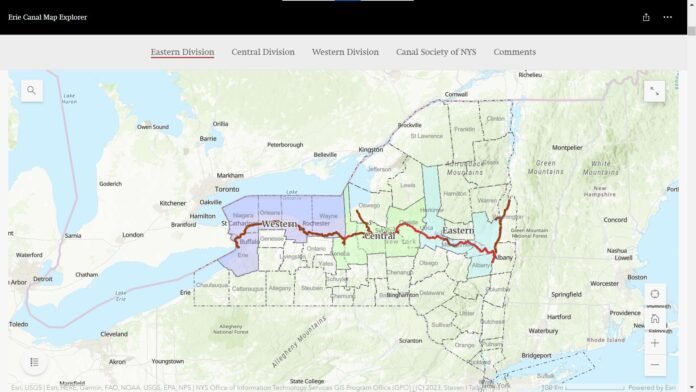

The latest map of the Erie Canal reflects a number of verified changes for 2025 and remains a critical resource for both navigation and recreational planning.
What the official map shows
The New York State Canal Corporation provides a comprehensive interactive map of the New York State Canal System—highlighting key features such as locks, lift bridges, guard gates, marinas, and points where the canalway trail intersects with the water route. In addition, the Erie Canalway National Heritage Corridor’s 2024 Map & Guide offers a traveler-friendly overview that blends the historic canal alignment with modern recreational access, showing nearby communities, trailheads, visitor services, and interpretive stops along the route.
Highlights of the map:
- The Erie Canal links the Hudson River at Waterford to Lake Erie at Buffalo, extending roughly 338 navigable miles across upstate New York.
- When combined with the Champlain, Oswego, and Cayuga-Seneca canals, the full New York State Canal System reaches approximately 524 miles in total length.
- The map details both the active waterway and the parallel canalway trail network, which traces large sections of the historic towpath and provides continuous opportunities for walking, running, and cycling along the water’s edge.
What’s new or updated for 2025
Several recent operational and infrastructure adjustments shape how the map should be used for the 2025 season:
- Extended Navigation Season: In recognition of the Erie Canal’s bicentennial, the 2025 navigation season has been extended. Recreational and commercial vessels will be able to travel the system through Monday, November 3, 2025 at 6:00 pm, offering a longer window for travel and tourism along the canal.
- Temporary Lock Closure: A major repair project has temporarily closed the section of the Erie Canal between Lock E-16 and Lock E-17 in the St. Johnsville–Little Falls region. The work involves structural improvements to a movable dam and its surrounding embankment. Until repairs are completed, navigation through this stretch will remain suspended.
- Map Now Reflects Live Alerts: The official map now incorporates real-time Notice to Mariners updates. Users can see current operational conditions directly on the map, including closures, restricted-width passage zones, and debris or obstruction alerts along the route.
These updates make the map not just a planning resource but an active monitoring tool, particularly for those navigating by boat or coordinating travel along the canalway trail.
How to use the map of the Erie Canal
The official Erie Canal map is designed to support a wide range of users—whether traveling on the water, exploring by trail, or learning about the canal’s historical significance. Here are some practical ways to make the most of it:
- For boaters:
The map is an essential navigation tool for identifying locks, lift bridges, depth conditions, and temporary restrictions. Because certain sections—such as the stretch between Lock E-16 and Lock E-17—may experience phased openings or closures due to ongoing repair work, it’s important to review the map before setting out. Boaters can use it to plan travel times, anticipate wait periods at locks, and confirm where services such as docking, fueling, and tie-ups are available. - For cyclists and hikers:
The map highlights the Canalway Trail and other parallel trail segments, showing clearly where the route is off-road, shared-roadway, or connected through town centers. It also marks trailheads, parking areas, rest stops, scenic viewpoints, and local amenities, making it easy to plan day trips or multi-day rides along the canal corridor. - For historians and heritage travelers:
The map overlays the historic canal alignment, pinpointing sites of earlier locks, abandoned sections, preserved structures, and interpretive markers. This allows visitors to curate self-guided heritage tours, explore connections to canal-era communities, and better understand how the canal shaped the cultural and economic development of New York State.
Key details at a glance
| Feature | Map Detail |
|---|---|
| Navigation season end date | November 3, 2025 at 6:00 pm |
| Closed section (2025) | Between Lock E-16 and Lock E-17 — repair in progress |
| System length (Erie Canal) | ~338 miles |
| System length (NY State Canals) | ~524 miles |
Why the map matters now
With 2025 marking the bicentennial of the Erie Canal’s opening in October 1825, the map of the canal takes on renewed importance. It is more than a navigational reference—it reflects an ongoing effort to celebrate, restore, and modernize the corridor. Extended operating seasons, infrastructure repairs, and anniversary programming mean that users need the most current version of the map and its real-time alerts to plan confidently. And because the canal now serves both waterway travelers and trail users, the map has become essential for organizing multimodal trips, whether by boat, bicycle, or on foot, across one of the nation’s most historic transportation routes.
Read Also- Erie Canal — How it’s 200 Years Later Also Shaping Michigan
Summary
The updated map of the Erie Canal offers a blend of historic route information and current operational status. It covers waterways, trail systems, infrastructure alerts and extended season use for 2025. Whether you plan to boat across locks, cycle along the towpath, or explore heritage sites, using the most current map ensures safety and maximizes your experience.
Feel free to comment below with your own experiences using the map or any recent journey you’ve taken along the canal route!