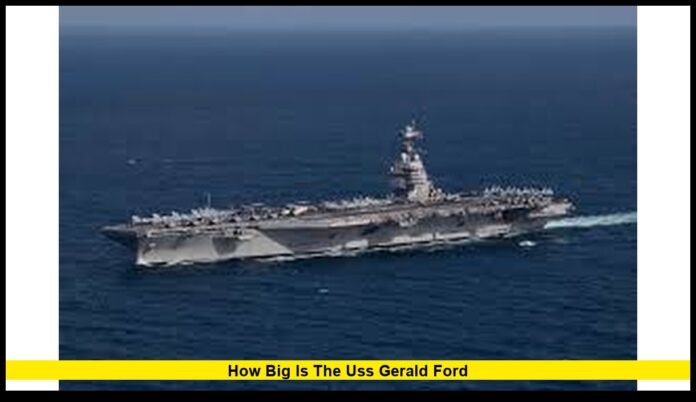

The question how big is the USS Gerald Ford continues to draw interest as the ship remains a centerpiece in America’s modern naval power. The USS Gerald R. Ford (CVN-78) is the first of a new class of supercarriers, designed to replace the aging Nimitz-class carriers and serve as the core of U.S. maritime strength for decades. Its size, systems, and operational capacity demonstrate the most advanced carrier capability ever placed at sea.
As of the latest updates, the USS Gerald Ford has completed major deployments and training cycles, operating across the Atlantic and participating in joint exercises with allied navies. Its scale is a critical part of its mission: to carry a powerful air wing, serve as a forward-operating base, and project U.S. influence across global waters.
This article breaks down the carrier’s size, layout, crew accommodations, and what its massive dimensions mean for naval readiness today and in the future.
Overall Dimensions: A Ship Designed for Maximum Capability
Understanding how big the USS Gerald Ford truly is begins with its raw physical measurements. These numbers place it among the largest mobile structures ever built by humans.
Key Dimensions of the USS Gerald R. Ford:
| Feature | Measurement |
|---|---|
| Length (overall) | About 1,100 feet (Over 3 football fields long) |
| Width at Flight Deck | Nearly 256 feet |
| Height (keel to mast top) | Around 250 feet |
| Displacement (full load) | Approximately 100,000 tons |
| Draft (underwater depth) | About 39 feet |
The ship’s size gives it the ability to support a large number of aircraft, sailors, and equipment necessary for extended operations. Unlike smaller naval ships, a carrier of this scale can stay at sea for months without refueling due to its dual nuclear reactors.
These reactors also generate three times more power than those on previous carriers, allowing the ship to operate current and future systems that demand massive energy output.
Why the Carrier Had to Be This Large
1. To Support a Full Air Wing
The USS Gerald Ford is capable of carrying more than 75 aircraft, including fighter jets, surveillance planes, and helicopters. The large flight deck allows for simultaneous launch and recovery operations, which increases mission efficiency.
2. To House a Floating Military Community
With a crew that can exceed 4,500 people, the ship must provide:
- Sleeping quarters
- Dining and kitchen facilities
- Hospital and surgical care
- Communications centers
- Maintenance hangars
It functions like a city on the ocean, with every essential system built for survival and operations thousands of miles from land.
3. To Generate Enough Power
The ship’s nuclear reactors allow:
- Continuous operation for 20+ years without refueling
- Power for electromagnetic launch systems (EMALS)
- Power reserves for future defensive technologies like laser systems
The scale is necessary to support both today’s missions and tomorrow’s innovations.
Flight Deck Design and Launch Operations
One of the most notable features of the USS Gerald Ford is its expansive, redesigned flight deck.
What Makes the Flight Deck Different
- The control tower (island) has been moved further back and redesigned to improve aircraft movement.
- The deck layout reduces congestion and allows aircraft to be repositioned faster.
- Advanced aircraft elevators lift jet fighters directly from hangar to flight deck more efficiently.
This increased space means the Ford-class carriers can launch over 160 sorties per day under sustained operations, and surge to even more during combat. That is a 30% increase in launch efficiency over older carriers.
Life Inside the Ship: Daily Function on a Giant Vessel
Because the ship is so large, life onboard resembles life inside a self-contained base.
Crew Accommodations
The USS Gerald Ford was designed with improved comfort compared to earlier carriers:
- Reduced crowding in sleeping berths
- Better climate control
- Expanded workout and recreation areas
Modern naval life emphasizes quality-of-life improvements, helping sailors stay healthy and alert during deployments.
Food and Logistics
The ship operates multiple galleys (kitchens) capable of serving thousands of meals per day. Storage holds contain:
- Long-term frozen foods
- Dry provisions
- Fresh produce stores
This allows crew to remain fed and supplied far from ports.
Medical Facilities
The medical bays include:
- Emergency treatment rooms
- Operating rooms
- Dental care stations
This ensures readiness and health without needing to return to shore.
Technological Innovations Enabled by Size
As we explore how big is the USS Gerald Ford, it’s important to understand that its size enables more than simple space—it supports exclusive technological advancements.
Electromagnetic Launch System (EMALS)
Instead of steam catapults, the ship uses an electromagnetic rail system to launch aircraft.
Benefits:
- Smoother acceleration for aircraft
- Lower wear and tear on airframes
- Compatible with future unmanned aircraft
Advanced Arresting Gear (AAG)
This system improves the safety and lifespan of aircraft during landings.
Smart Maintenance Design
Many spaces in the ship allow:
- Reduced crew workload
- Faster repairs
- Automation of routine processes
The result is a carrier built for long-term operating efficiency.
How the Carrier Shapes U.S. Military Strategy
The USS Gerald Ford’s massive scale allows the United States to:
- Project power globally
- Respond rapidly to international crises
- Maintain sea control in contested regions
Aircraft carriers are mobile airbases. They provide air superiority in areas without nearby friendly land installations.
This is crucial in:
- The Atlantic
- The Mediterranean
- The Pacific
- Strategic chokepoints like the Strait of Hormuz and South China Sea
The Ford’s size ensures that it remains relevant in high-complexity operational environments.
Operational Significance Today
As global tensions shift, the USS Gerald Ford plays a key role in:
- Joint exercises with NATO and Indo-Pacific partners
- Deterrence patrols in contested waters
- Rapid-response missions during crises
The carrier demonstrates that naval dominance remains a cornerstone of American defense power.
Conclusion
So, how big is the USS Gerald Ford?
It is extraordinarily large—big enough to carry an air force, support thousands of personnel, and operate independently across the world’s oceans. Yet its size is not just about physical scale. It represents capability, endurance, innovation, and strategic reach.
As the U.S. Navy continues to modernize and adapt to emerging global challenges, the USS Gerald Ford stands as a symbol of American strength at sea.
What are your thoughts on the future of U.S. aircraft carriers? Share your perspective below and stay engaged for more defense insights.