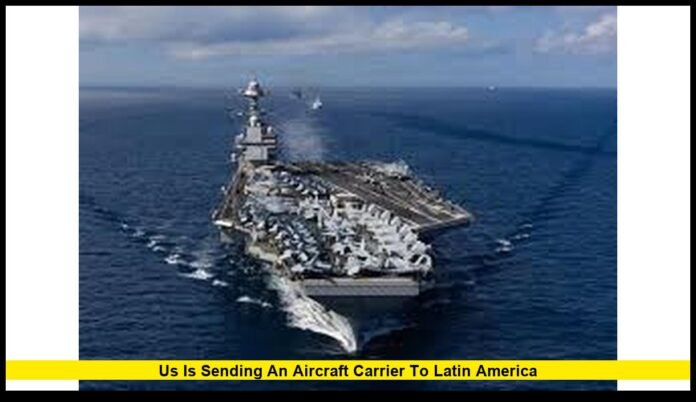

The US is sending an aircraft carrier to Latin America, a decision that marks one of the most significant military deployments in the region in recent years. This move, according to Pentagon officials, underscores Washington’s growing concern about security, foreign influence, and organized crime across the Western Hemisphere.
The deployment comes at a time when Latin America is increasingly becoming a stage for geopolitical competition between major powers. With China, Russia, and Iran deepening economic and defense ties with regional governments, the United States is now reasserting its presence to reinforce alliances and protect its strategic interests close to home.
Why the U.S. Is Deploying a Carrier to Latin America
The United States’ decision to send an aircraft carrier to Latin America reflects a shift toward re-establishing a visible security presence in its own hemisphere. In recent years, much of the U.S. military focus has centered on Europe and Asia, particularly the Indo-Pacific. But with rising instability in South and Central America, U.S. defense leaders are now turning attention back to their southern neighbors.
Defense analysts say the deployment has several clear objectives:
- Countering foreign military influence from nations seeking to expand their presence in Latin America.
- Disrupting transnational crime networks, including drug trafficking operations that directly impact U.S. security.
- Supporting regional allies through training, humanitarian missions, and joint naval operations.
- Reinforcing freedom of navigation in international waters and securing vital shipping routes.
A senior U.S. official described the deployment as “a proactive, forward-looking mission designed to reaffirm American leadership in the Western Hemisphere.”
The Mission and Its Scope
The aircraft carrier will operate under U.S. Southern Command (SOUTHCOM), which oversees military cooperation across Central and South America as well as the Caribbean. The ship will be accompanied by a carrier strike group, typically consisting of destroyers, cruisers, supply ships, and submarines. Together, this formation will represent one of the most powerful naval presences the region has seen in over a decade.
The mission’s scope includes:
- Joint military exercises with partner nations such as Colombia, Brazil, and Panama.
- Maritime security patrols aimed at countering smuggling and illegal fishing operations.
- Humanitarian assistance operations, including medical aid and disaster response training.
- Monitoring regional developments, including illegal arms trafficking and foreign military activities.
Officials noted that the deployment will last for several months, covering both Atlantic and Pacific waters adjacent to Latin America.
A Symbolic Return to the Region
While the U.S. Navy has maintained a modest presence in Latin America for decades, sending a full carrier group represents a major symbolic return. The last comparable deployment occurred more than ten years ago, during operations targeting organized crime and maritime smuggling networks.
The decision aligns with a broader strategic adjustment in Washington known as the “Hemisphere Defense Initiative”, which emphasizes regional engagement and partnerships to strengthen collective security. This marks a renewed commitment to Latin America at a time when the region faces escalating challenges, from political unrest to foreign-backed military cooperation agreements.
Geopolitical Context: Growing Competition in the Americas
The move also carries a clear geopolitical message. Over the past few years, China and Russia have expanded their presence in Latin America, financing large-scale infrastructure projects and engaging in defense collaborations.
- China has invested billions through its Belt and Road Initiative, gaining control of ports, energy assets, and telecom infrastructure across several Latin American countries.
- Russia has conducted joint naval drills with nations like Venezuela and Nicaragua, and even sent nuclear-powered vessels to the Caribbean.
- Iran has strengthened defense and intelligence ties with Venezuela, raising alarm among Western intelligence agencies.
For Washington, these developments pose a strategic challenge. The deployment of a U.S. aircraft carrier serves both as a deterrent and reassurance—a deterrent to rivals testing America’s influence in the hemisphere, and reassurance to allies that the United States remains committed to regional stability.
Reactions from Latin American Governments
Reactions across the region have been mixed.
- Supportive nations such as Colombia, Brazil, and Chile welcomed the move, calling it a “clear message of partnership” and a sign that the U.S. is serious about tackling shared security concerns.
- Critical voices in Venezuela, Nicaragua, and Cuba condemned the deployment, labeling it “an act of intimidation” and accusing the United States of militarizing the region.
- Neutral nations, including Mexico and Argentina, issued cautious statements emphasizing diplomacy and cooperation over military presence.
Regional experts note that while some governments view the deployment as a stabilizing force, others perceive it as a potential provocation—particularly those with close ties to China or Russia.
Military and Humanitarian Components
Beyond deterrence and power projection, the carrier group’s mission will also include humanitarian outreach.
The ship’s medical facilities and logistical capabilities make it a valuable tool for relief efforts. U.S. forces plan to assist with disaster preparedness training and to deliver supplies to areas vulnerable to hurricanes and floods—issues that frequently affect Caribbean and Central American nations.
Additionally, the deployment includes plans for:
- Medical outreach missions offering healthcare to underserved coastal communities.
- Environmental protection operations focusing on illegal fishing and pollution control.
- Educational exchanges with local naval academies to foster technical training and leadership development.
This dual-purpose approach—combining defense operations with humanitarian outreach—is a hallmark of modern U.S. naval missions in the region.
Strategic Significance of the Aircraft Carrier
An aircraft carrier is more than just a military platform—it’s a floating command center capable of projecting air power, surveillance, and rapid response anywhere within thousands of miles. The ship hosts up to 70 aircraft, including fighter jets, helicopters, and reconnaissance planes.
Key advantages of carrier deployment in Latin America include:
- Enhanced intelligence collection through airborne surveillance.
- Rapid response capability in case of regional crises.
- Improved coordination with allied navies through shared exercises and communications networks.
- High-visibility deterrence, demonstrating the U.S. Navy’s operational reach and readiness.
This presence gives Washington flexibility in responding to emergencies—whether military, humanitarian, or diplomatic—across both coasts of the Americas.
Economic and Political Impact
While the mission is primarily military, its economic and political effects are significant. The deployment reinforces trade route security along major shipping lanes that connect the U.S. to Latin American ports. These maritime corridors are critical for U.S. exports, energy transport, and regional commerce.
Politically, it reinforces the Biden administration’s messaging that the United States is “refocusing on its neighborhood.” As global competition intensifies, U.S. policymakers are realizing that Latin America’s proximity makes it central to both national security and economic resilience.
Challenges Ahead
Despite its benefits, the mission faces challenges. The U.S. must balance its show of strength with diplomatic sensitivity. Many Latin American nations remain wary of military presence due to past interventions. To maintain credibility, Washington will need to:
- Prioritize partnership and transparency with regional governments.
- Avoid any perception of unilateral action or dominance.
- Ensure the mission aligns with shared goals, such as disaster preparedness and countering organized crime.
Failure to maintain diplomatic balance could risk alienating key allies or fueling anti-U.S. narratives in the region.
Conclusion
The news that the US is sending an aircraft carrier to Latin America signals a pivotal moment in U.S. regional strategy. It demonstrates renewed commitment to defending the Western Hemisphere, strengthening partnerships, and countering external influence.
For the United States, this move is both a message and a mission—one that blends deterrence, diplomacy, and humanitarian outreach in a single, far-reaching operation.
As this deployment unfolds, it will redefine U.S.-Latin American relations and set the tone for the region’s security future. What’s your view on the U.S. reasserting its military presence in Latin America? Share your thoughts below.